Camera-based IoT solutions are evolving, but Original Equipment Manufacturers (OEMs), designers, and IoT integrators constantly face technical barriers. These include keeping up with bandwidth and connectivity needs, optimized processor performance, handling image and data processing complexity, and ensuring adequate development support for integrating advanced technology. Next-generation surveillance systems and driver monitoring platforms, for instance, demand robust data throughput, dependable hardware, and hassle-free module integration. The scenario gets more challenging when solutions must remain responsive across multiple geographies and network environments, especially where fallback options are essential for reliability.
Cavli CQS29X Smart IoT Module Family Overview
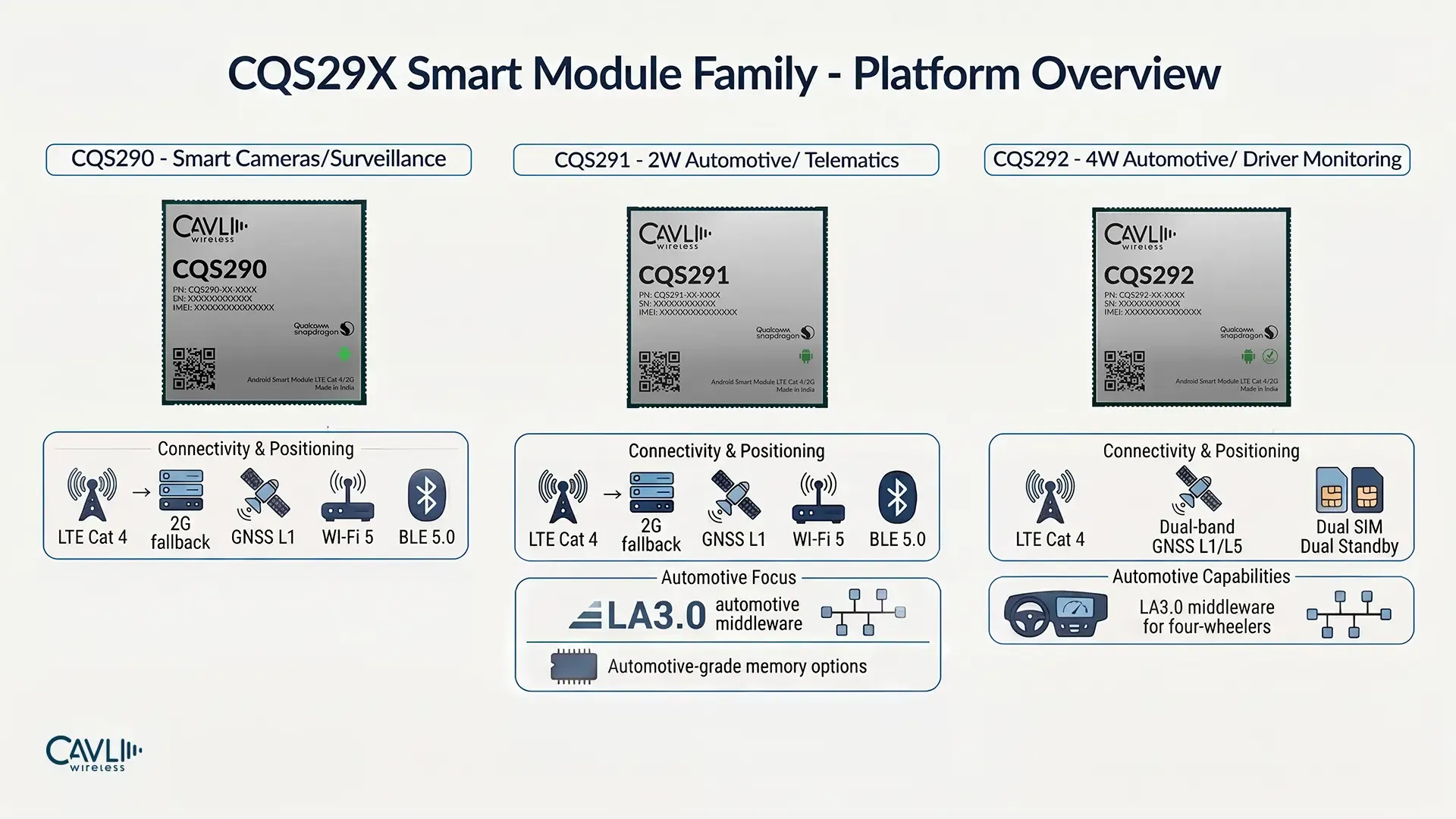
The Cavli CQS29X is designed as a smart module family specifically built for advanced camera-based IoT applications. This series includes the CQS290, CQS291, and CQS292 models, offering LTE Category 4 support (up to 150 Mbps download and 50 Mbps upload), with 2G fallback for ubiquitous connectivity. Available in Linux or Android OS versions, these modules feature a quad-core Cortex A53 processor reaching speeds of 2GHz. Depending on the specific variant chosen, Android or Linux, various memory configurations are offered to suit different requirements. GNSS support ranges from L1 to L1/L5, and a rich suite of interfaces ensures easy integration.
Key Features of the CQS29X Smart IoT Module Series
- Multiple MIPI-DSI and MIPI-CSI camera bus support
- Rich connectivity: Wi-Fi 5, BLE 5.0, DSICSI interface, and external SIM with DSDS
- Dedicated LA3.0 automotive middleware for two-wheeler (CQS291) and four-wheeler (CQS292) market segments
- Extensive IO: SPI, UART, I2C, I3C, SD, ADC, capacitive touch, and more
- Hardware image and video processing capabilities, including dual-ISP support, up to 25MP cameras, and 1080p30 video encode/decode
Camera and Edge Processing Capabilities of CQS29X Smart IoT Modules
CQS29X IoT module series features dual ISP interfaces, supporting simultaneous high-resolution camera streams (e.g., dual 13MP or single 25MP at 30fps, and even up to 48MP in near ZSL mode). These modules are capable of real-time encoding and decoding (1080p30 H.265/H.264, plus VP9 decode), making them ideal for applications that require concurrent video analytics or streaming.
OEM Advantages of Using CQS29X Smart IoT Modules for Smart Surveillance Cameras
A hardware designer building smart city cameras on CQS290 can replace separate single-board computers, modems, and encoders with one smart module. Two 13 MP sensors connect over dual MIPI-CSI to the dual ISP, or a single 25 MP sensor runs in zero shutter lag mode for high-detail applications. The video engine encodes 1080p30 streams in H.265 or H.264, with higher frame rates reserved only for incident review and fast motion scenes.
On the same hardware, LTE Cat 4 provides high bitrate backhaul, with 2G preserving basic connectivity in poor coverage situations. Integrated Wi-Fi 5 supports building backhaul and commissioning, BLE 5.0 supports field service tools, and GNSS L1 feeds geo tags into alarms. The Adreno 702 GPU at 845 MHz drives a 1680 × 720 MIPI DSI panel for local preview and status, while the integrated codec, and digital mics handle listen-in, incident audio capture, and public address functions. Attaching tamper sensors and other peripherals, and GPIOs can drive Pan-Tilt-Zoom motors and relays. A single CQS290 platform can therefore support multiple camera SKUs.
CQS292 Smart IoT Module for Automotive Driver Monitoring and Vehicle Telematics
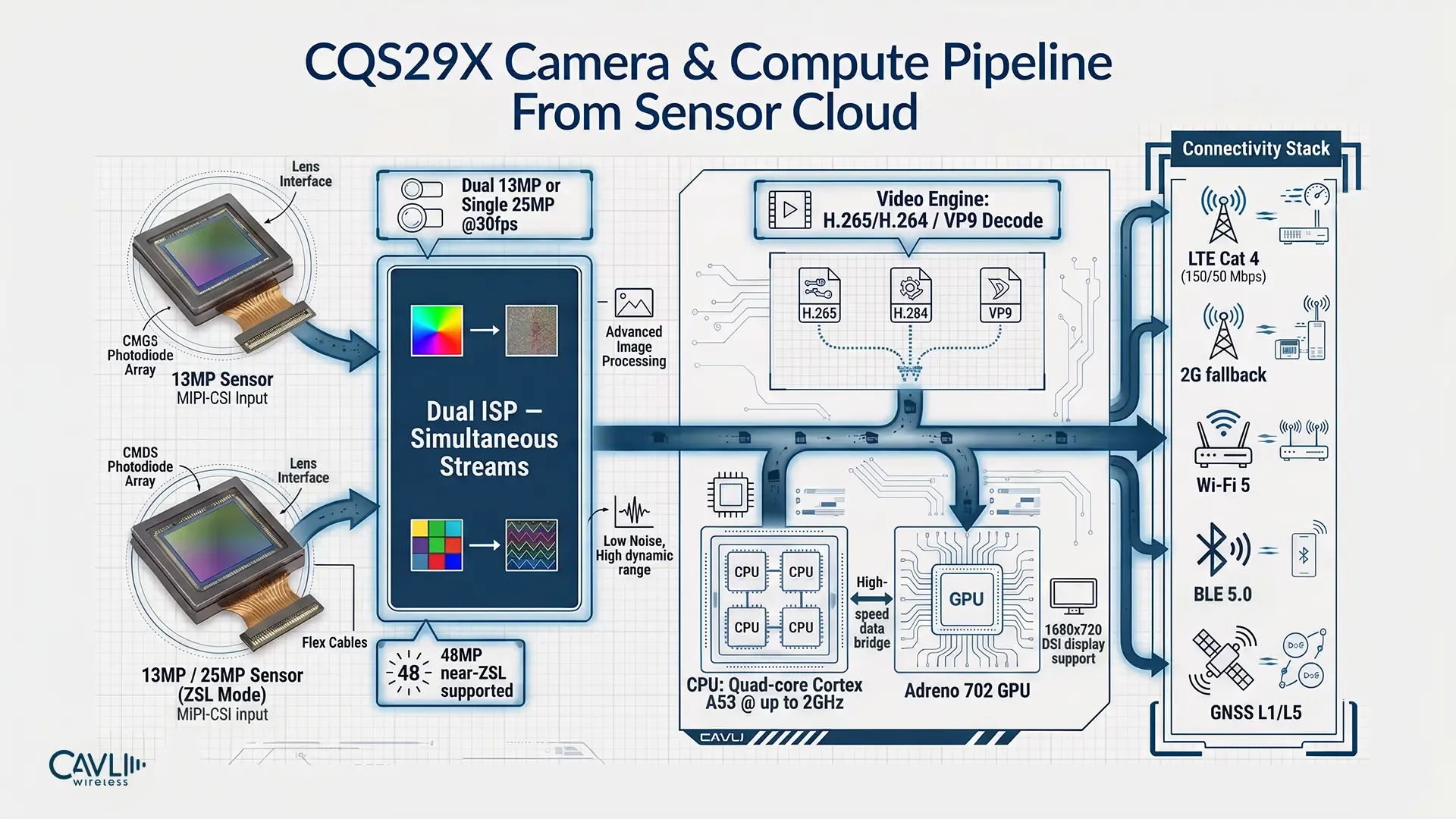
A passenger vehicle OEM using CQS292 for driver monitoring follows a similar pattern. The in-cabin DMS camera connects directly over MIPI-CSI, and frames can be fed into lightweight computer-vision models running on the quad-core Cortex-A53 cluster to detect drowsiness and distraction. The Adreno 702 GPU provides the graphical engine capabilities to process and analyse frames for behavior monitoring in such smart vehicle applications.
LTE Cat 4 with 2G fallback carries telematics and incident uploads, while dual-band L1 and L5 GNSS improve event localization. LA3.0 middleware exposes hooks into vehicle buses and USB service ports, so DMS, telematics, and connectivity sit on one CQS29X platform instead of several ECUs. This reduces wiring and validation effort and lets OEMs extend features and security updates across vehicle lines on a single, well-characterized baseline.
End-Customer Benefits for Smart City Surveillance and Fleet Safety
In the city surveillance scenario, end customers such as municipalities, campus operators, and large facility owners see more consistent video quality and fewer blind spots because CQS290-based cameras can sustain high bitrate streams over LTE Cat 4 while still falling back to 2G in poor coverage zones. The integrated compute and camera pipeline enables on-device analytics for intrusion detection, loitering alerts, or crowd density estimation, which translates into faster incident response and more actionable alerts instead of simple recording.
For drivers and fleet owners in the CQS292-based 4W driver monitoring scenario, the consolidation of camera, processing, and connectivity into one module results in more reliable and responsive in-cabin monitoring, including the detection of drowsiness and distraction, even when network coverage fluctuates. Higher accuracy dual-band GNSS improves the quality of telematics data and location-based safety services, which support better route planning, event reconstruction, and insurance or compliance reporting.
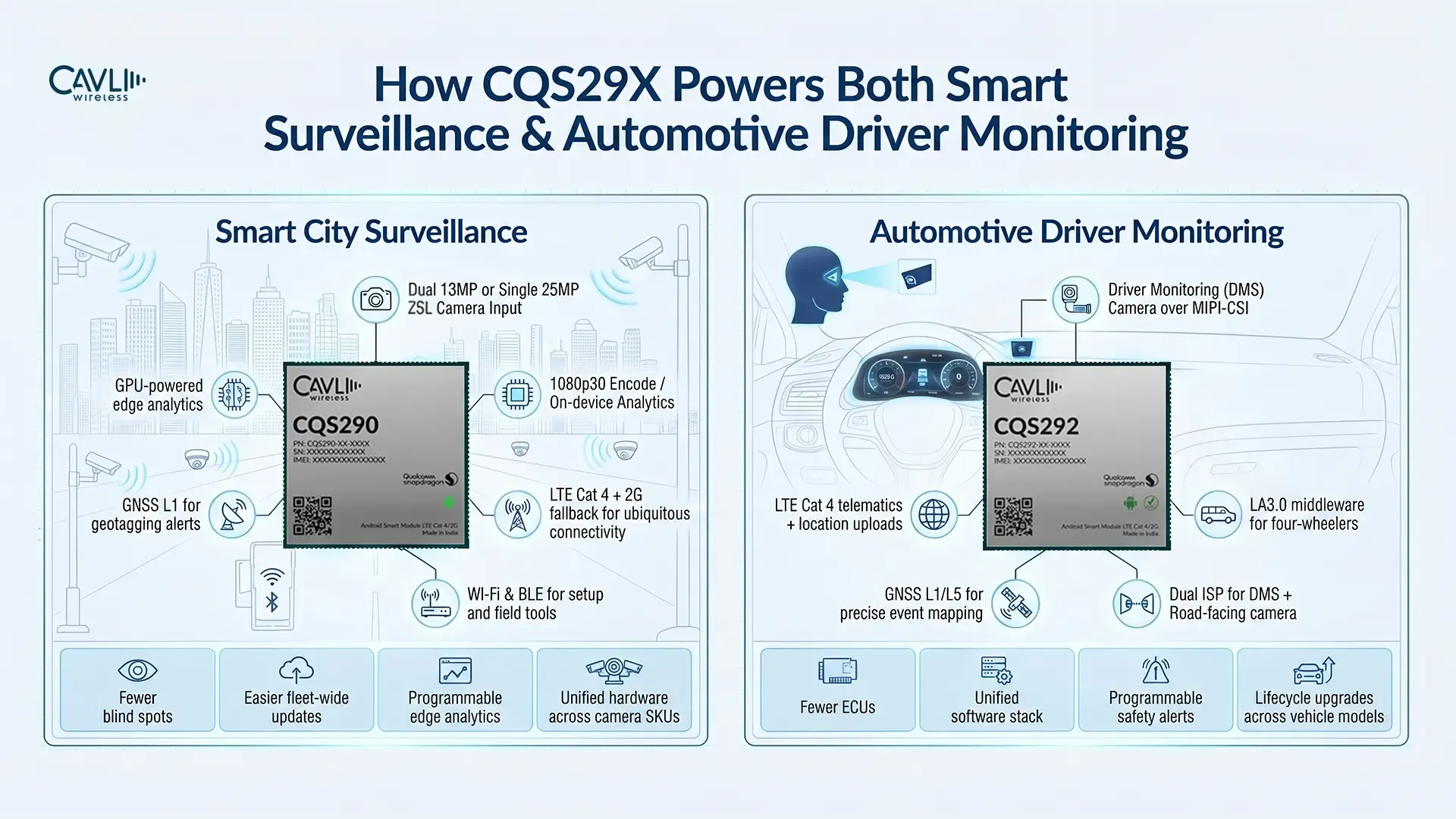
Since the same CQS29X platform also handles telematics and diagnostics, vehicle OEMs can roll out firmware updates, new safety algorithms, or connected services more frequently and consistently across models, which keeps driver assistance features current over the vehicle's lifetime. With fewer ECUs and a unified software stack, reducing in-field failure points, end customers experience fewer unexplained warnings or service visits related to driver-monitoring and connectivity subsystems. This leads to higher perceived reliability and greater trust in connected safety features.
Conclusion: Scaling Camera-Based IoT with Cavli CQS29X Smart IoT Modules
Across both smart surveillance and automotive driver monitoring, the CQS29X family provides a common, camera-centric platform that unifies compute, LTE Cat 4 with 2G fallback, and advanced imaging in a compact LGA form factor. CQS290 enables surveillance OEMs to replace fragmented NVR, modem, and encoder stacks with a single module that supports high-resolution sensors, rich IO, and on-device analytics, simplifying design and accelerating deployments.
In parallel, CQS291 and CQS292 extend the same foundation into automotive environments, adding LA3.0 middleware, optional automotive-grade memory, and enhanced GNSS to support reliable 2W and 4W telematics and driver monitoring. By leveraging on CQS29X, OEMs and integrators can cut integration effort, shorten validation and time to market, and deliver end solutions that are easier to scale, update, and maintain over their lifecycle.
Go Beyond and Explore
What are Cavli CQS29X Smart IoT Modules?
Which applications are Cavli CQS29X Smart IoT Modules designed for?
How does CQS29X support smart surveillance cameras?
How does CQS292 support automotive driver monitoring?
What connectivity features are available in the CQS29X Smart IoT Module family?
Why should OEMs use CQS29X Smart IoT Modules instead of separate compute, modem, and encoder components?
Author

Soorya Kumar A
Sr. Associate- Product Marketing
Cavli Wireless