
What Is Narrowband IoT (NB-IoT)? How It Works, Benefits & Applications
Narrowband IoT (NB-IoT) is a cellular Low Power Wide Area Network (LPWAN) technology standardized by 3GPP for IoT devices that need to transmit relatively small amounts of data while operating with low power consumption and extended coverage. NB-IoT uses a narrow radio carrier and licensed cellular spectrum, making it particularly suitable for applications such as smart metering, environmental sensing, agriculture, utility infrastructure, and industrial monitoring.
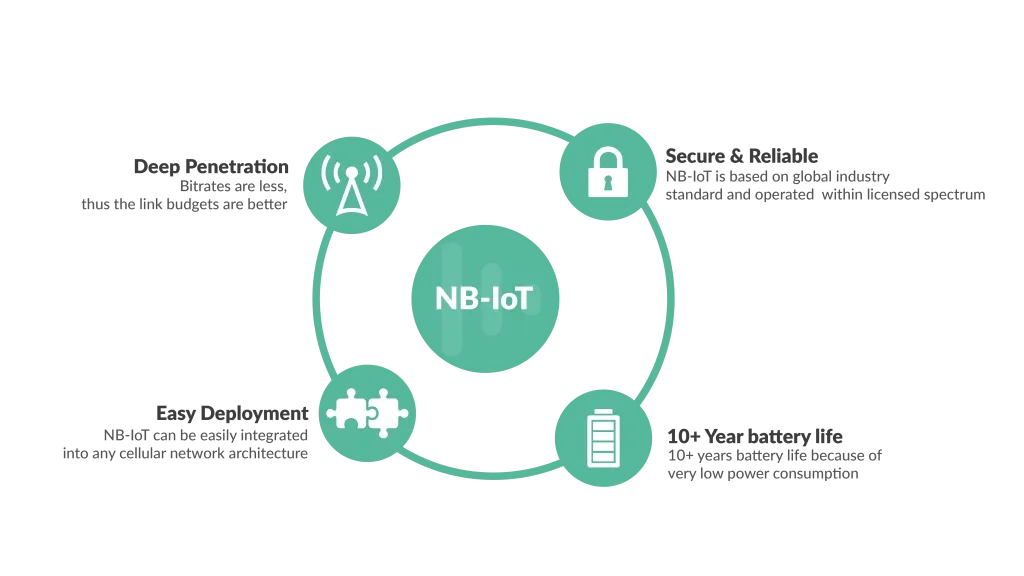
Unlike cellular technologies designed primarily for high throughput, NB-IoT prioritizes coverage, power efficiency, device density, and low-bandwidth machine communication. Features such as Power Saving Mode (PSM) and extended Discontinuous Reception (eDRX) can allow battery-powered devices to spend long periods in low-power states between data transmissions.
For OEMs and IoT solution developers, however, selecting NB-IoT requires more than looking at battery life or coverage claims. Deployment geography, operator availability, mobility, payload size, latency, frequency bands, module architecture, antenna design, power supply, and product lifecycle all influence whether NB-IoT is the right connectivity technology.
Key Takeaways
- NB-IoT is a cellular LPWAN technology designed for low-data-rate, power-constrained IoT applications.
- It operates in licensed spectrum and can be deployed using in-band, guard-band, or standalone spectrum configurations.
- PSM and eDRX help reduce device power consumption by limiting how long the radio remains actively connected or listening.
- NB-IoT is particularly well suited to many stationary or low-mobility applications such as smart meters, environmental sensors, infrastructure monitoring, and agriculture.
- NB-IoT and LTE-M solve different IoT requirements. LTE-M generally offers greater throughput, lower latency, and stronger mobility support, while NB-IoT prioritizes low power and coverage for smaller data payloads.
- Selecting an NB-IoT module also requires evaluation of bands, regional network availability, interfaces, RF design, power requirements, SIM architecture, certifications, and device-management needs.
What Is Narrowband IoT?
Narrowband Internet of Things, or NB-IoT, is a standardized cellular radio technology designed to connect large numbers of IoT devices that typically transmit small amounts of data.
NB-IoT was introduced by 3GPP as part of its cellular IoT specifications and is commonly classified alongside LTE-M as a cellular LPWAN technology. Unlike unlicensed LPWAN technologies, NB-IoT operates within licensed spectrum managed by mobile network operators.
A defining characteristic of NB-IoT is its narrow 180 kHz carrier bandwidth. By concentrating radio resources into a narrow channel and optimizing signaling for machine-type communication, NB-IoT can provide coverage and power-efficiency characteristics suited to devices that do not need broadband cellular performance.
This makes NB-IoT fundamentally different from choosing a conventional LTE technology simply because both use cellular infrastructure. The engineering priorities are different: an NB-IoT sensor may transmit a small reading periodically and remain in a low-power state for much of its operating life.
Designing a Low-Power Connected Device?
The right connectivity technology depends on payload size, transmission frequency, mobility, coverage, power budget, deployment geography, and product lifetime.
How Does NB-IoT Work?
An NB-IoT device communicates with a mobile operator's cellular network through an NB-IoT-capable modem or cellular IoT module.
At the device level, sensors or the host processor collect application data-for example, a meter reading, tank level, environmental measurement, or equipment status. The host communicates with the cellular module, which handles the radio connection and transmits the required information through the NB-IoT network toward the application backend or cloud platform.
The basic path can be understood as:
Sensor/Application → Host MCU → NB-IoT Module → Cellular Base Station → Operator Network → IoT Platform/Cloud
This architecture allows IoT developers to use standardized cellular infrastructure instead of deploying and operating a private wide-area radio network.
The advantage is not high throughput. NB-IoT is optimized for applications where relatively small payloads and intermittent communications are more important than continuous broadband connectivity.
How Is NB-IoT Deployed in Cellular Spectrum?
One of NB-IoT's important architectural characteristics is deployment flexibility. Network operators can deploy NB-IoT using spectrum resources in several ways.
In-Band Deployment
In-band NB-IoT uses resource blocks within an LTE carrier. This allows an operator to allocate part of its existing LTE spectrum to NB-IoT.
Guard-Band Deployment
Guard-band deployment uses spectrum resources around the edge of an LTE carrier that can otherwise remain unused for conventional LTE traffic.
Standalone Deployment
Standalone NB-IoT can use dedicated spectrum, including spectrum that may have previously supported other cellular technologies, subject to the operator's spectrum strategy and regulatory environment.
These deployment modes are primarily network-side considerations, but they matter to IoT developers because NB-IoT availability is ultimately operator- and region-dependent. A module supporting NB-IoT does not guarantee that an NB-IoT network is commercially available in every target market.
Why Does NB-IoT Use So Little Power?
Low power consumption is one of the major reasons engineers consider NB-IoT for battery-operated devices.
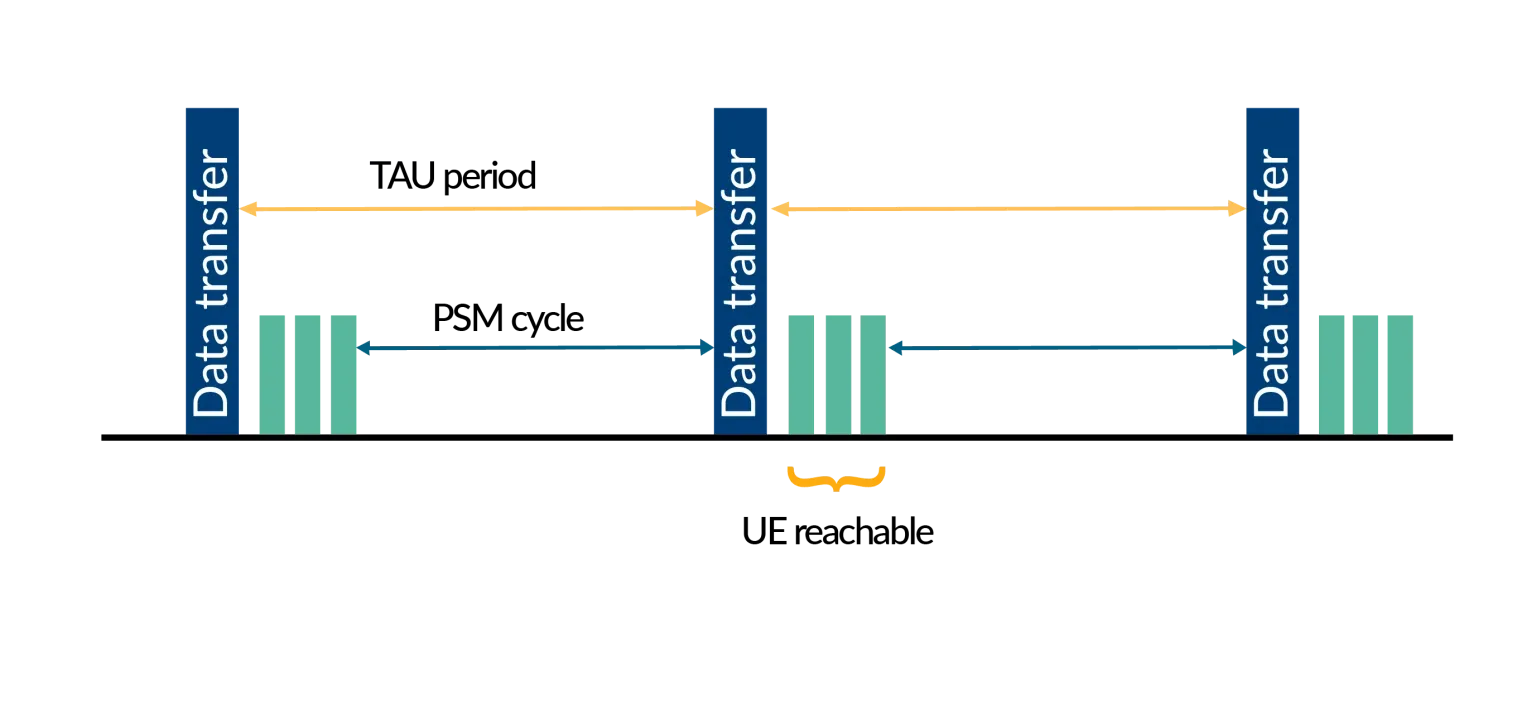
Two important mechanisms are Power Saving Mode (PSM) and extended Discontinuous Reception (eDRX).
Power Saving Mode (PSM)
PSM allows a device to enter a very low-power state for extended periods while maintaining network registration context. The device can wake according to its configured behavior when it needs to communicate.
This is useful for applications such as a meter or environmental sensor that may only need to report periodically.
Extended Discontinuous Reception (eDRX)
eDRX extends the intervals between periods when a device listens for paging from the network. By reducing how frequently the receiver needs to become active, eDRX can lower energy consumption while still allowing network-reachable operation according to the configured paging cycle.
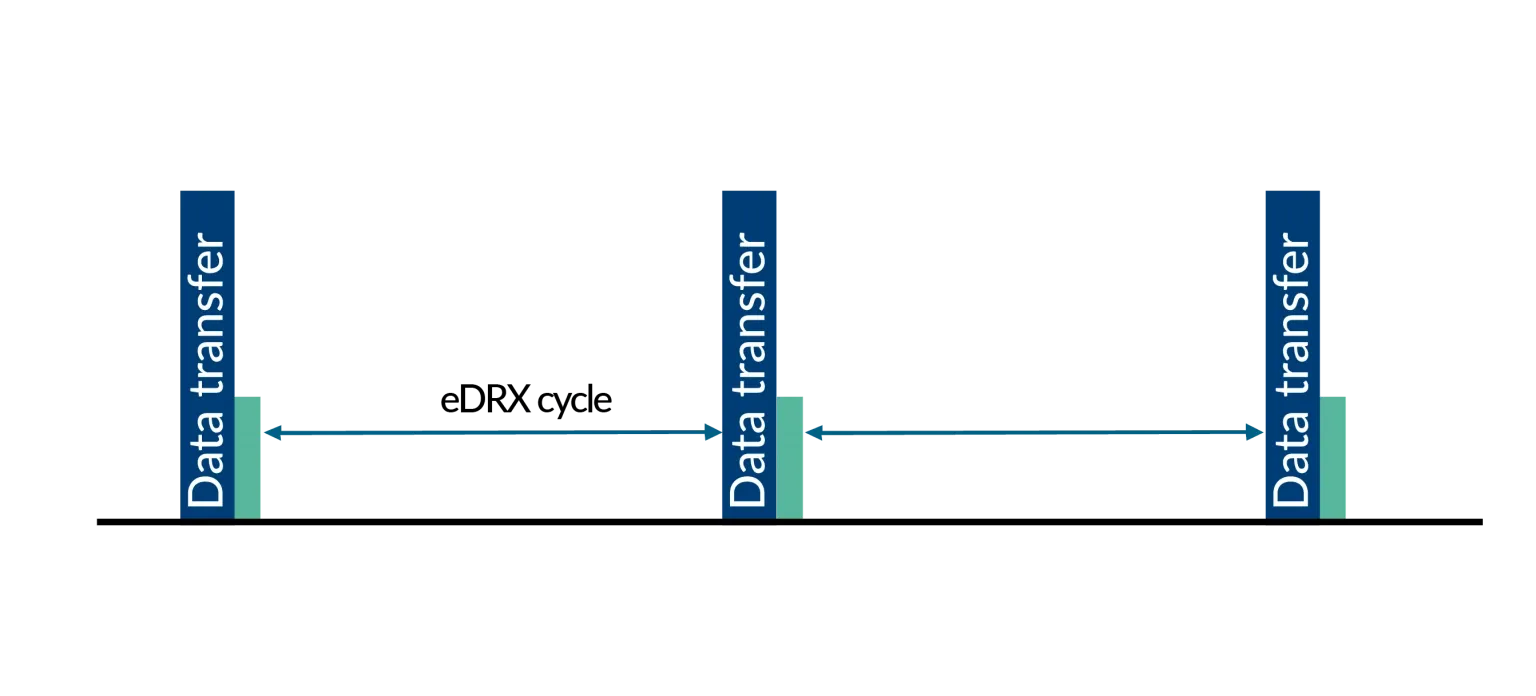
These features can support very long device lifetimes, but battery life should not be treated as a fixed NB-IoT specification.
A device's actual battery life depends on factors including transmission frequency, signal conditions, retransmissions, payload size, battery capacity and chemistry, temperature, processor consumption, sensor load, firmware behavior, and network configuration.
For an OEM, estimating battery life therefore requires a complete device-level power budget rather than simply adopting a headline figure for the radio technology.
NB-IoT Coverage and Range: Why Is It Suitable for Hard-to-Reach Devices?
NB-IoT was designed to improve coverage for low-throughput IoT devices, including devices installed in locations where conventional cellular reception may be challenging.
This characteristic is useful for applications such as utility meters in basements, underground infrastructure, remote environmental sensors, agricultural equipment, and industrial monitoring points.
However, NB-IoT range is not one universal distance figure.
Actual coverage depends on the operator network, spectrum band, base-station configuration, terrain, building materials, antenna efficiency, installation location, interference, device transmit power, and RF design.
For this reason, OEMs should validate coverage in representative deployment environments rather than assuming that an NB-IoT device will connect successfully simply because a country has commercial NB-IoT service.
Planning an NB-IoT Deployment Across Multiple Regions?
Validate operator availability, supported frequency bands, antenna design, coverage requirements, SIM architecture, and connectivity-management needs before finalizing hardware.
What Are the Main Benefits of NB-IoT?
The value of NB-IoT comes from combining cellular infrastructure with characteristics optimized for low-power machine communication.
Low Power for Intermittent IoT Communication
PSM and eDRX allow appropriately designed devices to minimize radio activity between transmissions. This can make NB-IoT suitable for applications where replacing batteries frequently would be operationally expensive.
Extended Coverage
NB-IoT's radio design supports use cases that require stronger coverage characteristics than many short-range technologies, including some deep-indoor installations.
Licensed-Spectrum Operation
Because NB-IoT is deployed by cellular operators in licensed spectrum, it benefits from managed cellular network infrastructure rather than relying on an OEM to deploy a wide-area access network.
Large-Scale Device Connectivity
NB-IoT is designed for massive machine-type communications where networks may need to support large populations of low-throughput connected devices.
Cellular Security Framework
NB-IoT benefits from cellular authentication and security mechanisms, but application developers must still secure the entire device-to-cloud architecture. Secure boot, firmware integrity, application-layer encryption, credential management, OTA/FOTA security, backend access control, and physical security remain system-level responsibilities.
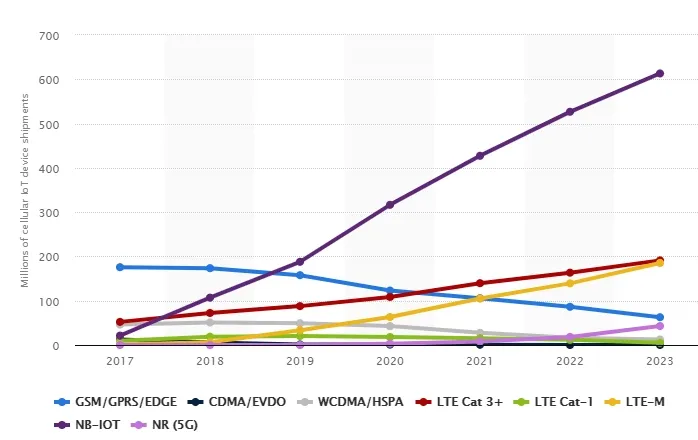
NB-IoT vs LTE-M: Which Cellular LPWAN Technology Fits the Application?
NB-IoT and LTE-M were both developed for cellular IoT, but they should not be treated as interchangeable technologies.
| Engineering FactorNB-IoTLTE-M | ||
|---|---|---|
| Primary design focus | Low-throughput, low-power IoT | Low-power IoT with greater throughput and mobility |
| Carrier bandwidth | Narrow, 180 kHz | Wider than NB-IoT |
| Data requirements | Best suited to smaller/infrequent payloads | Better suited to moderate data requirements |
| Mobility | More suited to stationary/limited-mobility applications | Better mobility support |
| Latency | Generally higher | Generally lower |
| Voice | Not a core NB-IoT capability | VoLTE can be supported where network/device implementation allows |
| Power-saving features | PSM, eDRX | PSM, eDRX |
| Typical applications | Metering, sensors, agriculture, infrastructure | Wearables, mobile tracking, alarms, connected devices |
The practical difference comes down to application behavior.
A water meter transmitting a small measurement periodically has very different connectivity requirements from a moving asset tracker that needs frequent location updates. NB-IoT may fit the first architecture well, while LTE-M can be more appropriate when mobility, throughput, or latency requirements increase.
Cavli's dedicated LTE-M guide provides a deeper discussion of LTE-M rather than duplicating that topic here:
Is NB-IoT a 5G Technology?
The answer requires some nuance.
NB-IoT originated within the LTE-era 3GPP cellular IoT standards rather than as a conventional 5G NR radio interface. However, 3GPP has incorporated NB-IoT and LTE-M into the broader evolution of 5G massive machine-type communications (mMTC). Cavli's existing NB-IoT content also describes this evolutionary relationship.
Therefore, it is more accurate to say that NB-IoT has an evolutionary role within the 5G ecosystem than to simply describe every NB-IoT connection as a 5G NR connection.
This distinction matters when selecting modules. An NB-IoT module and a 5G NR or 5G RedCap module target different performance requirements, network architectures, power profiles, and use cases.
NB-IoT for Fixed and Mobile Devices
NB-IoT is especially well suited to many fixed or low-mobility applications.
When an NB-IoT device moves between coverage areas, mobility behavior differs from LTE-M's stronger support for connected-mode mobility. Cell reselection and reconnection behavior can introduce additional signaling and power considerations for moving devices.
That does not mean NB-IoT devices can never move. Trackers and other moving applications can be implemented depending on the network and use case. The important engineering question is how much mobility the application requires and how frequently it must communicate while moving.
For devices that move continuously and require frequent updates, LTE-M or another cellular technology may be more appropriate.
Narrowband IoT Applications and Use Cases
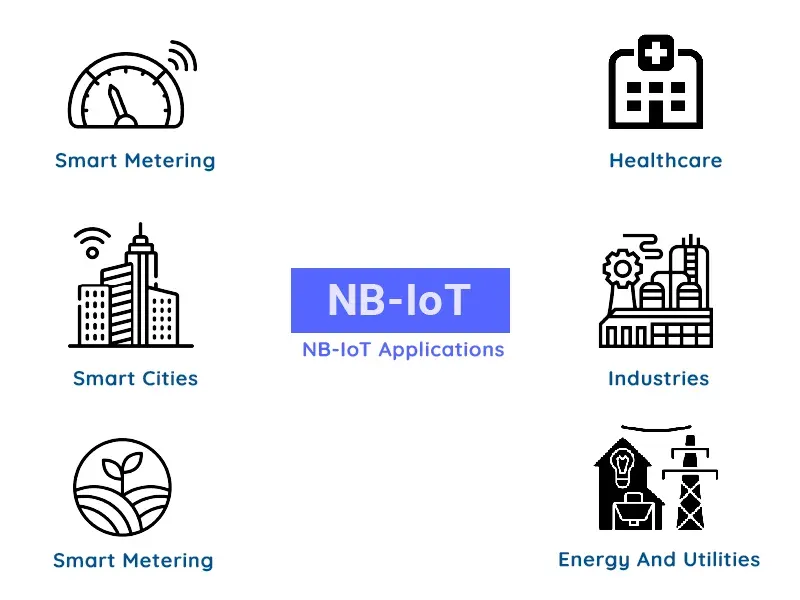
The strongest NB-IoT applications tend to share several characteristics: small data payloads, long deployment periods, constrained power budgets, and limited mobility.
Smart Metering and Utilities
Electricity, water, and gas meters are classic NB-IoT use cases. Meters are usually stationary, transmit relatively small datasets, and may remain deployed for many years.
NB-IoT can also support remote monitoring of utility infrastructure where wired connectivity would be impractical.
Smart Cities
Parking sensors, street infrastructure, environmental monitors, waste-management sensors, and other distributed city devices can benefit from cellular LPWAN connectivity when the application requires small periodic data transfers.
Agriculture and Environmental Monitoring
Soil sensors, environmental monitoring stations, irrigation systems, and other agricultural devices may operate remotely with limited access to mains power.
Cavli's agriculture IoT content includes NB-IoT module applications for connected monitoring systems:
Industrial IoT
Industrial facilities can use NB-IoT for low-bandwidth monitoring of equipment state, environmental conditions, tank levels, and other telemetry where high throughput or very low latency is not required.
The connectivity decision should nevertheless account for RF conditions inside the facility, latency requirements, payload frequency, device mobility, and availability of alternative private or public networks.
How Do NB-IoT Modules Fit into an IoT Device?
An NB-IoT module provides the cellular modem and radio functionality required for a device to communicate over a supported NB-IoT network.
A typical architecture can be represented as:
Sensors → Host MCU/Application → NB-IoT Module → Antenna → Cellular Network → IoT Platform/Cloud
The host processor can communicate with the cellular module through supported hardware interfaces and command sets, while the module handles cellular registration, radio communication, and data transport.
Depending on the module architecture, additional capabilities may include GNSS, integrated eSIM, network protocol stacks, power-saving functionality, and device-management features.
Cavli's current module portfolio includes LPWA/NB-IoT options alongside LTE Cat 1, Cat 1bis, Cat 4, 5G RedCap, and 5G NR modules.
The important engineering decision is not simply whether a module supports NB-IoT. OEMs should also evaluate:
- Target-country frequency bands and operator availability
- NB-IoT category and 3GPP release support
- Power supply and peak-current requirements
- Host interfaces and software integration
- Antenna and RF requirements
- GNSS requirements, if applicable
- SIM, eSIM, or iSIM architecture
- Certifications and carrier requirements
- Module lifecycle and availability
- Device and connectivity-management requirements
Evaluating an NB-IoT Module for a New Product?
Cavli's team can help evaluate your application requirements, target regions, power budget, cellular bands, GNSS requirements, interfaces, SIM architecture, and device-management needs.
Already Using Another NB-IoT or Cellular IoT Module?
An OEM may already have a deployed product or PCB designed around another cellular module and want to evaluate a Cavli module for a new hardware revision, additional region, or future product generation.
Migration may be possible after engineering evaluation, but module replacement should never be assumed to be a drop-in process.
Engineers need to compare the existing and target modules across package and form factor, PCB footprint, pin mapping, supply voltage, peak current, UART/USB and other host interfaces, AT commands, drivers, supported cellular bands, antenna/RF design, GNSS architecture, SIM/eSIM configuration, firmware behavior, certifications, carrier requirements, and regional regulations.
If the modules differ in any of these areas, PCB, firmware, RF, antenna, power, or certification changes may be required.
The right migration plan therefore begins with the existing design rather than with a generic compatibility claim.
Already Using Another Cellular IoT Module?
Share your existing module architecture, target markets, connectivity technology, band requirements, interfaces, GNSS needs, RF design, SIM architecture, and lifecycle requirements with Cavli's engineering team to evaluate a potential migration path.
When Should You Choose NB-IoT?
NB-IoT is worth evaluating when the application sends relatively small amounts of data, can tolerate its latency characteristics, needs low-power operation, and is deployed where supported NB-IoT network coverage is available.
It can be especially attractive when devices are stationary, difficult to access, battery-operated, or deployed in large numbers.
NB-IoT may be a weaker fit when the application requires continuous mobility, frequent large data transfers, broadband throughput, voice, very low latency, or other capabilities better served by LTE-M, LTE Cat 1/Cat 1bis, 5G RedCap, or higher-performance cellular technologies.
This is why connectivity selection should begin with the application requirements, not with a preferred radio technology.
For a broader comparison, see Cavli's IoT Connectivity Selection Guide:
Not Sure Whether NB-IoT, LTE-M, Cat 1bis, or 5G RedCap Fits Your Product?
Compare data requirements, mobility, latency, power, coverage, target regions, device lifetime, and deployment economics before selecting the cellular architecture.
Related Cavli Resources for Cellular LPWAN and IoT Connectivity
For engineering teams evaluating NB-IoT as part of a broader connectivity strategy, Cavli’s related resources can help clarify where different cellular technologies and module options fit. The LTE-M for IoT guide explains when LTE-M may be better suited for applications that require stronger mobility support, lower latency, or higher data throughput than NB-IoT.
For a broader technology comparison, the IoT Connectivity Selection Guide helps compare cellular, LPWAN, and other wide-area connectivity options based on factors such as coverage, power consumption, mobility, latency, and deployment requirements.
The LTE Category Guide provides additional context on how NB-IoT fits within the wider LTE ecosystem and how different LTE categories address varying IoT connectivity needs.
For product evaluation, explore Cavli Cellular IoT Modules to review LPWA, LTE, 5G RedCap, 5G NR, and other module options for different device architectures and deployment scenarios.
Conclusion: Is Narrowband IoT Right for Your IoT Product?
Narrowband IoT (NB-IoT) is designed for a specific class of connected products: devices that typically transmit relatively small amounts of data, prioritize power efficiency and coverage, and do not require broadband throughput or continuous high-speed mobility.
Its narrow carrier, licensed-spectrum operation, PSM and eDRX support, flexible network deployment modes, and cellular infrastructure make NB-IoT a compelling option for applications such as smart metering, environmental sensing, agriculture, smart-city infrastructure, and industrial telemetry.
But NB-IoT should not be selected from a feature checklist alone.
OEMs need to evaluate network availability, frequency bands, payload behavior, latency, mobility, battery requirements, antenna/RF performance, module architecture, SIM strategy, certifications, target markets, and device lifecycle before committing to the technology.
For products that need more mobility, throughput, or lower latency, LTE-M, LTE Cat 1bis, 5G RedCap, or another cellular technology may provide a better engineering fit.
The right approach is therefore to select the cellular technology and IoT module together as part of the complete device architecture.
Building a Low-Power Cellular IoT Product?
Evaluate NB-IoT alongside LTE-M and other cellular technologies based on your application's data, power, mobility, coverage, regional, RF, GNSS, interface, and lifecycle requirements.
Author

Sony Sunny
IoT Solutions Consultant, Cavli Wireless