
The IoT Connectivity Selection Guide: Making Sense of Wide-Area Networks
Connecting a device to Wi-Fi or Bluetooth is simple. It wasn’t always straightforward, but today - it just works. However, anyone who’s tried to scale beyond a single site knows that wide-area connectivity is a different story. The moment you step into the world of cellular, LPWAN, and roaming agreements, simplicity disappears behind layers of infrastructure, regulation, and commercial fine print.
The consequence is that many IoT projects stall not because the hardware or software fails, but because the connectivity layer is misunderstood or mismatched to the use case. As an industry, we’ve built incredible technology, but we’ve also built unnecessary complexity around it. We can and should simplify it.
Wide-area IoT connectivity, which includes cellular (2G-5G, LTE-M, NB-IoT) and open spectrum LPWAN technologies (LoRaWAN, Mioty, WiSUN) - involves a web of technical, regulatory, and commercial decisions that can easily overwhelm even experienced teams. This guide breaks down that complexity and provides a structured approach for selecting the right wide-area connectivity for your IoT deployment.
Start with the Use Case - Context Defines Everything
Each IoT use case comes with its own priorities: Smart meters demand long battery life and strong indoor penetration, as they are often installed underground. Fleet tracking relies on mobility and roaming to enable continuous transmission of fleet data, while Industrial monitoring values uptime and data control to ensure proper quality of service and continued operation While the specifics vary from project to project, the network choice almost always hinges on a few common factors:
- Expected data volume and frequency
- Power and energy constraints
- Mobility (fixed vs moving assets)
- Geographic footprint (local, regional, global)
- Device lifespan
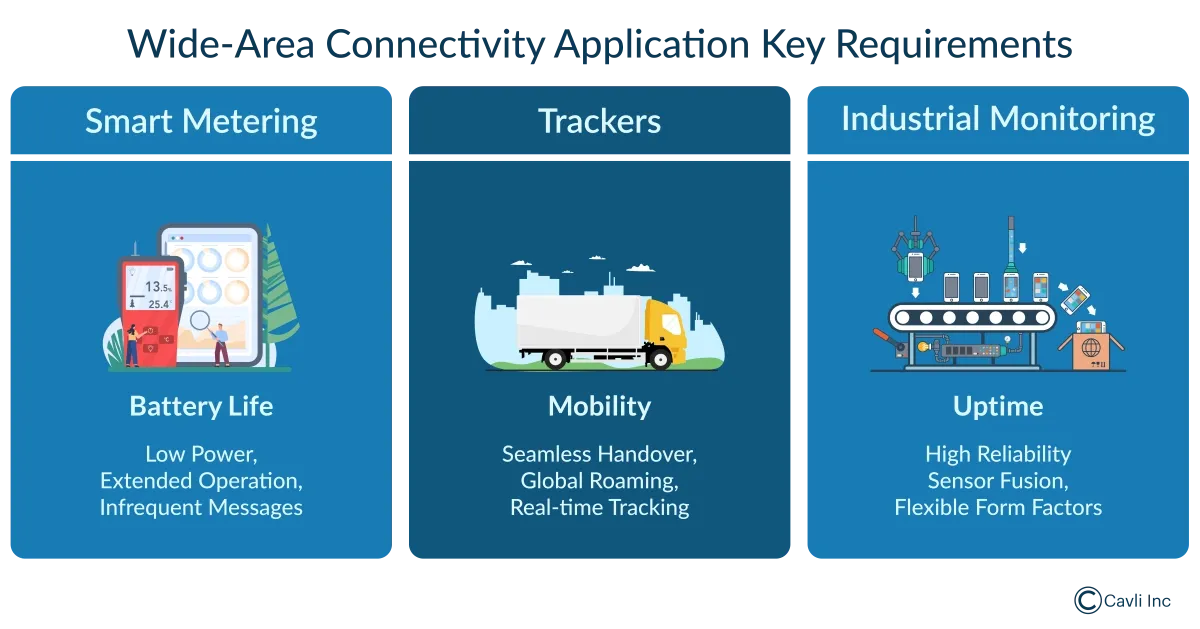
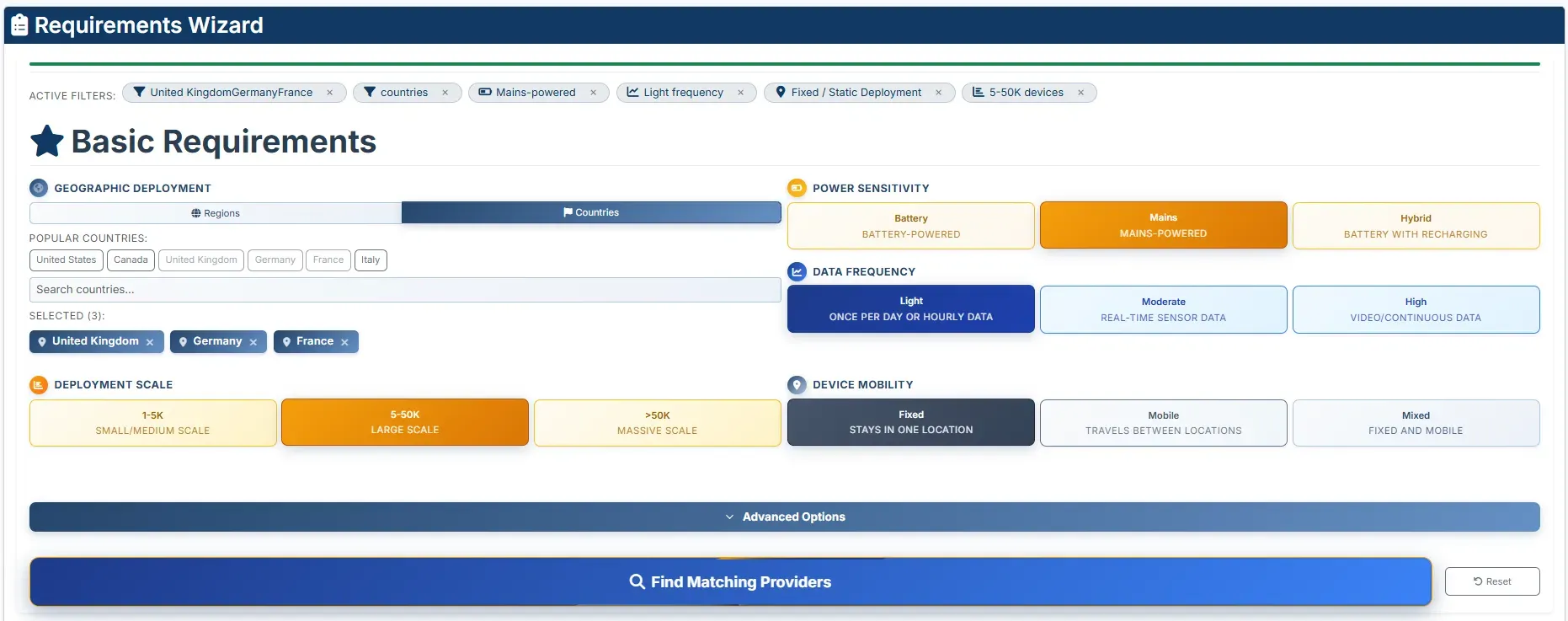
Whether it’s a smart meter buried underground, a moving fleet of assets, or an industrial sensor that can’t go offline, each use case shapes the network requirements that follow. Once those fundamentals are understood - data volume, power, mobility, geography, and device lifespan - the technology shortlist becomes much clearer. Tools that standardize terminology and let you filter providers by technology, region, and deployment scale, such as the IoT Connectivity Marketplace, can simplify this early evaluation and reduce weeks of manual comparison.
Private vs. Public Networks: A Strategic Decision
The choice between public and private networks is one of the most strategic decisions in any wide-area IoT deployment. It goes far beyond cost or technical preference. It defines who truly controls the infrastructure your solution depends on. Few decisions have as much long-term impact as whether to build your own network or rely on someone else’s.
Using public networks, such as cellular or public LoRaWAN, offers immediate benefits: fast deployment, no need to invest in infrastructure, and access to global coverage managed by established operators. The trade-off is dependency, where your service becomes tied to the telcos’ coverage footprint, technology roadmap, and commercial policies.
In contrast, private networks such as private LTE, 5G, or LoRaWAN, place control directly in the hands of the enterprise. They allow full authority over reliability, latency, data handling, and upgrades, supporting tailored performance and greater data sovereignty. Yet that autonomy comes with significant capital and operational expenses, as well as the potential need for in-house or specialized expertise to maintain the network.
For many organizations, a hybrid model offers the best of both worlds: public networks for mobility and large-scale reach, complemented by private deployments for critical sites, sensitive data, or environments where performance and control outweigh convenience. However, this approach comes with a cost that can make or break a business case, especially for early-stage solutions.
Before deciding which network to use, it’s worth understanding the landscape itself -because the right choice isn’t only about speed or cost, it’s about fit.
The Technology Landscape: Cellular vs. Unlicensed spectrum LPWAN
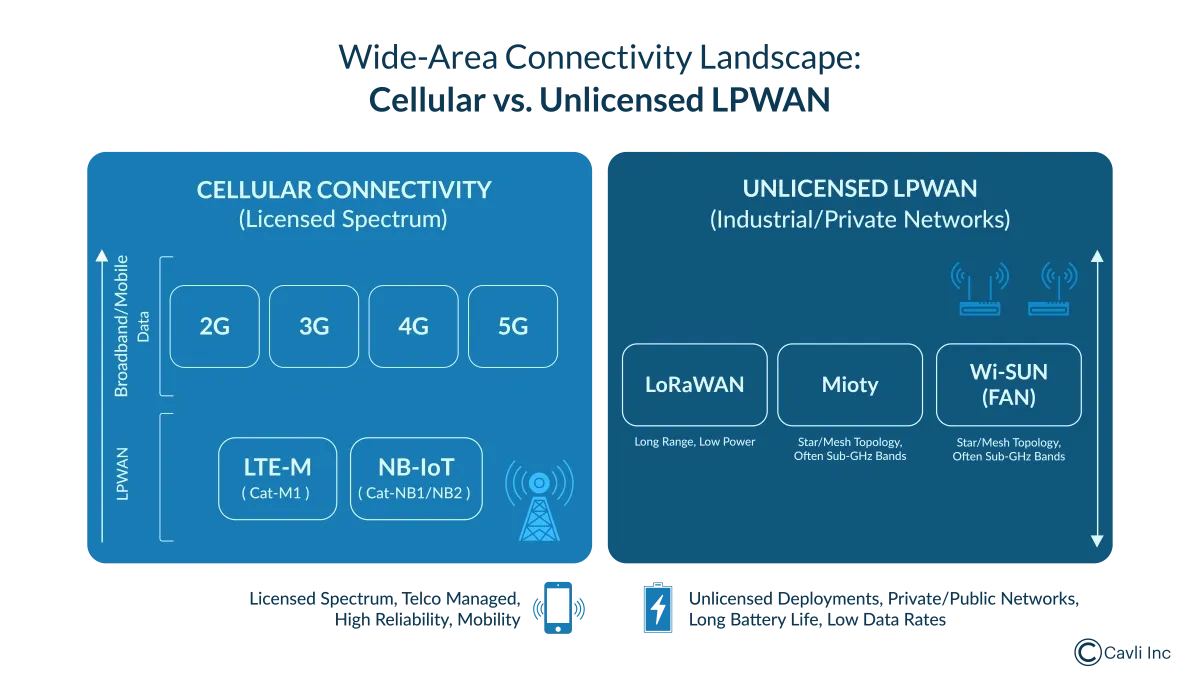
Wide-area IoT connectivity generally falls into two broad categories: cellular networks and unlicensed LPWAN technologies. Cellular options, including 4G, 5G, LTE-M, and NB-IoT (and legacy 2G, 3G), are built on licensed spectrum and supported by mature, global infrastructure. They offer managed services, strong roaming capabilities, and broad coverage, making them well-suited for mobile or cross-border applications. Their main drawbacks are dependencies on cellular infrastructure providers' roadmaps, higher modem costs, and the complexity of managing roaming for certain LPWAN variants such as LTE-M and NB-IoT.
Unlicensed LPWAN technologies, such as LoRaWAN, Mioty, and WiSUN, trade scale for control. They operate on unlicensed spectrum, allowing organizations to build and manage their own networks with low power consumption and long-range communication. These networks are particularly effective for static or localized deployments like smart city infrastructure, agriculture, or utilities. However, they come with fragmented ecosystems, limited interoperability, and the responsibility of maintaining infrastructure ownership.
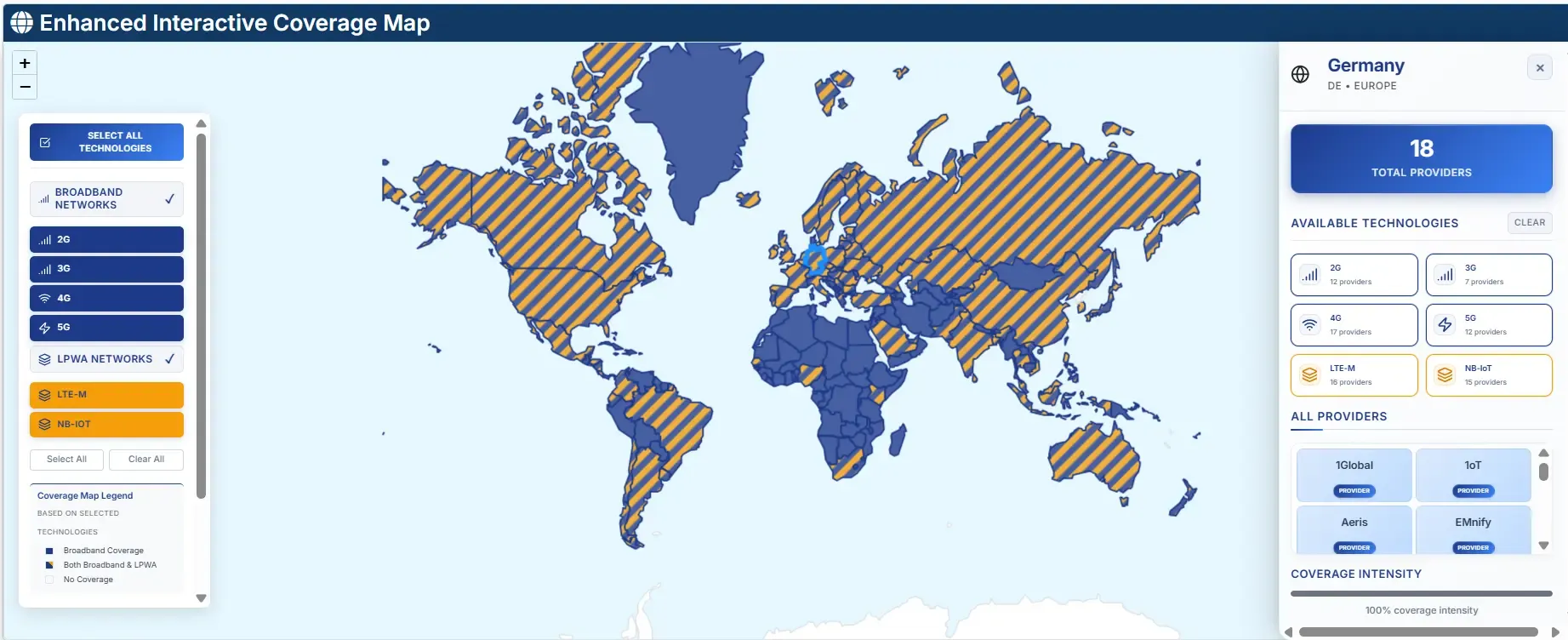
Structured directories make it easier to compare these options in practice, help visualize which technologies and providers offer true coverage by country and frequency band, transforming what used to be guesswork into an informed, data-driven decision.
In practice, most large-scale deployments end up using either cellular or LPWAN (sometimes both) for reach and efficiency - proving that there’s rarely a single “best” technology, only the best fit for the job.
Coverage and Reality Checks
Every IoT engineer eventually learns that coverage maps are marketing documents, not guarantees. Real-world testing remains the only truth. Coverage is often shown as a single map, but what truly matters are the layers beneath it. The distinction between native coverage, where the provider owns and operates the network, and roaming coverage, which depends on partner agreements.
Additionally, there is the technology coverage, indicating which specific protocols are actually active in each region. Understanding these layers is essential to evaluating real-world availability rather than relying solely on marketing maps Maps can be optimistic. NB-IoT may be “launched” in a country but not yet commercially available; LTE-M may exist only in major cities or lack support for certain features (e.g., eDRX, which is crucial for power-sensitive applications) Field validation and aggregated coverage databases can reveal where networks truly operate, and where fallback technologies are required.
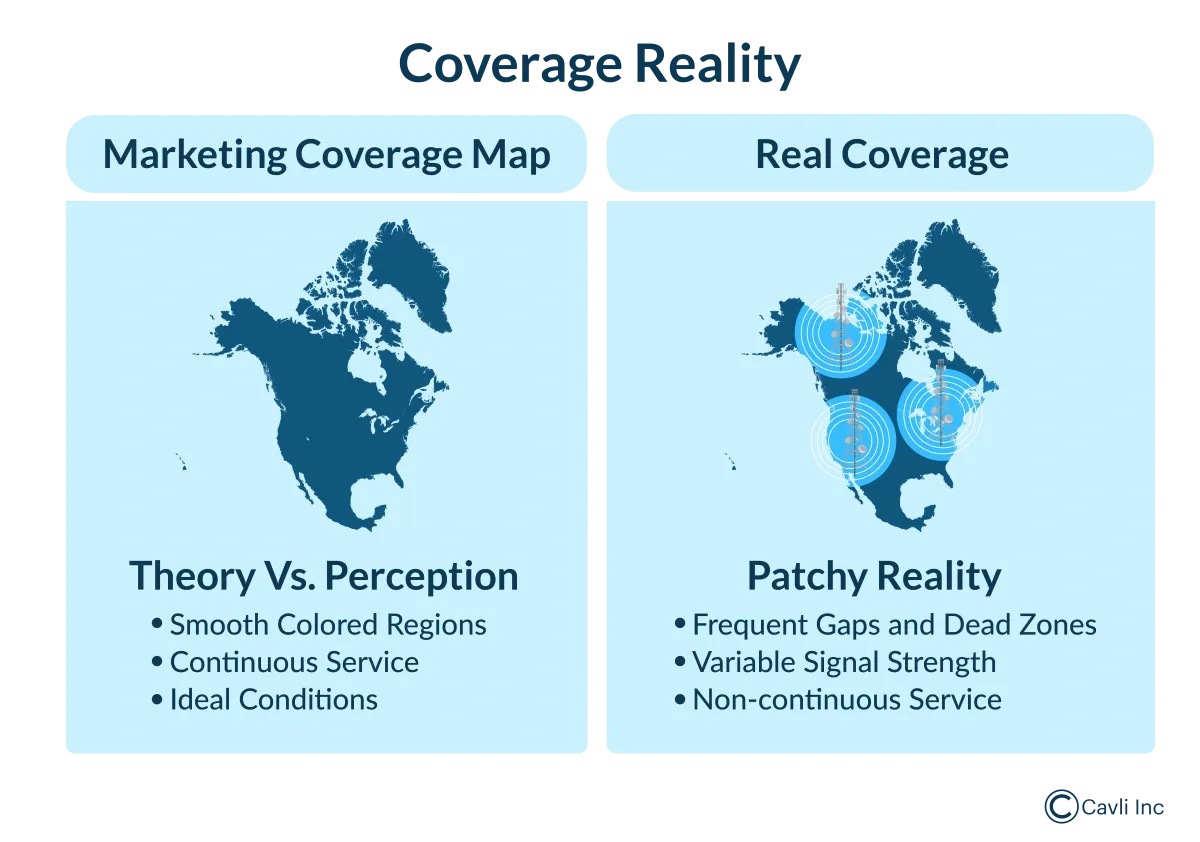
Aggregated coverage datasets and verified provider listings, like those available through the IoT Connectivity Marketplace, help expose the real footprint of each technology, reducing the gap between marketing claims and reality.
Platform Capabilities: The Hidden Differentiator
Many teams underestimate how quickly platform limitations surface, often only after devices are deployed. Connectivity today extends far beyond signal reach. Scalability depends largely on the strength of the underlying management platform.
A robust Connectivity Management Platform (CMP) enables full control over SIM lifecycles, provides API access for automation, offers usage analytics and alerting, integrates seamlessly with device and cloud management systems, and includes essential security features such as IMEI locking.
Choosing a provider without a clear understanding of these platform capabilities often results in operational bottlenecks or a lack of visibility once the deployment begins to scale.
Commercial Considerations: Pricing and Terms
Connectivity pricing remains one of the least transparent aspects of Wide-Area IoT Connectivity. Models vary widely from per-megabyte and per-device plans to pooled data structures and often hide additional costs related to activation, roaming, or minimum order sizes.
When assessing offers, it is essential to look beyond headline rates and understand the full pricing structure, including whether it is usage-based or flat-rate, the length and size of contractual commitments, the presence of roaming fees or fair-use restrictions, and how much flexibility is offered for pilot phases or seasonal deployments. Providers that make these terms visible through clear, published pricing or open quotation mechanisms make planning far simpler and help prevent unnecessary delays in procurement.
Preparing for the eSIM and SGP.32 Era
The introduction of SGP.32 promises to make switching connectivity providers as seamless as a software update - a real remote SIM provisioning experience and a potential game-changer for global IoT deployments.
The reality is more nuanced. SGP.32 is not one thing. It is five roles working together: the eUICC, the IPA, the eIM, the SM-DP+, and the connectivity provider. In a real deployment, these are almost never owned by the same company. Five vendors. Five release cycles. Five interpretations of the same specification. And they all need to interoperate perfectly the first time, in the field.
This is why "SGP.32 ready" means very different things depending on who is saying it. Some vendors run all five roles in production. Some run one. Some have nothing in production but have the standard on a roadmap slide.
When evaluating partners, the right questions are not "do you support SGP.32" but "which roles do you operate in production, which do you license, and where can I see verified evidence."
That’s why we’ve built alongside leading SIM OS vendors a structured maturity framework with clear KPIs, distinguishing Production Ready, Under Implementation, and Roadmap stages. The SGP.32 Maturity Index turns a marketing claim into a commercial decision.
A Structured Selection Framework
A practical way to select wide-area connectivity is to follow a clear, step-by-step process: Define application requirements → Shortlist compatible technologies → Decide on public, private, or hybrid network strategy → Assess coverage, platform capabilities, and roaming options → Compare pricing and contractual terms → Validate through pilot testing.
Taking this structured approach, supported by vendor-neutral data such as verified coverage, platform features, and contract flexibility, allows for faster, evidence-based decision-making and reduces the risk of costly missteps later in deployment.
Conclusion
IoT developers increasingly expect the same plug-and-play connectivity simplicity they experience with Wi-Fi or BLE, but wide-area connectivity operates in a different world, one governed by infrastructure, regulation, and complex commercial relationships.
Selecting the right network is not just a technical exercise; it’s a strategic decision that affects performance, cost, and long-term independence.
Initiatives that bring transparency and standardization to the ecosystem, including open, vendor-neutral directories like the IoT Connectivity Marketplace, are an important step toward making IoT connectivity truly simple.
The challenge is clear, and so is the opportunity. By aligning terminology, sharing verified data, and improving transparency, we can make IoT connectivity as seamless as it was always meant to be. The task is bigger than any single company - it’s something we need to simplify together.
Go Beyond and Explore
How do I choose the right wide-area IoT connectivity?
What is the difference between public and private IoT networks?
Why should I distrust IoT coverage maps?
What should I look for in an IoT Connectivity Management Platform (CMP)?
What is the significance of SGP.32 for global IoT deployments?
Author

Samenta Binoj
Junior Associate - Digital Marketing Cavli Wireless