

Modern connected vehicles require positioning capabilities that go beyond conventional GPS tracking. Automotive OEMs, Tier-1 suppliers, and mobility solution providers are developing increasingly intelligent vehicle platforms that depend on accurate, reliable, and continuous location intelligence.
Applications such as advanced telematics, fleet management, connected vehicle platforms, navigation systems, and ADAS require positioning systems that can perform across different operating environments. While traditional GNSS provides the foundation for vehicle positioning, GNSS-only positioning can face limitations in challenging scenarios such as dense urban environments, tunnels, underground parking areas, and locations with reduced satellite visibility.
To address these challenges, automotive positioning systems are increasingly adopting a multi-layer architecture that combines:
- Multi-constellation GNSS
- Real-Time Kinematic (RTK) positioning
- Inertial Measurement Unit (IMU) based motion sensing
- Dead reckoning technologies
- High-performance connectivity and edge computing
The Cavli AQ62 5G NR Autograde Module is designed to support these next-generation automotive requirements by combining high-performance connectivity, onboard computing, and advanced positioning capabilities into a single automotive-grade platform.
Beyond traditional GNSS-based positioning, AQ62 integrates multi-constellation GNSS support, its EVK offers an onboard IMU-based motion tracking, optional RTK and optional Qualcomm Dead Reckoning (QDR 3.0) to enable more accurate and continuous vehicle positioning.
With support for Qualcomm Location Suite Gen 9VT, AQ62 provides automotive OEMs and connected mobility developers with a foundation for building advanced vehicle positioning solutions.
By combining 5G NR connectivity, LTE Cat 18 fallback, edge computing capabilities, and advanced positioning technologies, AQ62 enables the development of intelligent connected vehicle platforms.
Key Takeaways
- High-precision automotive positioning requires more than standalone GNSS.
- RTK and GNSS improves positioning accuracy by applying correction data to GNSS calculations.
- IMU and dead reckoning technologies help maintain positioning continuity when satellite signals are degraded.
- AQ62 combines connectivity, compute, and positioning capabilities in an automotive-grade smart module.
- Multi-constellation GNSS support improves positioning availability across different geographic regions.
- Optional RTK and Qualcomm Dead Reckoning capabilities allow OEMs to develop more advanced connected vehicle applications.
Why Automotive Positioning Systems Need Higher Accuracy
Vehicle tracking technology has evolved significantly. Earlier tracking systems primarily focused on identifying approximate vehicle location. Modern connected vehicles require more precise and context-aware location intelligence.
Today, vehicle positioning supports critical automotive functions, including:
- Real-time telematics
- Fleet monitoring
- Remote diagnostics
- Navigation services
- ADAS applications
- Connected mobility platforms
- Intelligent vehicle tracking
For advanced automotive applications, accurate positioning enables real-time monitoring, optimized fleet operations, navigation services, connected vehicle experiences, and location-aware decision-making for systems such as ADAS.
As automotive platforms move toward higher levels of intelligence, positioning is no longer only about determining where a vehicle is located. It is about enabling vehicles and connected services to interpret movement, context, and surroundings with greater precision.
Moving Beyond Traditional GNSS: The Need for Advanced Vehicle Positioning
GNSS as the Foundation of Automotive Positioning
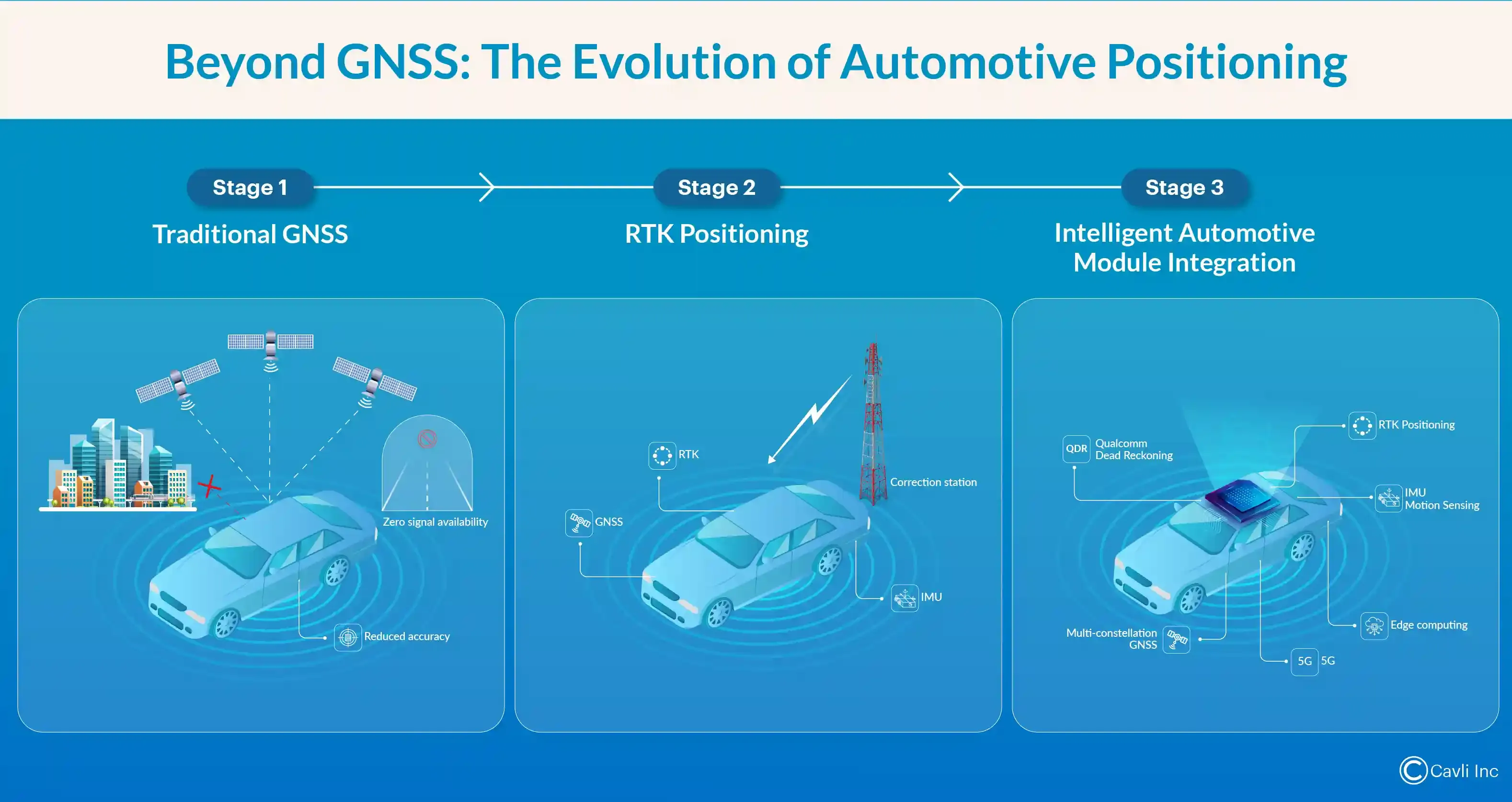
Global Navigation Satellite Systems (GNSS) provide satellite-based positioning by calculating vehicle location using signals received from multiple navigation satellite constellations.
Modern automotive GNSS receivers can improve availability and reliability by supporting multiple satellite constellations.
AQ62 supports multi-constellation GNSS, including:
- GPS
- GLONASS
- Galileo
- BeiDou
- NavIC
- QZSS
Supporting multiple satellite systems helps improve satellite availability and positioning reliability for global connected vehicle applications.
However, GNSS-only architectures may experience limitations when operating in environments where satellite signals are obstructed, degraded, or temporarily unavailable.
Common challenges include:
Urban Canyon Environments
Tall buildings can obstruct satellite signals and affect positioning reliability.
Tunnels and Underground Locations
Satellite signals may become unavailable when vehicles travel through enclosed environments.
Limited Satellite Visibility
Certain environments may reduce the number of available satellites and impact positioning performance.
For this reason, advanced automotive positioning systems combine GNSS with additional technologies such as RTK, IMU-based motion sensing, and dead reckoning.
Real-Time Kinematic (RTK) Positioning for Automotive Applications
What Is RTK Positioning?
Real-Time Kinematic (RTK) is a GNSS enhancement technology that improves positioning accuracy by using correction data to refine standard GNSS calculations.
Traditional GNSS determines vehicle position using satellite signals. RTK improves this process by applying correction information, allowing positioning systems to achieve higher accuracy when suitable correction data is available.
For automotive applications, RTK positioning can support scenarios where improved location precision is required, including:
- Advanced vehicle tracking
- Precision fleet monitoring
- Location-sensitive automotive services
- High-value connected mobility applications
The Cavli AQ62 supports optional RTK capability for applications requiring enhanced positioning performance.
RTK GNSS vs Standard GNSS: Understanding the Difference
| Technology | Description | Automotive Application Consideration |
|---|---|---|
| Standard GNSS | Satellite-based positioning using navigation signals | Suitable for general vehicle tracking applications |
| RTK GNSS | Uses correction data to improve GNSS accuracy | Suitable for applications requiring higher positioning precision |
| GNSS + IMU | Combines satellite data with IMU-based motion sensing | Improves continuity during positioning challenges |
| GNSS + RTK + Dead Reckoning | Combines multiple positioning inputs | Supports advanced connected vehicle platforms |
RTK should be evaluated based on application requirements, correction-data availability, regional deployment conditions, and overall vehicle system architecture.
IMU-Based Motion Tracking for Improved Positioning Continuity
An Inertial Measurement Unit (IMU) provides additional information about vehicle movement by measuring parameters such as:
- Acceleration
- Angular Motion
- Orientation
When combined with GNSS, IMU-based motion data provides additional context about vehicle movement and helps improve positioning continuity.
For automotive systems, this is important because vehicle movement information can continue contributing to positioning intelligence even when satellite positioning conditions become challenging.
AQ62 supports IMU integration as part of its advanced positioning architecture.
Qualcomm Dead Reckoning for Continuous Vehicle Location Estimation
Dead reckoning helps estimate vehicle position when GNSS signals become degraded or unavailable.
By using movement information from sensors, dead reckoning enables systems to continue estimating vehicle location during temporary GNSS signal interruptions.
For connected vehicles, this capability is valuable because location services often need to remain functional across different driving environments.
AQ62 supports optional Qualcomm Dead Reckoning technology to improve location estimation continuity when GNSS availability is limited.
How AQ62 Combines GNSS, RTK, IMU, and Dead Reckoning
AQ62 brings together multiple positioning technologies to create a more robust automotive location architecture.
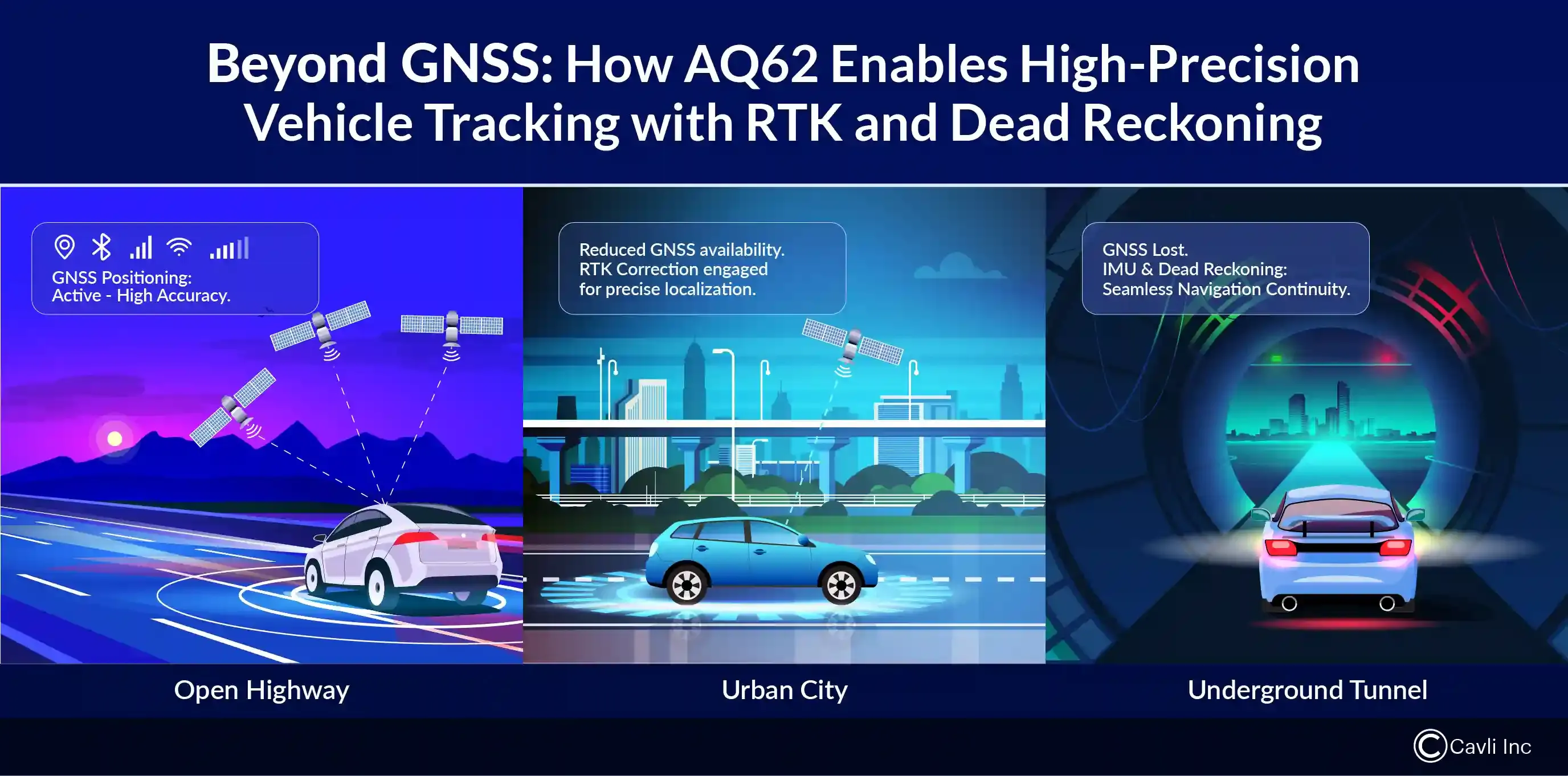
Instead of relying only on satellite signals, AQ62 combines GNSS information with motion data from IMU-based sensing to improve positioning reliability across different driving conditions.
For example, a connected vehicle operating in a dense urban environment may experience temporary GNSS signal degradation due to obstructions such as buildings blocking satellite visibility.
In such scenarios, combining GNSS information with vehicle movement data helps maintain better location awareness.
This multi-layer positioning architecture enables automotive OEMs to develop systems with improved:
- Positioning accuracy
- Location availability
- Operational reliability
- Location continuity
AQ62 Precision Positioning Capabilities for Automotive OEMs
AQ62 is designed to support automotive applications that require reliable and accurate location intelligence.
Modern vehicle platforms increasingly require positioning systems that can operate as part of a larger connected architecture. Instead of treating location as an isolated feature, automotive manufacturers need positioning capabilities that work together with connectivity, computing, and vehicle intelligence systems.
AQ62 supports advanced positioning capabilities through the integration of:
- Multi-constellation GNSS
- Qualcomm Location Suite Gen 9VT support
- Optional L5 GNSS capability
- IMU-based motion tracking
- Optional RTK positioning capability
- Optional Qualcomm Dead Reckoning technology
This combination allows automotive OEMs to develop platforms where location accuracy, availability, and reliability are considered core system capabilities rather than additional features.
AQ62 Automotive Architecture: Combining Connectivity, Compute, and Location Intelligence
Modern connected vehicles require multiple technologies to work together.
An automotive positioning system is no longer limited to a GNSS receiver. It must integrate:
- Communication capability
- Processing capability
- Location intelligence
- Sensor inputs
- Vehicle data interfaces
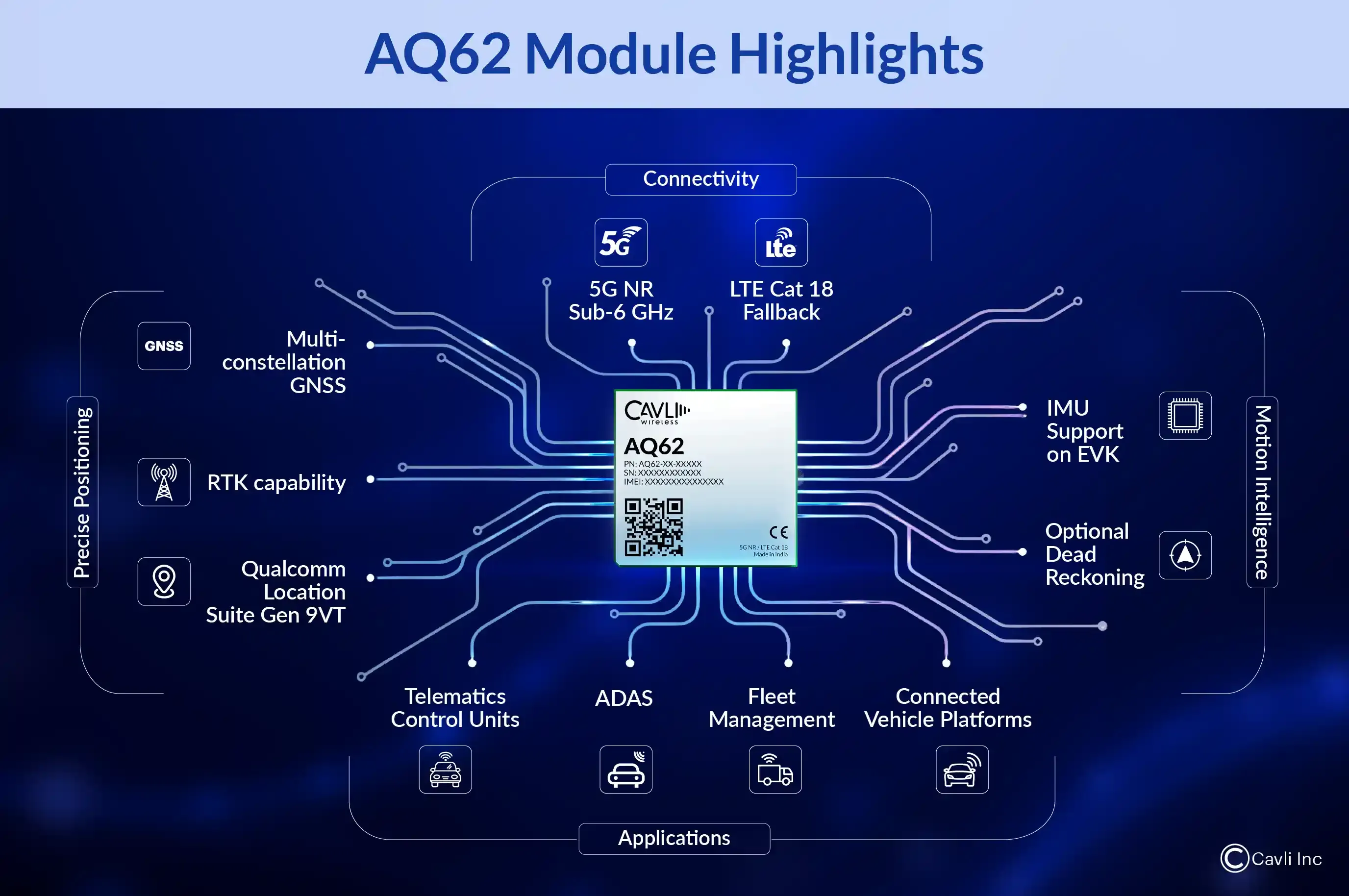
AQ62 combines automotive-grade 5G connectivity, onboard processing, and advanced positioning capabilities into a single platform.
The module integrates:
- 5G NR Sub-6 GHz connectivity
- LTE Cat 18 fallback
- Quad-core Arm Cortex-A55 processing
- Multi-constellation GNSS
- Qualcomm Location Suite Gen 9VT support
- Optional RTK capability
- Optional Qualcomm Dead Reckoning capabilities
By combining communication, computing, and positioning capabilities, AQ62 provides automotive OEMs with a foundation for developing future-ready connected vehicle platforms.
Engineering Benefits of an Integrated Automotive Positioning Module
For automotive OEMs, developing reliable positioning systems traditionally requires integrating multiple components, validating different technologies, and ensuring that each subsystem performs effectively under real-world driving conditions.
A conventional GNSS-only architecture may provide accurate positioning in open environments, but performance can become challenging in areas with poor satellite visibility, including:
- Underground parking facilities
- Dense urban locations
- Tunnels
AQ62 addresses these challenges by combining GNSS with IMU-based motion sensing.
Instead of depending only on satellite signals, the module uses vehicle movement information to provide a more complete understanding of location and motion.
This creates a more robust positioning architecture compared with GNSS-only solutions.
For manufacturers developing advanced automotive solutions, optional RTK support and Qualcomm Dead Reckoning technology provide additional capabilities for applications requiring improved positioning accuracy and continuity.
By integrating advanced positioning capabilities alongside 5G connectivity and onboard computing, AQ62 enables engineering teams to simplify system architecture, streamline validation, and reduce integration complexity.
AQ62 Applications in Connected Vehicle Systems
AQ62 supports a range of automotive applications where reliable positioning and connectivity are required.
Telematics Control Units (TCUs)
Telematics Control Units are central components in connected vehicle architectures.
TCUs collect vehicle information, enable communication services, and support applications such as:
- Remote monitoring
- Fleet operations
- Vehicle diagnostics
- Connected services
AQ62 enables TCUs to collect and process accurate vehicle location data for connected services, remote monitoring, and fleet applications through integrated connectivity, computing, and positioning capabilities.
For TCU developers, integrated positioning capabilities can simplify architecture design by reducing the need to combine separate connectivity and positioning components.
Advanced Driver Assistance Systems (ADAS)
ADAS applications depend on accurate awareness of vehicle position and driving environment.
Accurate positioning can contribute to applications requiring:
- Improved vehicle awareness
- Location intelligence
- Connected driving features
AQ62 supports ADAS-related positioning requirements by combining GNSS, sensor-based motion information, and advanced location technologies.
Fleet Management and Vehicle Tracking Solutions
Fleet operators require reliable vehicle location data across different operating environments.
For commercial fleets, positioning accuracy supports:
- Better vehicle visibility
- Route optimization
- Operational monitoring
- Location-based services
AQ62 enables fleet operators and solution providers to move beyond basic vehicle tracking toward more more connected and data-driven fleet management capabilities.
Connected Vehicle Platforms
Connected vehicle platforms require communication, processing, and location intelligence to work together.
By combining connectivity, compute, and positioning, AQ62 supports the development of next-generation connected mobility solutions.
Applications may include:
- Connected mobility platforms
- Intelligent tracking systems
- Automotive IoT solutions
- Location-based vehicle services
Digital Cockpit and Navigation Systems
Navigation and digital cockpit systems depend on reliable positioning information.
Enhanced positioning capabilities can improve navigation accuracy and enable richer location-based automotive experiences.
Selecting an Automotive Positioning Module: Engineering Considerations
When evaluating an automotive GNSS module or connected vehicle platform, engineering teams should consider more than positioning accuracy alone.
Important evaluation factors include:
Positioning Architecture
Consider whether the application requires:
- Standard GNSS
- Multi-constellation GNSS
- RTK positioning
- IMU integration
- Dead reckoning capability
Connectivity Requirements
Vehicle platforms may require:
- 5G connectivity
- LTE fallback capability
- Regional network support
- Long-term connectivity planning
Computing Requirements
Applications involving edge processing, vehicle intelligence, and connected services may require onboard processing capability.
AQ62 integrates a quad-core Arm Cortex-A55 processor as part of its automotive-grade platform architecture.
Deployment Environment
Positioning requirements can vary depending on:
- Urban vs highway operation
- Fleet vs passenger vehicle applications
- Regional satellite availability
- Data requirements
- Vehicle architecture
Already Using Another Cellular IoT Module?
Evaluate Your Migration Requirements with Cavli
Automotive module migration requires engineering evaluation to ensure hardware, software, and connectivity compatibility.
Replacing an existing cellular IoT module depends on multiple technical factors, including:
- Module form factor
- PCB footprint
- Pin mapping
- Power requirements
- Peak current characteristics
- Host processor interfaces
- AT command compatibility
- Firmware requirements
- GNSS architecture
- Antenna and RF design
- SIM/eSIM/iSIM architecture
- Regional cellular bands
- Certifications
- Carrier requirements
- Device-management architecture
A migration path may be possible after evaluating the existing system architecture and application requirements.
Cavli engineers can help assess:
- Existing hardware architecture
- Connectivity requirements
- Positioning requirements
- Automotive deployment conditions
- Lifecycle management needs
Evaluate Your Migration Requirements with Cavli
Already evaluating a new automotive IoT module? Talk with Cavli experts about your connected vehicle architecture.
Go Beyond and Explore
Why is GNSS alone not sufficient for advanced automotive applications?
How does RTK improve vehicle positioning accuracy?
What role does IMU play in vehicle tracking?
How does Qualcomm Dead Reckoning improve vehicle positioning?
Which automotive applications benefit from AQ62 precision positioning?
Author

Issac Vinu
Associate - Product Marketing