
This blog explores these distinctions in depth, using Cavli Wireless’ C-Series IoT modules as reference points. It provides a practical framework for choosing between Cat 1 and Cat 1bis, helping developers, product managers, and system architects make informed decisions for their IoT deployments.
LTE Cat 1 vs Cat 1bis
LTE Cat 1 and LTE Cat 1bis are cellular IoT technologies designed for moderate data-rate applications. LTE Cat 1 typically uses two receive antennas and supports up to 10 Mbps downlink and 5 Mbps uplink, making it suitable for IoT devices that need reliable connectivity, stronger RF performance, and fallback options. LTE Cat 1bis delivers similar Cat 1-class performance with a single receive antenna, reducing RF complexity, device size, power consumption, and total solution cost for scalable IoT deployments.
- Choose LTE Cat 1 for applications that need stronger RF performance, processing flexibility, and fallback support.
- Choose LTE Cat 1bis for compact, cost-sensitive, power-optimized, and high-volume IoT deployments.
- Main architecture difference: Cat 1 typically uses two receive antennas, while Cat 1bis uses one receive antenna.
As IoT continues to move from pilot projects to large-scale deployments, the importance of selecting the right connectivity technology has never been greater. Connectivity is no longer just a technical decision. It directly impacts device cost, power consumption, scalability, and long-term viability. For many IoT applications that sit between low-bandwidth LPWAN and high-throughput broadband, LTE Cat 1 and Cat 1bis have emerged as highly relevant technologies.
Both Cat 1 and Cat 1bis offer a balanced combination of throughput, coverage, and reliability. They support data rates that are sufficient for most IoT use cases, including telemetry, firmware updates, and moderate data streaming. At the same time, they operate on LTE networks, ensuring better longevity compared to legacy technologies.
However, despite these similarities, Cat 1 and Cat 1bis differ significantly in terms of architecture, power efficiency, hardware complexity, and deployment economics. These differences become especially important when designing devices for scale.
This blog explores these distinctions in depth, using Cavli Wireless’ C-Series IoT modules as reference points. It provides a practical framework for choosing between Cat 1 and Cat 1bis, helping developers, product managers, and system architects make informed decisions for their IoT deployments.
Understanding LTE Cat 1 vs Cat 1bis: Architecture, Performance, and Evolution
What is LTE Cat 1 and Its Role in IoT Connectivity
LTE Cat 1 is a 3GPP LTE user equipment category that has been widely adopted for IoT applications requiring moderate data rates with reliable connectivity. Cat 1 modules typically support up to 10 Mbps downlink and 5 Mbps uplink, making them suitable for applications such as fleet management, telematics, and industrial monitoring.
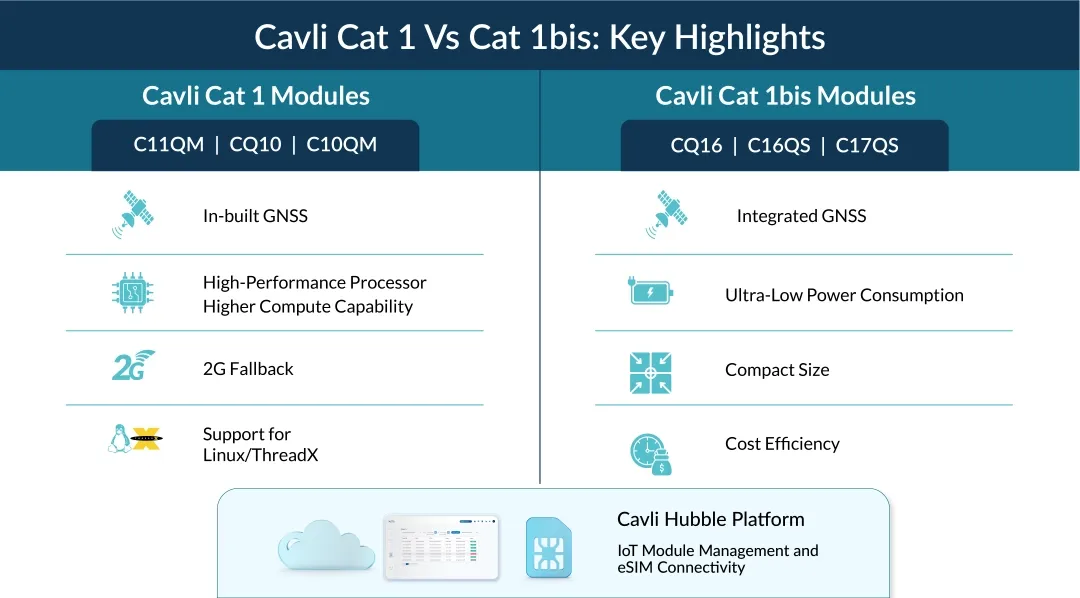
Cavli’s Cat 1 portfolio includes modules such as the C10QM, C11QM, and CQ10. These modules are designed with robust feature sets that include in-built GNSS capabilities, VoLTE, and support for a wide range of internet protocols. The C11QM, for example, integrates GNSS with multi-constellation support and includes 2G fallback, ensuring reliable connectivity even in areas with inconsistent LTE coverage. The C10QM extends functionality further by offering an integrated eSIM powered by the Cavli Hubble platform, enabling global connectivity and remote device management. In addition, it supports a MIPI DBI display interface for efficient communication with a wide range of embedded displays. The CQ10 focuses on a compact design, making it a great choice for space-constrained applications while providing reliable performance and connectivity.
What is LTE Cat 1bis and How It Improves IoT Efficiency
LTE Cat 1bis was designed as an evolution of Cat 1 with a focus on simplifying hardware and reducing cost. While maintaining similar data rate capabilities to Cat 1, Cat 1bis eliminates the need for a second receive antenna. This single-antenna architecture reduces RF complexity and enables more compact, cost-efficient, and energy-efficient IoT device designs.
Cavli’s Cat 1bis lineup includes the C16QS, C17QS, and CQ16 modules. These modules are optimized for modern IoT deployments that prioritize scalability and efficiency. The C16QS is equipped with features such as low-power modes, independent LTE and GNSS power domains, and edge-based GNSS processing, making it ideal for tracking and metering applications. The C17QS builds on this foundation with additional capabilities, including Wi-Fi scanning, enabling more advanced device intelligence in a compact footprint. Wi-Fi scanning allows the module to detect and analyze nearby access points without establishing a full connection, capturing parameters such as SSID, BSSID, signal strength (RSSI), and channel information, which can be leveraged for enhanced positioning in GNSS-challenged environments, context awareness, geofencing, and presence detection. The module also enables low-power operation by avoiding continuous connectivity while still supporting edge-based decision-making for faster, more efficient IoT deployments. The CQ16 focuses on ultra-compact design and power efficiency, offering features such as dual-SIM support and a significantly reduced module size for space-constrained applications.
Key Differences Between Cat 1 and Cat 1bis for IoT Deployments
While both technologies deliver similar throughput, Cat 1 focuses on performance and backward compatibility, whereas Cat 1bis is optimized for cost efficiency, power savings, and future-ready deployments.
LTE Cat 1 vs Cat 1bis Technical Comparison
| Factor | LTE Cat 1 | LTE Cat 1bis |
|---|---|---|
| Antenna architecture | Typically uses two receive antennas | Uses one receive antenna |
| Peak data rate | Up to 10 Mbps downlink and 5 Mbps uplink | Similar Cat 1-class data rates |
| RF design complexity | Higher RF and antenna design complexity | Lower RF complexity and simpler device integration |
| Power and device size | Better suited for feature-rich devices with higher processing needs | Better suited for compact and power-optimized IoT devices |
| Deployment economics | Useful where RF performance, fallback, and compute flexibility matter more | Useful where cost, scale, size, and power efficiency matter more |
| Typical use cases | Fleet management, telematics, industrial gateways, richer embedded applications | Asset tracking, smart metering, POS terminals, wearables, remote monitoring, compact sensors |
| Cavli module examples | C10QM, C11QM, CQ10 | C16QS, C17QS, CQ16 |
Engineering Considerations: Cat 1 vs Cat 1bis Hardware, Power, and System Design
Processing Capability and System Architecture Trade-offs
From an engineering standpoint, the differences between Cat 1 and Cat 1bis directly influence hardware design, system architecture, and firmware complexity. Processing capability highlights a key trade-off between performance and power efficiency. Cat 1 modules prioritize compute flexibility and application complexity, leveraging higher-performance processors such as ARM Cortex-A7 and operating systems like Yocto Linux or ThreadX. This allows them to support richer applications, multitasking, and edge computing workloads, but at the cost of higher power consumption and greater system overhead. In contrast, Cat 1bis modules are designed for optimal power consumption, typically built around microcontroller-class processors such as ARM Cortex-M3 and running lightweight RTOS environments like FreeRTOS. This architecture enables lower memory usage, faster boot times, and highly deterministic behavior, making Cat 1bis an excellent choice for energy-constrained, always-on embedded IoT applications, albeit with limited compute capabilities.
Power Consumption Comparison: Cat 1 vs Cat 1bis
Power consumption is where Cat 1bis clearly demonstrates an advantage. Cat 1 IoT modules, due to their more powerful processors, typically consume more power during operation and in idle states. Cat 1bis IoT modules in contrast are designed with advanced power-saving features, including deep sleep and extended discontinuous reception modes, which enable them to have extremely low power consumption in standby conditions. This makes Cat 1bis modules particularly suitable for battery-powered devices that need to operate for extended periods without maintenance.
Network Compatibility and Coverage Considerations
Another important engineering factor is network compatibility. Cat 1 modules support 2G fallback, which can be critical in regions where LTE coverage is not yet ubiquitous. This adds a layer of reliability but also increases design complexity. Cat 1bis modules are LTE-only, which simplifies design but requires confidence in LTE network availability.
Real-World Applications: When to Choose Cat 1 vs Cat 1bis in IoT
Cost Efficiency and Scalability in Large IoT Deployments
When moving from engineering design to real-world deployment, the choice between Cat 1 and Cat 1bis directly shapes cost structures, operational efficiency, scalability, and development complexity, while also aligning closely with specific application needs.
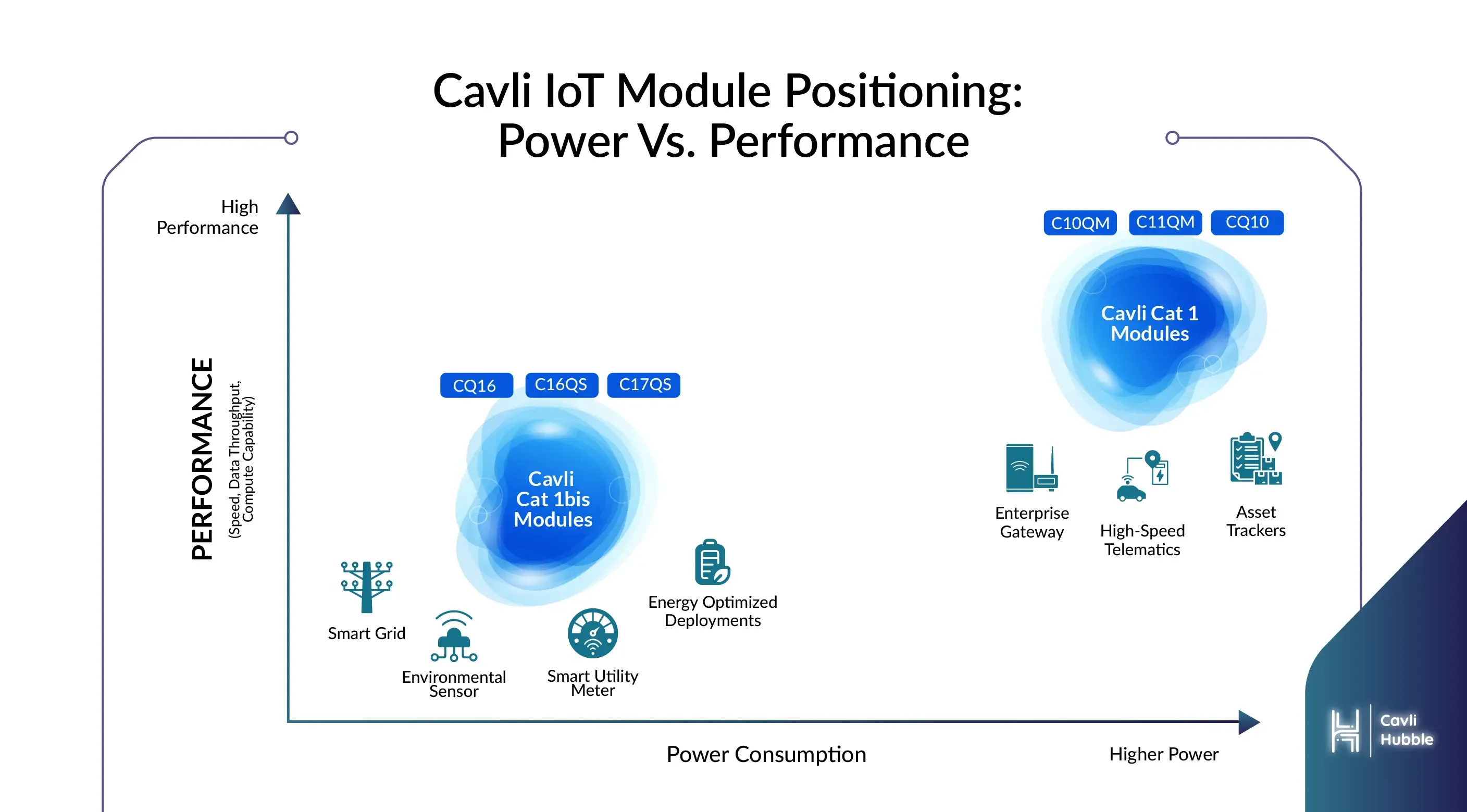
In large-scale deployments such as smart metering, logistics tracking, and remote monitoring networks, Cat 1bis modules provide a strong advantage. Their single-antenna architecture and simplified hardware reduce the bill of materials, which becomes highly impactful when deploying thousands or millions of devices, turning small per-unit savings into substantial overall cost reductions. These benefits extend to battery-powered applications like asset tracking and wearable devices, where lower power consumption enables longer battery life and reduces maintenance frequency, especially in remote or hard-to-access environments. Cat 1bis also enables more compact and flexible product designs, making it well-suited for portable healthcare devices, smart sensors, and POS terminals where space and efficiency are critical.
Remote Monitoring and Low-Power IoT Use Cases
Remote monitoring systems further highlight the strengths of Cat 1bis, as they typically involve transmitting small amounts of data at regular intervals. In such scenarios, the reduced power consumption and lower cost make it easier to scale deployments without significantly increasing operational overhead. This makes Cat 1bis a natural fit for modern IoT use cases that prioritize efficiency, cost-effectiveness, and long-term scalability.
High-Performance IoT Applications Where Cat 1 Excels
At the same time, Cat 1 modules remain the better fit for scenarios that demand higher processing capability and robust connectivity across varying network conditions. Applications such as fleet management, industrial gateways, and telematics systems often operate across regions with inconsistent LTE coverage, where 2G fallback ensures uninterrupted operation. These applications also benefit from higher compute performance, enabling support for complex workloads, richer user interfaces, and integration with multiple subsystems.
Flexible Deployment Strategies with Cavli C-Series Modules
A key real-world consideration is flexibility and the ability to adapt deployments over time. Cavli’s C-Series portfolio addresses this through pin-compatible designs, such as the Cavli C11QM and Cavli C17QS, allowing developers to switch between Cat 1 and Cat 1bis with minimal hardware redesign. This supports a phased deployment strategy where devices can initially use Cat 1 for broader coverage and later transition to Cat 1bis for cost and power optimization. It also enables regional customization without requiring entirely new hardware platforms, reducing development time and simplifying supply chain management.
Development Complexity and Firmware Optimization
From an engineering standpoint, these choices introduce important design trade-offs. Cat 1 development involves managing higher power consumption, more complex software stacks, and greater system resource requirements, but provides flexibility for advanced features and edge computing. In contrast, Cat 1bis development requires tighter optimization around processing, memory, and firmware design, often within RTOS environments, which can limit application complexity but delivers faster boot times, lower energy usage, and more predictable performance.
Device Management and Connectivity with Cavli Hubble Platform
Finally, integration with the Cavli Hubble platform provides a unified approach to connectivity management across both module types, enabling remote provisioning, diagnostics, and lifecycle management. This reduces operational complexity and ensures that both Cat 1 and Cat 1bis deployments can be managed efficiently at scale.
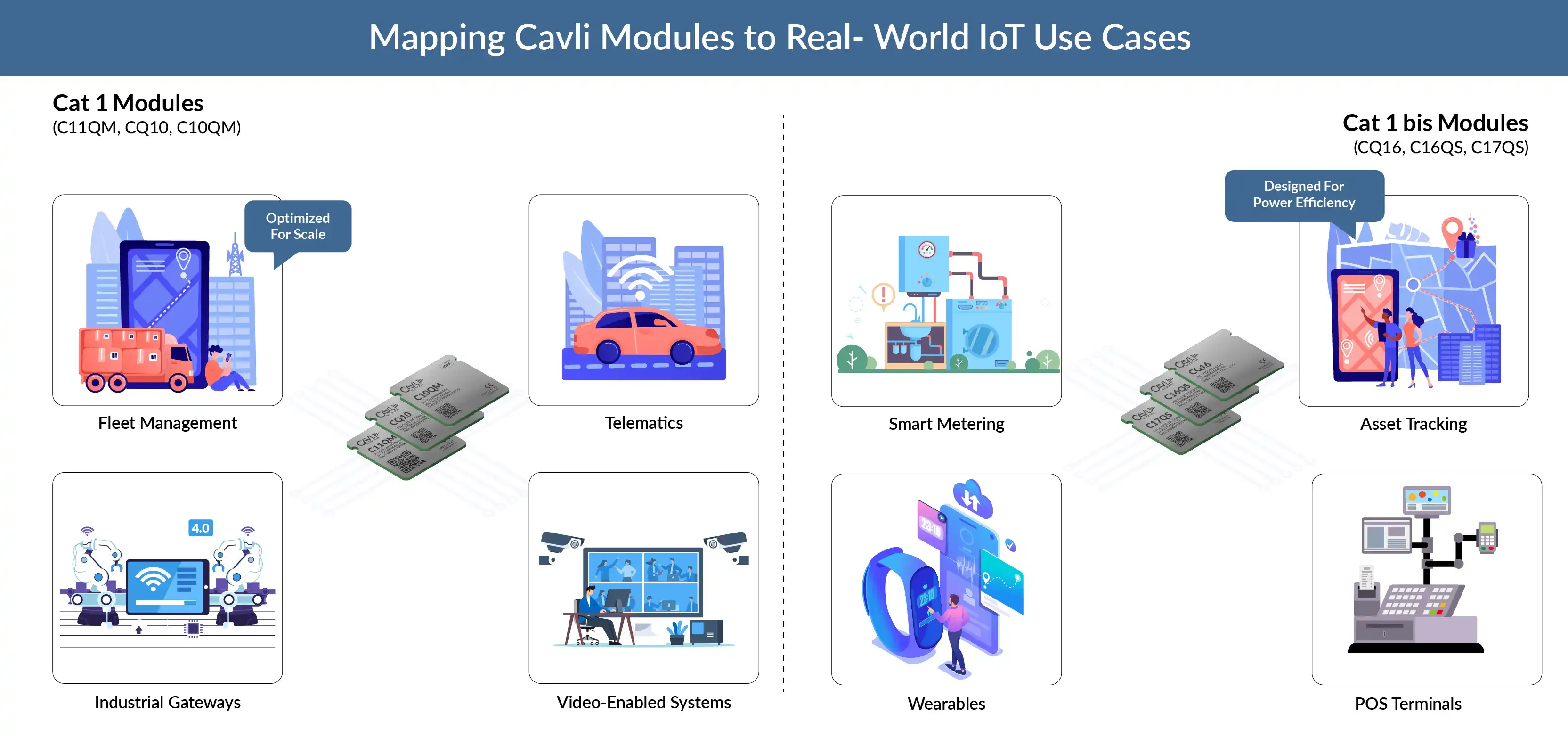
Decision Matrix: When to Choose LTE Cat 1 or Cat 1bis
Choose LTE Cat 1 when:
- The device operates in regions with inconsistent LTE coverage.
- The application needs stronger RF performance or receive diversity.
- The product requires higher processing flexibility or richer application support.
- The deployment involves fleet management, industrial gateways, telematics, or advanced embedded applications.
Choose LTE Cat 1bis when:
- The device must be compact, cost-efficient, and power-optimized.
- The product design benefits from a single-antenna architecture.
- The deployment involves large fleets of IoT devices.
- The use case includes asset tracking, smart metering, POS terminals, wearables, compact sensors, or remote monitoring.
Evaluating LTE Cat 1 and Cat 1bis for Your IoT Product?
Cavli C-Series modules support different LTE Cat 1 and Cat 1bis deployment needs across connectivity, form factor, power, fallback, GNSS, eSIM, and device management requirements.
View Cavli LTE Cat 1 Modules | View Cavli LTE Cat 1bis Modules
Conclusion
Cat 1 and Cat 1bis both play important roles in the IoT connectivity landscape, offering reliable LTE-based communication for a wide range of applications. While Cat 1 provides advantages in terms of processing capability and legacy network support, Cat 1bis represents a power efficient and cost effective approach that aligns with the needs of modern IoT deployments.
With its single antenna architecture, lower power consumption, and reduced hardware complexity, Cat 1bis enables cost-effective and scalable solutions without compromising on performance. As global networks continue to phase out 2G and 3G technologies, Cat 1bis is well positioned to become the default choice for new deployments.
Cavli Wireless offers a comprehensive portfolio that spans both Cat 1 and Cat 1bis, giving developers the flexibility to choose the right technology for their specific use case while maintaining a clear path for future migration. For organizations looking to build scalable, future-ready IoT solutions, Cat 1bis offers a compelling balance of performance, efficiency, and long-term viability.
For OEMs evaluating LTE Cat 1 vs Cat 1bis modules, the right choice depends on antenna architecture, power budget, RF conditions, fallback requirements, processing needs, device size, and long-term deployment strategy.
Go Beyond and Explore
What is the main difference between LTE Cat 1 and Cat 1bis?
What is LTE Cat 1 used for in IoT?
What is LTE Cat 1bis used for in IoT?
Does LTE Cat 1bis use one antenna?
Is LTE Cat 1bis always better than LTE Cat 1?
Which Cavli modules support LTE Cat 1 and Cat 1bis?
Author

Issac Vinu
Associate - Product Marketing