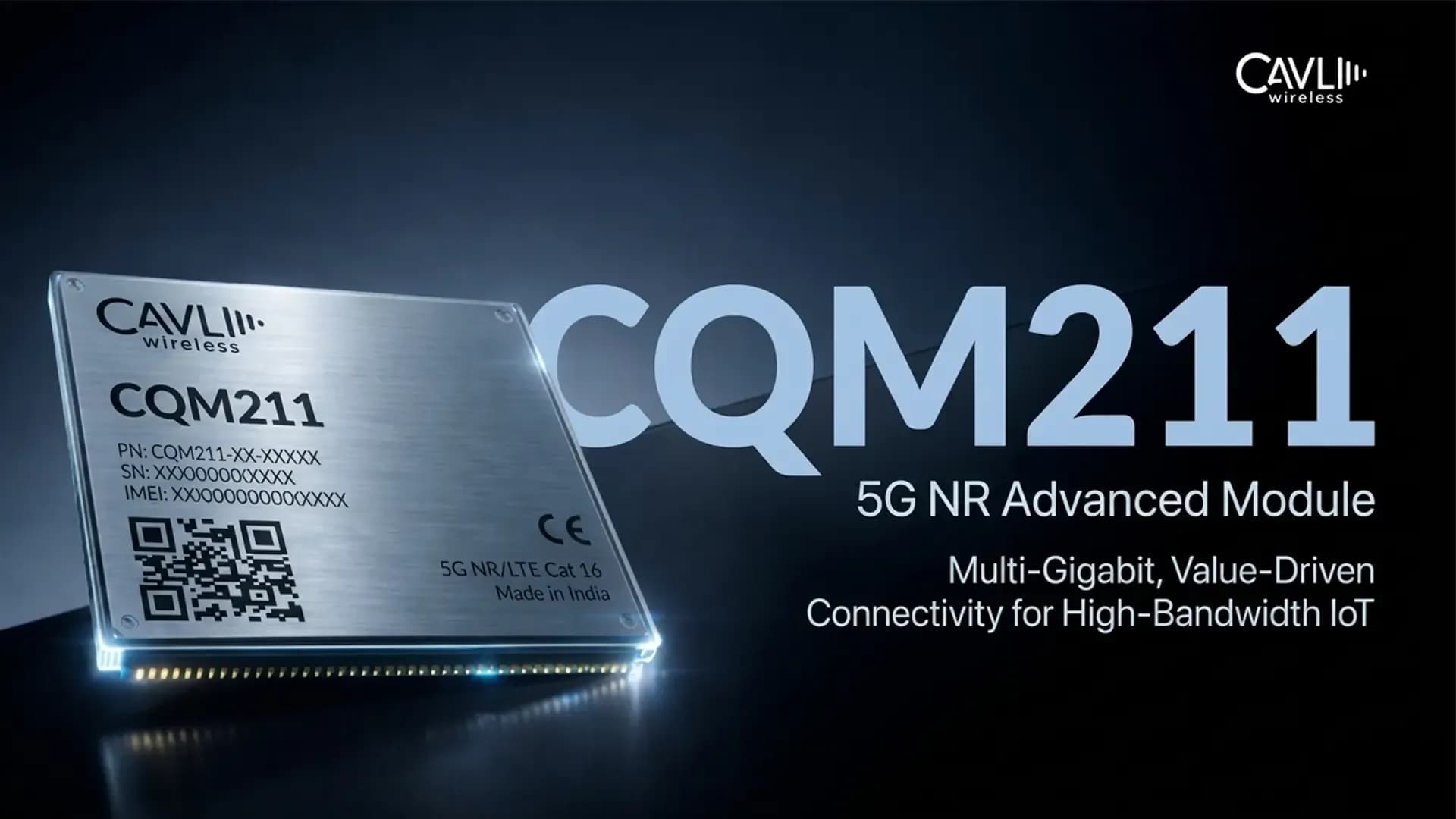

The Internet of Things (IoT) is transforming industries with automation, operational efficiency, and data-driven insights. Seamless connectivity and accurate location awareness are critical for unlocking the full potential of connected devices, especially in indoor environments where traditional positioning solutions may face limitations. Cavli’s upgraded LTE Cat 1bis module, the C16QS, introduces advanced WiFi scanning capabilities, offering a cost-effective and energy-efficient solution for location-aware IoT applications. This blog explores how C16QS enhances IoT deployments, its technical capabilities, and the practical benefits it delivers for developers and end users.
Why Choose C16QS for IoT Connectivity?
Cavli’s C16QS module, built on the Qualcomm QCX217 chipset, combines reliable LTE Cat 1bis connectivity with advanced WiFi scanning capabilities, making it ideal for low-power IoT applications.
By leveraging existing WiFi infrastructure, C16QS enables location awareness in GPS-challenging environments while reducing dependence on power-intensive positioning technologies. This makes it suitable for battery-powered devices requiring long operational life, reliable connectivity, and efficient data communication.
Key Features of C16QS Cellular IoT Module
C16QS:
Processor: Cortex M3 up to 204 MHz.
Memory: 1.25MB RAM, 4MB Flash.
Connectivity: Integrated eSIM option for seamless cellular connectivity.
Location: L1 GNSS support for basic positioning requirements.
Power Efficiency: Designed for low-power IoT deployments with optimized energy consumption.
Use Case: Ideal for cost-sensitive IoT applications requiring reliable connectivity and location awareness.
Powered by Qualcomm’s proven QCX217 chipset, C16QS delivers dependable performance for a wide range of IoT applications, including asset tracking, smart logistics, industrial monitoring, and connected devices.
Understanding WiFi Scanning in IoT Modules
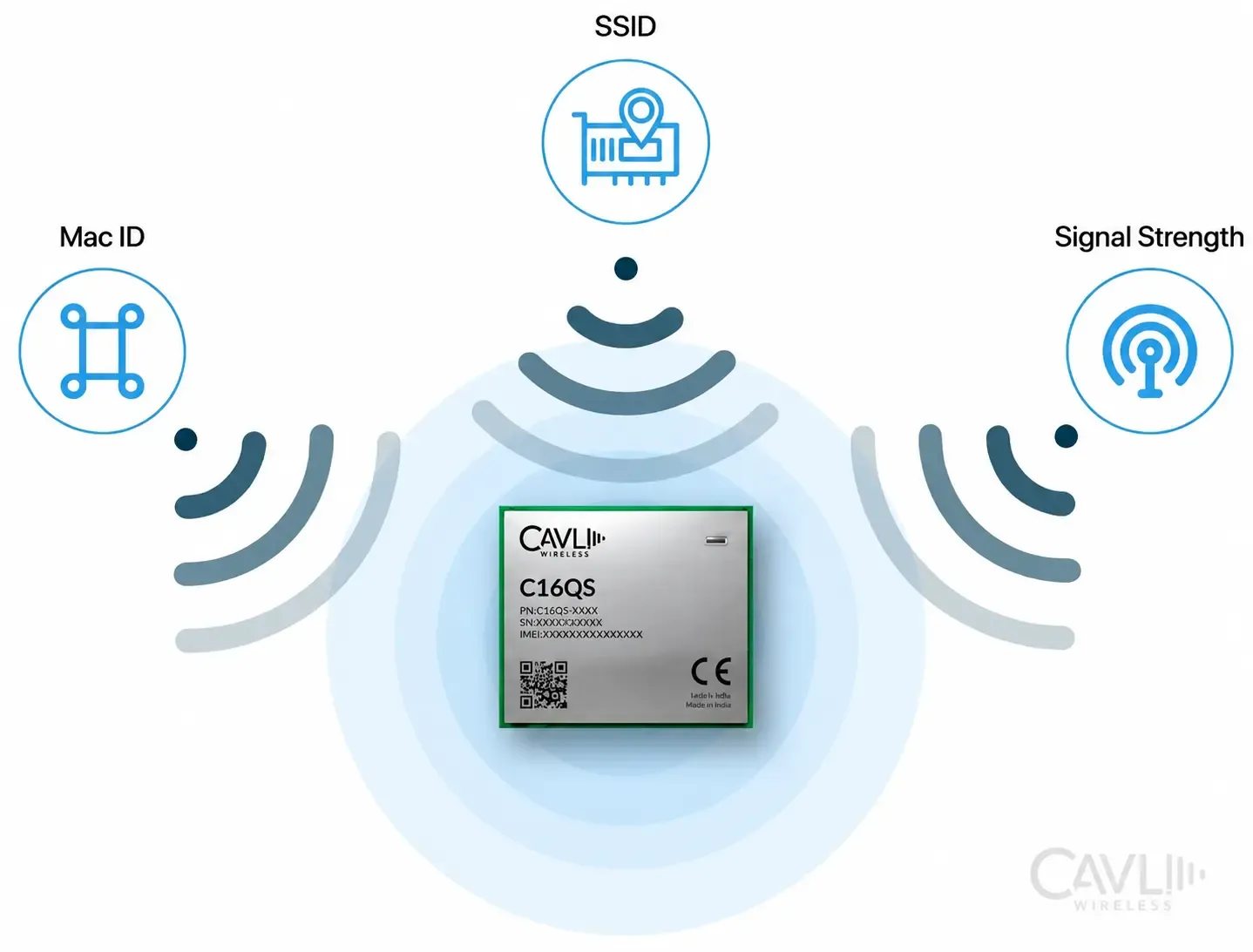
WiFi scanning enables IoT devices to passively detect nearby WiFi access points by collecting information such as SSID and signal strength. By analyzing signals from multiple access points, C16QS can estimate device location, providing a power-efficient alternative for indoor and urban positioning scenarios.
This capability is particularly valuable for battery-powered IoT devices where continuous GPS usage can significantly impact operational life.
Benefits of WiFi Scanning:
Indoor Location Accuracy:
Enables location awareness in GPS-limited environments such as warehouses, hospitals, and manufacturing facilities.
Energy Efficiency:
Consumes less power compared to traditional GPS-based tracking methods, helping extend device battery life.
Cost-Effective Deployment:
Uses existing WiFi infrastructure, reducing the need for additional positioning hardware.
Engineering Benefits for OEMs
Integrating WiFi scanning into the C16QS module simplifies IoT product development. By eliminating the need for separate WiFi positioning hardware, OEMs can reduce Bill of Materials (BOM) costs, lower power consumption, and accelerate product development cycles.
C16QS allows developers to leverage existing WiFi networks for indoor positioning applications without requiring dedicated infrastructure such as Ultra-Wideband systems or additional beacon deployments.
Example Use Case: Smart Logistics Tracking
For logistics tracking solutions, OEMs can use C16QS to enable location awareness across warehouses and distribution centers without additional positioning hardware.
The module collects WiFi access point information and enables real-time location updates, helping businesses improve asset visibility, simplify deployment, and reduce operational complexity.
Technical Advantages:
Simplified Integration:
No additional positioning hardware or dedicated transceivers are required.
Reduced BOM Costs:
Integrated WiFi scanning capabilities minimize hardware requirements.
Faster Development:
Accessible WiFi positioning data enables quicker development of location-based IoT applications.
Practical Implications for End Users
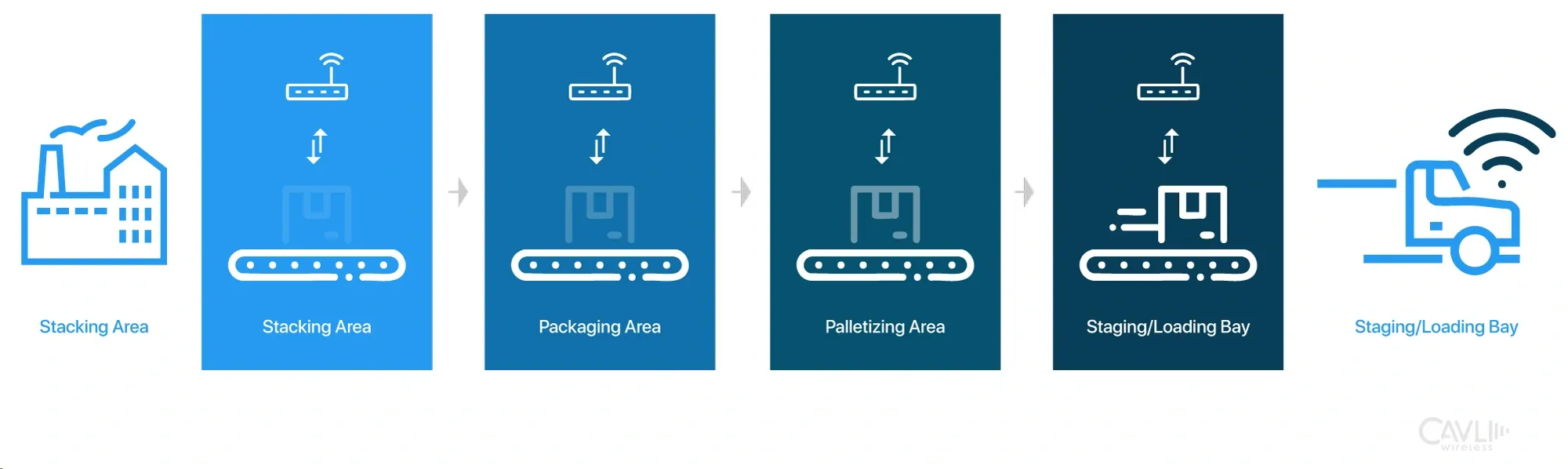
WiFi scanning enhances operational efficiency across real-world IoT deployments. In warehouse environments, C16QS-enabled devices can track valuable assets throughout different stages of movement by detecting nearby WiFi access points.
This information can integrate with warehouse management systems to provide real-time visibility, improve inventory accuracy, and optimize operational workflows.
Real-World Example: Warehouse Asset Tracking
A high-value package equipped with a C16QS module moves through a warehouse facility. As it passes different WiFi access points, the module identifies its approximate location and updates the management system.
This improves asset visibility, accelerates fulfillment processes, and enables smarter inventory management across logistics, manufacturing, and healthcare environments.
End-User Benefits:
Real-Time Tracking:
Improves asset visibility with location-based insights.
Operational Efficiency:
Automates tracking processes and reduces manual intervention.
Versatility:
Supports applications across industries including logistics, healthcare, manufacturing, and industrial IoT.
Conclusion: The Future of Location-Aware IoT
Cavli’s C16QS LTE Cat 1bis module with integrated WiFi scanning enables developers to build cost-effective, power-efficient, and location-aware IoT solutions.
By simplifying hardware design, reducing deployment costs, and enabling efficient indoor tracking capabilities, C16QS helps businesses accelerate the adoption of connected solutions across industries.
As IoT continues to evolve, Cavli remains committed to delivering reliable connectivity solutions powered by advanced technology and industry-leading expertise.
Go Beyond and Explore
How does C16QS enable location-aware IoT applications?
What is WiFi scanning in the C16QS module, and how does it work?
Why is C16QS WiFi scanning useful for indoor IoT applications?
How does C16QS help OEMs simplify IoT product development?
How can C16QS support warehouse asset tracking applications?
Author

Soorya Kumar A
Sr. Associate- Product Marketing
Cavli Wireless