
Customer Premises Equipment (CPE) refers to networking or communication equipment installed at a customer location to connect the local network to an internet, telecom, private LTE/5G, or enterprise WAN service. In networking, CPE commonly includes routers, modems, gateways, firewalls, Wi-Fi access points, fixed wireless access devices, and cellular CPE routers.
CPE sits at the boundary between service provider networks and user environments, shaping how connectivity, security, and services are delivered at the edge. As networks evolve toward private LTE/5G, cloud-native architectures, and virtualized services, the role of CPE has expanded far beyond basic access devices. This guide explains what CPE is, how it works, and how modern CPE architectures support today’s private and enterprise networks.
What Is CPE in Networking? Customer Premises Equipment Explained
CPE stands for Customer Premises Equipment. In networking and telecom, CPE is the device or group of devices located at the customer site that connects the local area network (LAN) to a service provider, internet, private LTE/5G, or enterprise wide area network (WAN).
Common CPE devices include routers, modems, gateways, ONTs, firewalls, Wi-Fi access points, SD-WAN appliances, 4G/5G CPE routers, and industrial IoT gateways.
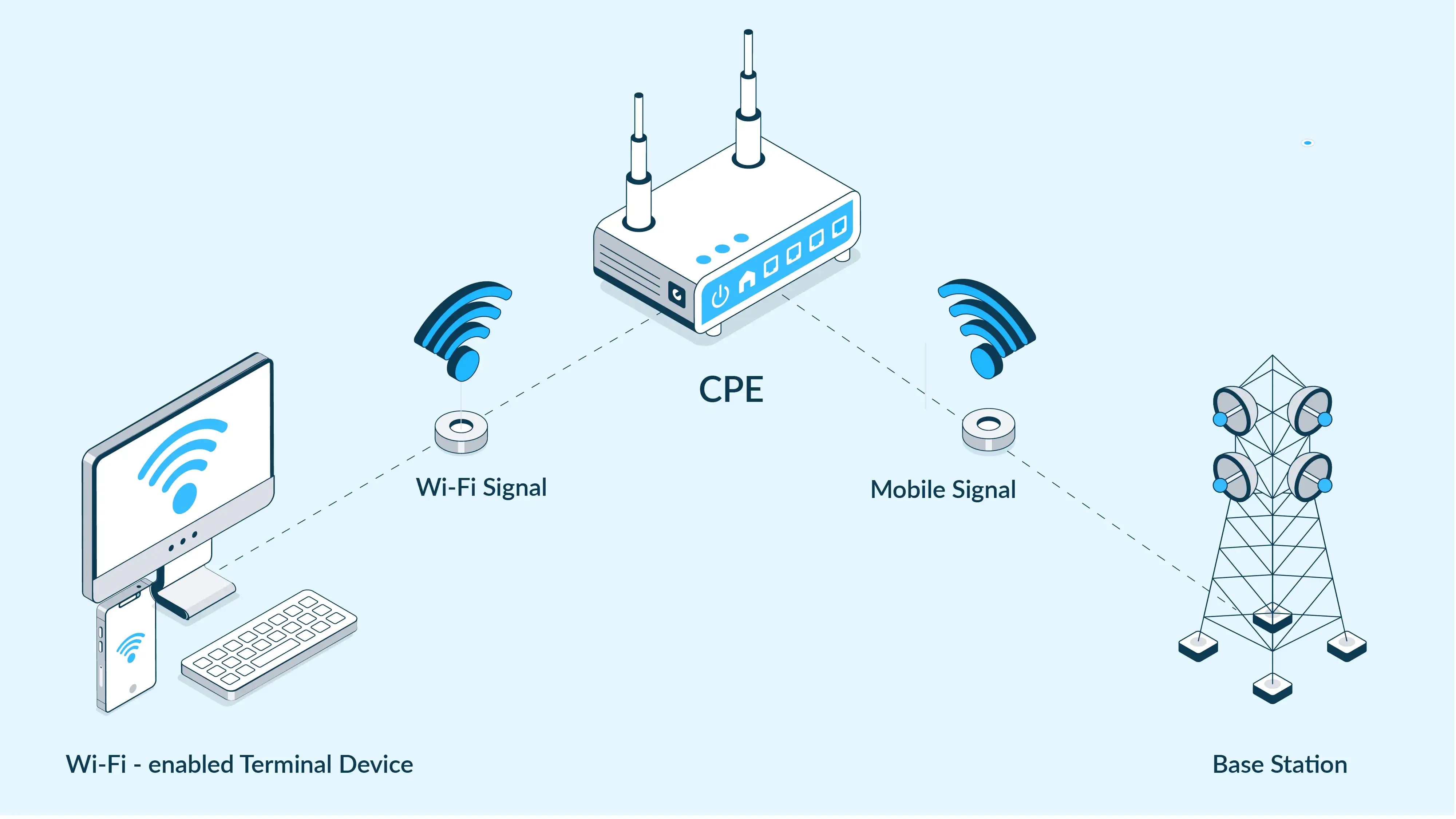
Customer Premises Equipment connectivity is established through the demarcation point in the carrier’s network infrastructure. The demarcation point, or “demarc,” is the physical boundary between the service provider’s wider internet or private network and the customer-owned network. It defines the exact point of responsibility for maintenance, troubleshooting, and repairs for CPE routers and other devices.
In networking, CPE plays a critical role by providing last-mile connectivity and bridging the service provider’s wide area network (WAN) with the user’s local area network (LAN). It enables customer devices to access services delivered over broadband technologies such as fiber, cable, and DSL, as well as cellular networks like 4G and 5G. In private LTE and private 5G deployments, CPE also acts as the customer-side gateway for secure enterprise and industrial connectivity.
CPE Network Meaning: Key Terms Explained
| Term | Simple Meaning |
|---|---|
| CPE | Customer Premises Equipment installed at the customer site. |
| CPE device | A router, modem, gateway, firewall, ONT, 4G/5G router, or other customer-site network device. |
| CPE network | The customer-side network equipment that connects local devices to an ISP, telecom, private LTE/5G, or enterprise WAN service. |
| CPE internet | CPE used to deliver internet access to homes, offices, branches, factories, or remote sites. |
| Cellular CPE | CPE that uses LTE, 5G RedCap, or 5G NR connectivity instead of, or alongside, wired broadband. |
Examples of Customer Premises Equipment (CPE Devices)
Customer Premises Equipment can include many types of customer-site networking, communication, security, media, cellular, and IoT devices. The table below shows common CPE examples, what they do, and where they are used.
| CPE Category | Typical Examples | What It Does | Where It’s Used |
|---|---|---|---|
| Modems & Gateways | DSL, Cable, FTTH modems, cellular gateways | Terminates the service provider’s access network and converts it into usable IP connectivity | Homes, offices, industrial sites |
| Networking Equipment | Routers, switches, Wi-Fi access points | Distributes and manages connectivity inside a customer site | Homes, enterprises, campuses, and factories |
| Telephony Devices | IP phones, ATAs, PBX systems | Enables VoIP calling and voice services over IP networks | Offices, call centers, enterprises |
| Media & Entertainment Devices | Set-top boxes, satellite receivers | Decodes and delivers broadcast or streamed multimedia content | Homes, hotels, hospitality |
| Wireless / Mobile CPE | 4G/5G routers, hotspots | Provides cellular-based internet access where wired broadband CPE is unavailable or impractical | Homes, branch offices, temporary sites |
| Security & Specialized CPE | Firewalls, SD-WAN CPE, SASE devices | Enforces network security, VPN, and traffic optimization | Branch offices, retail stores, enterprise edges |
| Fixed Wireless Access (FWA) CPE | Indoor & outdoor cellular broadband terminals | Replaces or complements wired broadband CPE using cellular networks | Homes, rural broadband, businesses |
| Edge Computing / AI CPE | Edge gateways, AI gateways | Processes data locally for analytics, AI inference, and control | Industrial, retail, smart cities |
| IoT Gateways | Multi-protocol industrial gateways | Aggregates sensors and machines and connects them to cloud or enterprise platforms | Industrial IoT, utilities, infrastructure |
| Private LTE/5G Network Gateways | Enterprise cellular gateways | Connects devices to private cellular networks | Factories, ports, mines, campuses |
| Virtual / Cloud-Managed CPE (vCPE) | White-box CPE, virtualized edge devices | Runs networking and security functions as centrally orchestrated software | Service providers, enterprises |
| Smart Home Hubs | Home automation hubs | Manages lighting, HVAC, security, and appliances | Residential environments |
| EV & Energy Communication Gateways | EV charger controllers, smart meter gateways | Connects energy assets to utility or cloud platforms | EV charging, smart grid, renewables |
Types of Customer Premises Equipment (CPE): Residential, Enterprise, Industrial, Indoor, Outdoor, Fixed-Line, and Cellular
In modern networks, Customer Premises Equipment (CPE) is commonly categorized along three fundamental dimensions:
- Target environment – who the CPE is designed for
- Installation location – where the device is deployed
- Access technology – how the device connects to the network
Understanding these classifications helps OEMs, service providers, and enterprises select the right CPE architecture for performance, reliability, and cost.
Residential CPE
Residential CPE refers to consumer-grade devices designed to provide internet access and basic networking inside homes and apartments. It is primarily used for broadband access, streaming, online gaming, and smart home connectivity. Typical examples of residential CPE include:
- Home routers
- Cable or fiber gateways
- Wi-Fi extenders
- Set-top boxes
Enterprise CPE
Enterprise CPE is designed for business environments that require higher throughput, stronger security, and centralized management. These devices often support advanced routing, firewalling, VPN, and SD-WAN capabilities. Enterprise CPE is commonly deployed in offices, retail chains, branch locations, and campuses.
Industrial CPE
Industrial CPE is designed for harsh and mission-critical environments. These devices feature rugged enclosures, wide operating temperature ranges, long product lifecycles, and industrial interfaces such as RS-485, CAN, and digital I/O. Industrial CPE is widely used in factories, utilities, transportation systems, oil and gas facilities, and smart infrastructure.
Indoor CPE vs Outdoor CPE
Indoor CPE
Indoor CPE is installed inside buildings and is typically compact and aesthetically designed. These devices often rely on internal or small external antennas and are powered from standard AC outlets. Indoor CPE is used in homes, offices, shops, hotels, and control rooms where environmental exposure is limited.
Outdoor CPE
Outdoor CPE is deployed externally on walls, rooftops, or poles and is built with weatherproof, IP-rated enclosures. These devices usually integrate high-gain directional antennas and are optimized for maintaining reliable connectivity over longer distances. Outdoor CPE is widely used in rural broadband deployments, industrial campuses, warehouses, ports, mining sites, and remote facilities where indoor signal strength may be insufficient.
Fixed-Line CPE vs Cellular CPE
Fixed-Line CPE
Fixed-line CPE connects to service providers using wired access technologies such as fiber, cable, DSL, or Ethernet. These devices typically deliver high and consistent throughput with low latency. Fixed-line CPE is commonly used in locations with wired broadband CPE, including residential buildings, offices, and data-centric enterprise sites.
Cellular CPE
Cellular CPE uses mobile networks such as LTE, LTE Cat-1/LTE Cat-4, and 5G to provide connectivity. These devices enable fast deployment without physical cabling and support both primary and backup connectivity models. Cellular CPE is widely used for fixed wireless access (FWA), temporary sites, mobile assets, rural broadband, IoT gateways, and business continuity applications.
Core Functions of CPE
Network access, routing and traffic forwarding, local network distribution, security and threat protection, device and network management, edge processing, and redundancy/failover are integrated to enable a CPE to function as a unified edge gateway rather than a single-purpose device. Here are the core functions of a CPE from a deployment perspective.
Network Access & Termination
CPE terminates the access network (fiber, cable, DSL, LTE, or 5G) and converts it into IP connectivity usable by local devices. This function ensures reliable last-mile connectivity and determines baseline bandwidth, latency, and coverage.
Routing & Traffic Forwarding
CPE routes data between the wide-area network (WAN) and the local-area network (LAN), directing traffic to the correct destinations. Its capabilities include IP routing and NAT, LAN/WAN bridging, and VLAN segmentation. It allows multiple devices and applications to share a single network connection efficiently.
Local Network Distribution
Most CPE devices distribute connectivity via Ethernet ports, Wi-Fi, or both. They enable laptops, sensors, cameras, POS terminals, and other endpoints to connect through a single gateway.
Security & Threat Protection
Modern CPE integrates essential security features to protect data and devices. Common functions include firewall and packet filtering, VPN tunnels (IPsec / SSL), and intrusion detection/prevention (in advanced models). It prevents unauthorized access and protects sensitive data flow between the site and the cloud.
Device & Network Management
CPE supports local and remote configuration, monitoring, and diagnostics. This includes remote provisioning, performance monitoring, logging and alerts, firmware, and software updates. It reduces on-site maintenance and enables large-scale fleet management.
Protocol Translation & Aggregation
Many CPE platforms translate between industrial or IoT protocols and IP networks, allowing legacy devices and field equipment to connect to modern cloud platforms.
Edge Processing in Advanced CPE
Some CPE devices include compute resources to process data locally. Key functions include data filtering and normalization, local analytics, AI inference, and application hosting. It reduces latency, lowers bandwidth usage, and enables faster decision-making.
Redundancy & Failover
CPE can support multiple WAN links (fiber + cellular) and automatically switch when one fails, maintaining continuous connectivity for business-critical operations.
CPE vs Router vs Modem vs Gateway
A router, modem, or gateway can be a type of CPE, but CPE is the broader category. CPE refers to the equipment located at the customer premises, while a router routes traffic, a modem terminates an access connection, and a gateway combines multiple network functions in one device.
| Aspect | Customer Premises Equipment CPE | Gateway | Router | Modem |
|---|---|---|---|---|
| Definition | A broad category covering any device installed at a customer site to connect to a service provider’s network | A multi-function device combining a modem, router, and often additional services | A device that routes traffic between networks | A device that converts ISP access signals into usable digital data |
| Primary role | Acts as the customer-side network endpoint | Provides end-to-end connectivity and network control | Directs traffic between the WAN and the LAN | Terminates access network (DSL, cable, fiber, cellular) |
| Wi-Fi Capability | Yes | Yes | Sometimes | No |
| Security Capabilities | May include firewall, VPN, IDS/IPS | Firewall, VPN, NAT, filtering | Basic firewall (varies) | None |
| Protocol translation support | Often (especially in industrial/IoT CPE) | Yes (LAN ↔ WAN, sometimes IoT protocols ↔ IP) | No | No |
| Typical examples | Cellular router, fiber gateway, industrial IoT gateway, SD-WAN CPE | Home broadband gateway, industrial gateway, enterprise edge gateway | Home router, enterprise router | Cable modem, DSL modem, fiber ONT, cellular modem |
| Relationship to CPE | Umbrella category | A type of CPE | Component device | Component device |
CPE Network Architecture: How CPE Works
At the foundation of a cellular CPE sits the cellular modem or module, which establishes the radio link to the mobile network and defines supported bands, bandwidth, and peak data rates.
On top of the modem layer sits the routing and security layer, responsible for packet forwarding, NAT, firewalling, and VPN termination.
Above the routing layer is the local distribution layer, typically Wi-Fi and Ethernet, which delivers connectivity to user devices inside the premises.
Over the entire system sits the cloud management layer, enabling remote provisioning, monitoring, firmware updates, and policy control across large fleets of CPE devices.
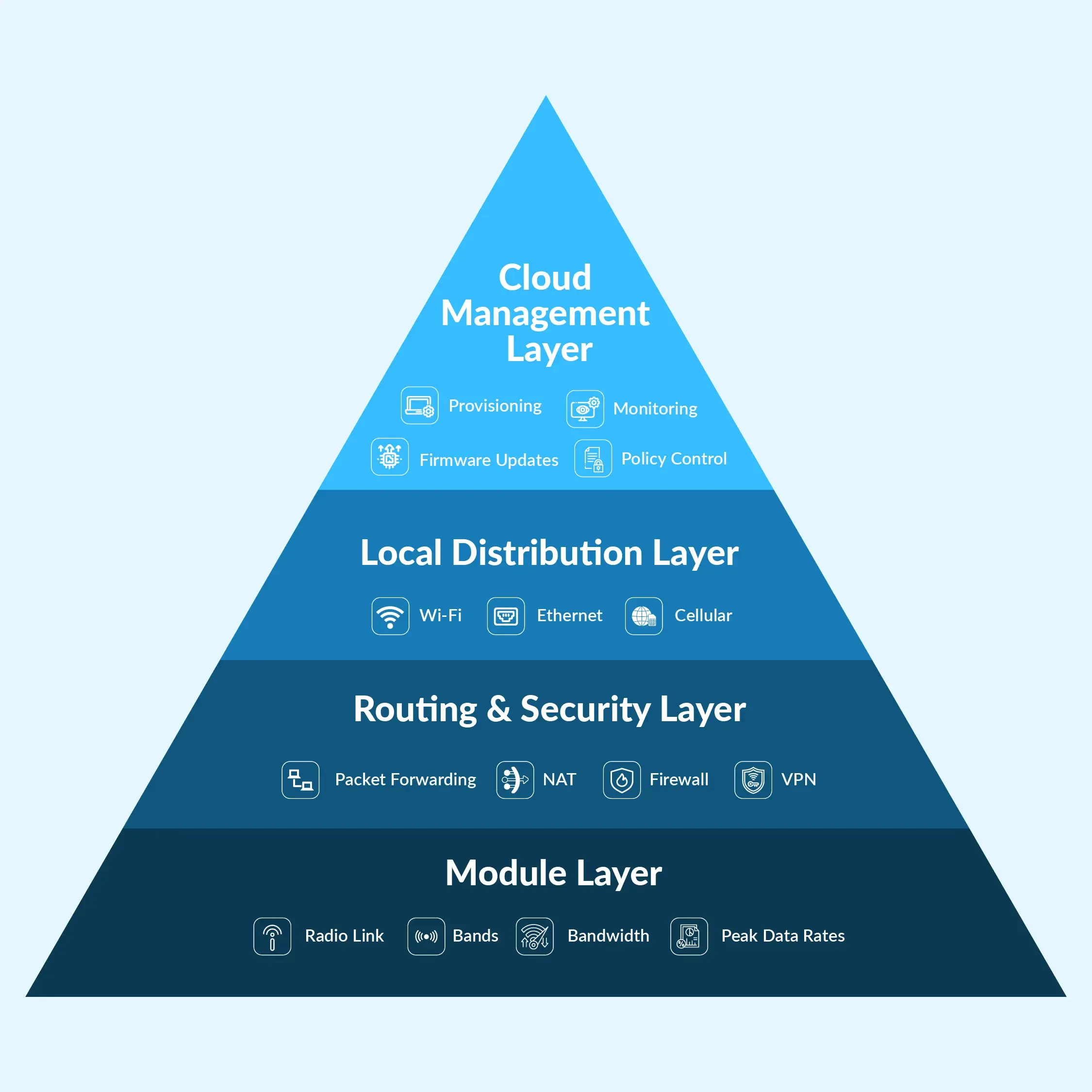
While a CPE is logically organized as a layered stack from modem to routing, LAN, and cloud management, each layer is ultimately constrained by physical and network realities. The architecture does not operate in isolation; several factors, such as radio design choices and cellular network conditions, influence the CPE performance.
Designing a Cellular CPE Architecture?
The cellular module defines the CPE device’s supported bands, throughput, form factor, operating system support, eSIM capability, and long-term deployment flexibility.
Factors Influencing CPE Architecture
RF Design
Supported bands, antenna design, antenna placement, and MIMO configurations (2×2 MIMO in entry-level designs, 4×4 MIMO in mainstream LTE and 5G CPE, and up to 8×8 MIMO in high-performance 5G FWA CPE) determine how well a CPE attaches to the network and sustains usable data rates. Poor RF performance limits throughput and stability before traffic reaches higher layers of the CPE stack and is further constrained by enclosure layout and Specific Absorption Rate (SAR) requirements.
Network Conditions
Network-side factors such as spectrum bandwidth, cell congestion, carrier aggregation availability, duplex mode (FDD/TDD), and the device’s location within the cell (center vs. edge) strongly influence real-world CPE performance. These conditions define the throughput, latency, and consistency that the modem can actually deliver.
Device Processing & Throughput
Inside a CPE, the processor (CPU) is responsible for packet forwarding, Network Address Translation (NAT), encryption, and firewall processing. The combined processing capacity, therefore, sets the maximum sustained throughput the device can deliver. Even with strong RF conditions and high network bandwidth, insufficient processing resources create bottlenecks, reducing routing performance, VPN throughput, firewall capacity, and SD-WAN effectiveness.
Local Distribution Interfaces (Wi-Fi & Ethernet)
The Wi-Fi subsystem and Ethernet port speeds determine how much WAN bandwidth the CPE can actually deliver to connected devices. If LAN interfaces are slower than the modem’s capability, additional WAN capacity cannot be utilized. Modern CPE increasingly adopts Wi-Fi 6/6E and Wi-Fi 7 for higher efficiency and multi-gigabit distribution, while Wi-Fi HaLow addresses long-range, low-power connectivity for IoT endpoints. Modem performance must therefore be matched with the appropriate Wi-Fi generation and Ethernet speeds to prevent internal bandwidth bottlenecks.
Thermal Design
Continuous high data rates generate significant heat within the modem, CPU, and power circuitry. Without adequate thermal design, the system may throttle to protect components, reducing sustained throughput and long-session reliability. Thermal engineering, therefore, directly impacts real-world performance, not just mechanical design.
Cloud & Fleet Management
Modern CPE is expected to support remote provisioning, monitoring, diagnostics, and firmware updates at scale. This requirement influences software architecture, flash storage sizing, security design, and boot mechanisms, shaping how the device operates across its entire lifecycle.
What is Modern CPE?
Modern CPE is a software-driven, cloud-managed, and compute-capable edge platform that combines connectivity, routing, security, and management in a single device rather than just focusing on access termination as in traditional CPE.
The rise of cloud computing, private LTE/5G, SD-WAN, IoT, and distributed sites has increased the need for scalable, centrally managed, and software-defined networking.
Modern CPE enables faster deployment, consistent security, remote management, and flexible feature upgrades without replacing hardware, making it essential for scalable and distributed networks.
Architectural Capabilities in Modern CPE
CPE in Cloud-Native and Edge-Native Network Architectures
Cloud-native network architectures centralize control and intelligence in the cloud. Configuration management, policy definition, authentication, analytics, and software updates are handled by centralized platforms rather than on each device individually. CPE fits naturally into this model because its networking and security functions are implemented as software-controlled services that can be provisioned and managed remotely.
Edge-native architectures focus on executing latency-sensitive and reliability-critical functions locally, close to users and devices. CPE is inherently an edge device. Packet forwarding, firewall enforcement, traffic shaping, local breakout, and edge compute occur locally to avoid latency and dependence on cloud connectivity. It also continues to operate during backhaul disruptions to support local analytics and edge computing near users and devices.
Containerization on CPE: Running Network and IoT Services at the Edge
Advanced CPE platforms increasingly support containerization technologies. Firewall functions, protocol translators, MQTT brokers, local databases, and lightweight analytics engines can be deployed as separate containers rather than as part of a single firmware image.
Containerization enables modular upgrades, faster patching, and independent lifecycle management of individual services. For IoT deployments, this approach allows local protocol conversion, data filtering, and device management services to run directly on the CPE.
AI-Native Security at the CPE Edge
AI-native security introduces machine-learning models directly into CPE platforms to analyze traffic patterns and detect anomalies in real time. Rather than relying solely on static rules or signature databases, AI-driven engines learn baseline behavior and identify deviations that may indicate threats. Edge-based inference enables detection and mitigation of suspicious activity locally, reducing response time and limiting lateral movement within the network.
NIC Cards in High-Performance CPE and vCPE
High-performance CPE platforms, whether implemented as traditional appliances or as part of virtual CPE (vCPE) architectures, may include dedicated network interface cards (NICs) to offload packet processing from the main CPU. These components accelerate encryption, Network Address Translation (NAT), and packet forwarding operations, enabling higher sustained throughput. Smart NICs allow virtual network functions to scale efficiently without excessive CPU overhead.
What is Virtual CPE (vCPE)?
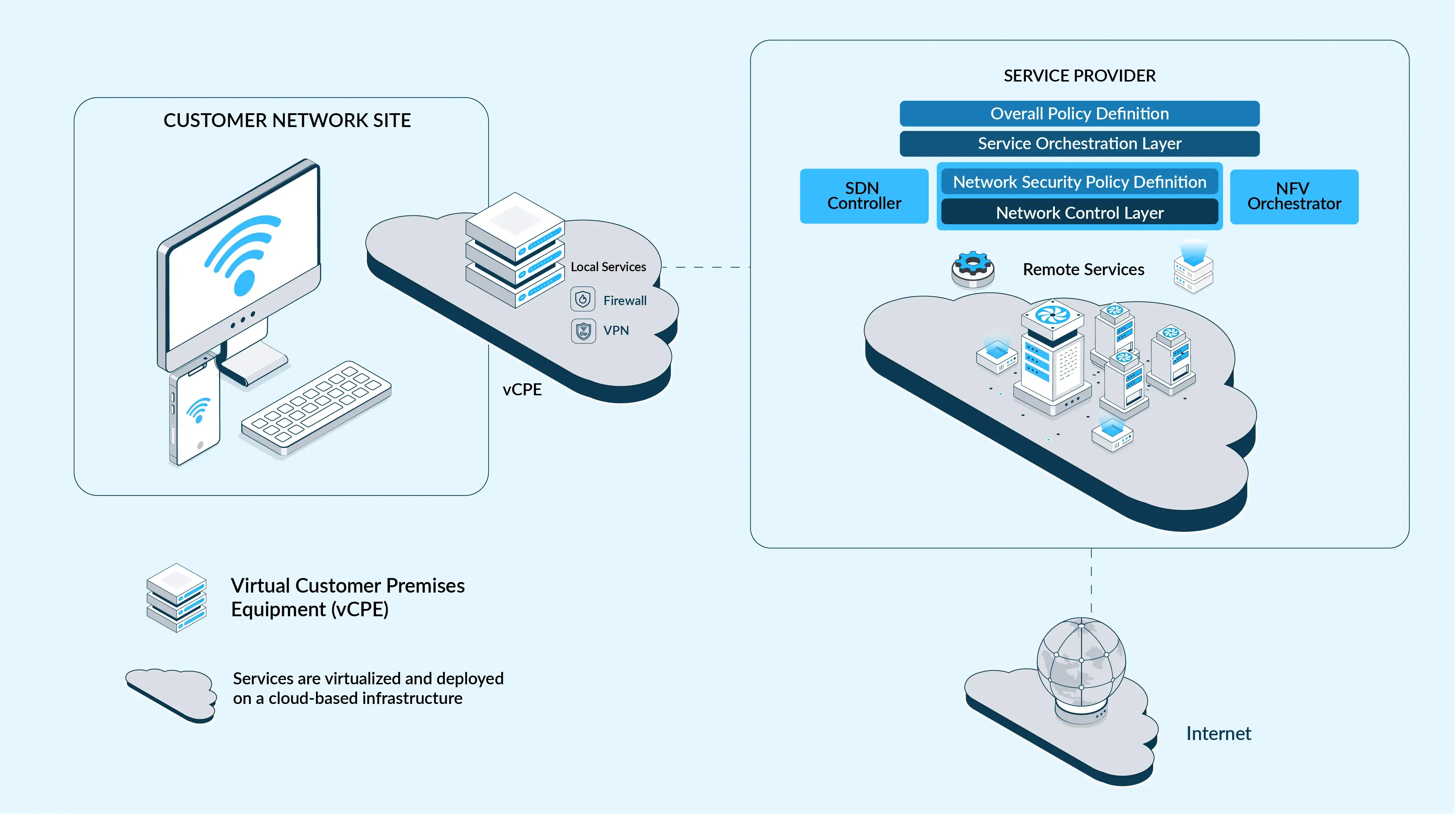
Virtual CPE (vCPE) is an architectural model in which the traditional networking and security functions of a physical CPE device are implemented as software-based virtual network functions (VNFs) running on centralized cloud or edge infrastructure, rather than being permanently embedded in dedicated hardware appliances.
The virtual CPE market is on a steep growth curve, quadrupling from USD 7.19 billion in 2024 to USD 32.18 billion by 2033 at an 18.4% CAGR. —Grand View Research
In a vCPE model, the on-premises device primarily acts as a lightweight forwarding platform that provides WAN access, basic switching, and packet forwarding. Advanced functions such as firewalling, VPN, routing, WAN optimization, and intrusion prevention are instantiated as virtualized services that can be deployed, scaled, and updated independently from the physical hardware.
This decoupling of hardware and software allows enterprises and service providers to deliver networking capabilities dynamically through software orchestration rather than fixed device configurations.
What is the difference between a Virtual CPE and a Traditional CPE
| Aspect | Traditional CPE | vCPE (Virtual CPE) |
|---|---|---|
| Definition | A physical CPE device where networking, security, and routing functions run directly on the hardware | A CPE model where networking and security functions run as virtualized software instances, orchestrated and managed from the cloud |
| How they fundamentally differ | Hardware-centric: features are tightly coupled to the device | Software-centric: features are decoupled from hardware |
| Feature updates | Require local firmware or, in some cases, hardware replacement | Enabled, disabled, or upgraded centrally via software |
| Service activation | Slower, often requires on-site changes | Faster, software-based activation |
| Maintenance model | Higher on-site maintenance | Reduced on-site maintenance |
| Scalability | Limited by hardware capabilities | Elastic scaling of features |
| Policy consistency | Managed per device | Centrally enforced across locations |
| Typical deployment model | Standalone device-based CPE | Cloud-orchestrated CPE with a lightweight edge device |
| Common use cases | Small offices, static sites | Multi-branch enterprises, MSPs, and large IoT deployments |
How vCPE Works?
A typical vCPE architecture consists of three logical layers:
On-Premises Access Layer
A minimal CPE device provides physical interfaces (Ethernet, Wi-Fi, cellular) and forwards traffic to the service platform.
Virtual Network Function Layer
Core networking services such as routing, firewall, SD-WAN, VPN, and traffic optimization run as virtual machines or containers in cloud or edge data centers.
Orchestration and Management Layer
A centralized platform controls service deployment, policy definition, monitoring, scaling, and lifecycle management across all customer sites.
Traffic flows from the site through the access device to the appropriate virtual functions based on policy, then onward to enterprise networks, cloud services, or the internet.
Software-Defined CPE: Relation between CPE and SD-WAN
Software-Defined Wide Area Networking (SD-WAN) is a networking approach that uses software-based control to intelligently manage how traffic is routed across multiple wide-area network connections, such as fiber, broadband, LTE, and 5G.
It is applicable in both traditional and virtual CPE architectures. vCPE significantly accelerated SD-WAN adoption by changing how network functions are delivered. Virtual CPE (vCPE) shifts most traditional CPE functions, such as routing, firewalling, and WAN optimization, from fixed on-device implementations into centrally managed virtualized software workloads running in cloud or edge infrastructure.
Software-Defined Wide Area Networking (SD-WAN) focuses on how traffic is intelligently steered across multiple WAN links (fiber, broadband, LTE/5G, satellite).
Enterprises and service providers deploy, update, and scale SD-WAN CPE purely through software, without replacing hardware at each site.
5G FWA CPE
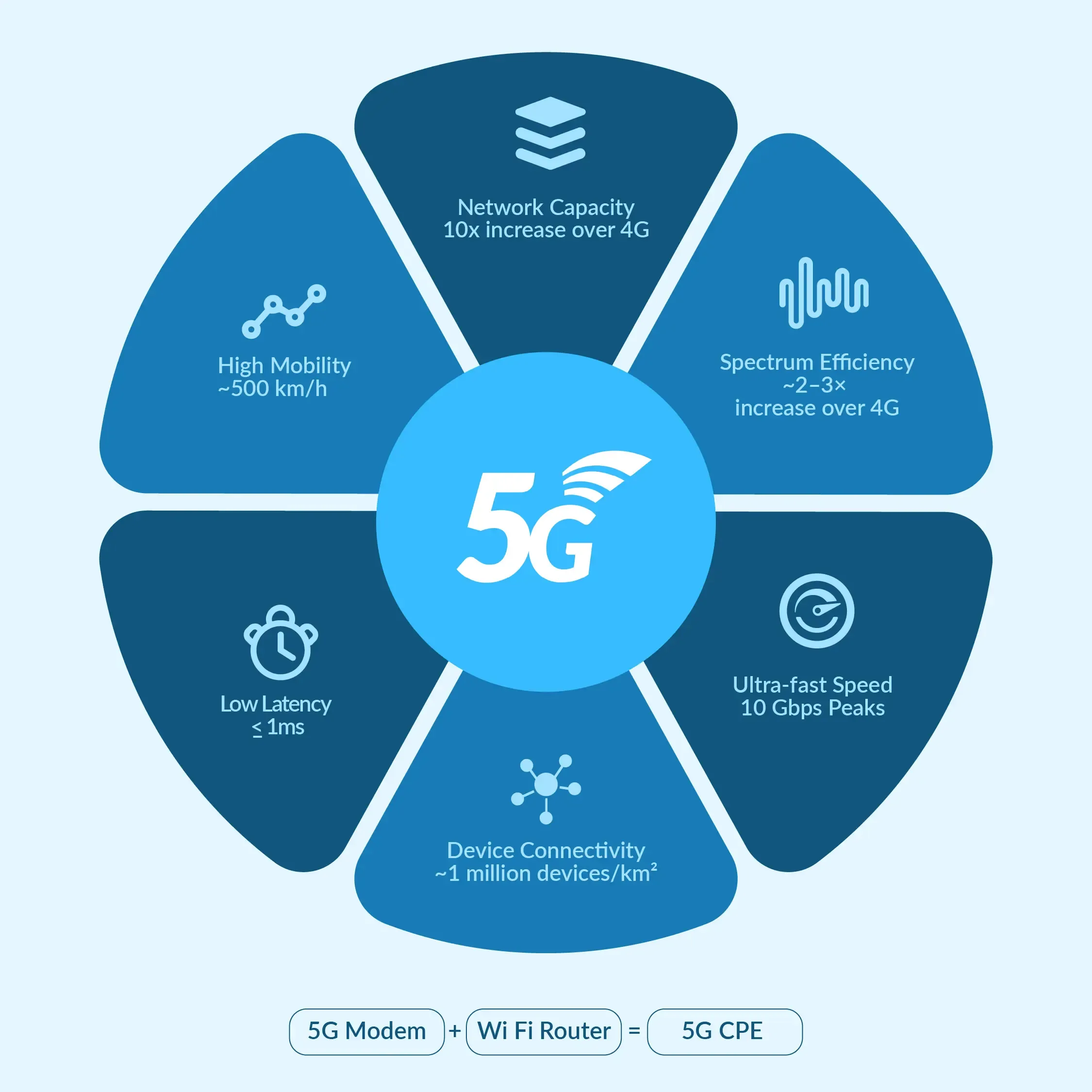
5G Fixed Wireless Access CPE, also called 5G FWA CPE or a 5G CPE router, delivers broadband connectivity over cellular networks instead of fiber or cable. Indoor and outdoor Fixed Wireless Access CPE devices integrate cellular modules, high-gain antennas, and advanced MIMO to provide consistent throughput and low latency with rapid installation. Unlike wired broadband CPE, CPE in 5G technology enables fast deployment and extends broadband coverage to homes, businesses, and underserved areas.
The Role of CPE in CBRS and Private LTE/5G Networks
In Citizens Broadband Radio Service (CBRS)-based private LTE CPE and private 5G network deployments, CPE serves as the primary gateway between the on-premises cellular radio network and enterprise or cloud infrastructure. While CBRS small cells provide local radio coverage, the CPE aggregates user traffic, applies routing and security policies, and connects the private network to external services.
CPE enables critical functions such as firewalling, VPN termination, QoS enforcement, and traffic segmentation for devices operating on CBRS networks. This architecture allows enterprises to support voice, unified communications, industrial IoT, video surveillance, and data applications over private cellular infrastructure with the same control and reliability as wired networks.
By integrating CBRS CPE, enterprises can build scalable private networks without relying solely on public mobile operators, while maintaining centralized management and security.
Managed CPE Services
Many service providers now offer managed CPE solutions, where enterprises consume networking and security capabilities as a subscription-based service. Hardware deployment, software updates, security patches, monitoring, and troubleshooting are handled centrally by the provider.
Managed CPE solutions rely on cloud-hosted orchestration platforms tightly integrated with on-premises CPE devices, enabling zero-touch provisioning and continuous lifecycle management.
How to Choose Cellular CPE for LTE and 5G Customer Premises Equipment
Choosing the right Cellular Customer Premises Equipment (CPE) goes beyond matching peak throughput numbers. For LTE CPE, 5G RedCap CPE, and 5G FWA CPE deployments, the decision affects network reliability, security posture, scalability, and long-term operating cost. A well-chosen CPE platform must balance radio capability, processing performance, software flexibility, module form factor, antenna design, and lifecycle management.
Security and Management Considerations
Modern CPE sits at the network edge and acts as a primary enforcement point for security policies. For business and industrial deployments, secure boot, signed firmware, and certificate-based authentication help prevent device compromise. Cloud-based provisioning, monitoring, diagnostics, and over-the-air firmware updates enable large fleets to be managed remotely, reducing site visits and operational overhead.
Software & OS Ecosystem
The operating system and software framework determine extensibility. Linux- or Android-based platforms with SDKs, APIs, and container support enable customization, automation, and application hosting.
SIM & Subscription Management
Cellular CPE increasingly relies on eSIM or multi-SIM architectures. Remote profile provisioning and switching simplify large-scale deployments and allow operator changes without physical SIM replacement.
Uplink Capability
Many applications depend heavily on uplink performance, including video conferencing, cloud storage, surveillance backhaul, and IoT data transmission. Uplink bandwidth, supported modulation schemes, and uplink carrier aggregation determine usability.
Carrier Aggregation Depth
Not all CPE supports the same number or types of carrier aggregation combinations. Depth and flexibility in DL and UL aggregation allow better utilization of available spectrum and improve average throughput.
Network Feature Exposure
Some cellular features, such as QoS marking, traffic steering hooks, or network slicing awareness, are only usable if exposed by the CPE. Support for these capabilities enables tighter alignment between network behavior and application requirements.
RF Capability & Antenna Flexibility
Because RF performance originates at the modem and RF front-end, it determines how well a CPE can connect, hold a signal, and sustain data rates. Supported bands, channel bandwidths, MIMO order, and antenna design determine how a CPE connects to cellular networks.
Future-Proofing with Wi-Fi 6/7 CPE and 5G FWA CPE
CPE is often deployed for many years, making forward compatibility essential. Wi-Fi 6 or Wi-Fi 7 support improves efficiency in dense environments and enables better distribution of high WAN bandwidth inside the premises. On the WAN side, 5G FWA CPE provides access to wider bandwidths, improved uplink performance, and ongoing network enhancements while retaining LTE fallback where coverage is limited.
Certification & Regulatory Coverage
CPE must meet regional and operator requirements, including regulatory approvals and RF exposure compliance. Broad certification coverage simplifies global deployments and avoids market-specific redesigns.
Cavli Modules for Customer Premises Equipment and LTE/5G CPE Devices
For OEMs and enterprises building LTE and 5G Customer Premises Equipment, Cavli Cellular Modules can help simplify cellular CPE design, certification, connectivity, and lifecycle management. Cavli modules suitable for CPE solutions include LTE Cat 4 C20QM, LTE Cat 4 CQ20, CQM220 for 5G RedCap CPE applications, and CQM211 from Cavli’s 5G NR module family. With form factors such as MiniPCIe, M.2, and LGA, these modules support both new CPE development and retrofitting existing CPE devices.
Building LTE or 5G CPE Devices?
Compare Cavli LTE Cat 4, 5G RedCap, and 5G NR modules for cellular CPE routers, FWA CPE, private LTE/5G gateways, and industrial IoT gateway designs.Explore Cavli Cellular Modules | Talk to a Cavli Solutions Expert
5G IoT Modules for CPE Solutions
| Module Name | Network Technology | Form Factors | Download & Uplink Speed (Peak Values) | OS |
|---|---|---|---|---|
| CQM220 | 5G RedCap | M.2, LGA |
| Linux / OpenWrt |
| CQM211 | 5G NR | M.2, LGA |
| Linux / OpenWrt |
4G LTE IoT Modules for CPE Solutions
| Module Name | Form Factors | Download & Uplink Speed (Peak Values) | OS |
|---|---|---|---|
| C20QM | LGA, MiniPCIe |
| Yocto Linux |
| CQ20 | LCC+LGA, MiniPCIe |
| Yocto Linux |
Conclusion
CPE has evolved from a simple access device into a programmable, software-defined network edge platform. Understanding its architecture, deployment models, and design considerations is essential for building scalable, secure, and future-ready private networks. The right CPE foundation directly influences performance, reliability, and long-term operational efficiency.
For LTE, 5G RedCap, and 5G NR CPE designs, selecting the right cellular module is a key step in achieving reliable connectivity, scalable deployment, and long-term product support.
Go Beyond and Explore
What does CPE stand for in networking?
What is CPE in networking?
What is a CPE device?
Is a router a CPE device?
What is CPE internet?
What is CPE in telecom?
What is the difference between CPE, router, modem, and gateway?
What is 5G CPE?
What is vCPE?
How do you choose cellular CPE for LTE and 5G deployments?
Author

Drishya Manohar
Sr. Associate - Content Marketing