
IoT Smart City Solutions: Architecture, Applications, and Cellular Connectivity
Smart city IoT solutions connect sensors, meters, cameras, gateways, and control systems to help cities monitor infrastructure and deliver public services more efficiently. Applications of IoT in smart cities include traffic management, smart parking, utility metering, street lighting, environmental monitoring, and waste management.
For OEMs, system integrators, and municipal teams, the challenge is making these connected systems work reliably throughout their service life. An effective IoT solution for smart cities must match each application's coverage, power, bandwidth, security, and maintenance requirements while integrating with existing infrastructure.
Cavli Wireless supports this connectivity foundation through cellular IoT modules, eSIM-enabled connectivity options, and the Cavli Hubble connectivity and module management platform. Together, these capabilities help product makers develop and manage connected devices for urban infrastructure. Explore Cavli's smart city IoT solutions.
What Is a Smart City? The Role of IoT in Smart Cities
A smart city in IoT uses connected infrastructure and data to improve public services and resource management. The role of IoT in smart cities is to connect physical assets with the teams and applications that operate them. A smart city using IoT combines sensors, communication networks, data processing, and authorized control actions. The relationship between the Internet of Things and smart cities depends on devices that deliver useful measurements and remain manageable throughout their service life. For product makers, IoT and smart cities involve both device design and ongoing operations.
Understanding IoT Smart City Architecture for Device and System Integration
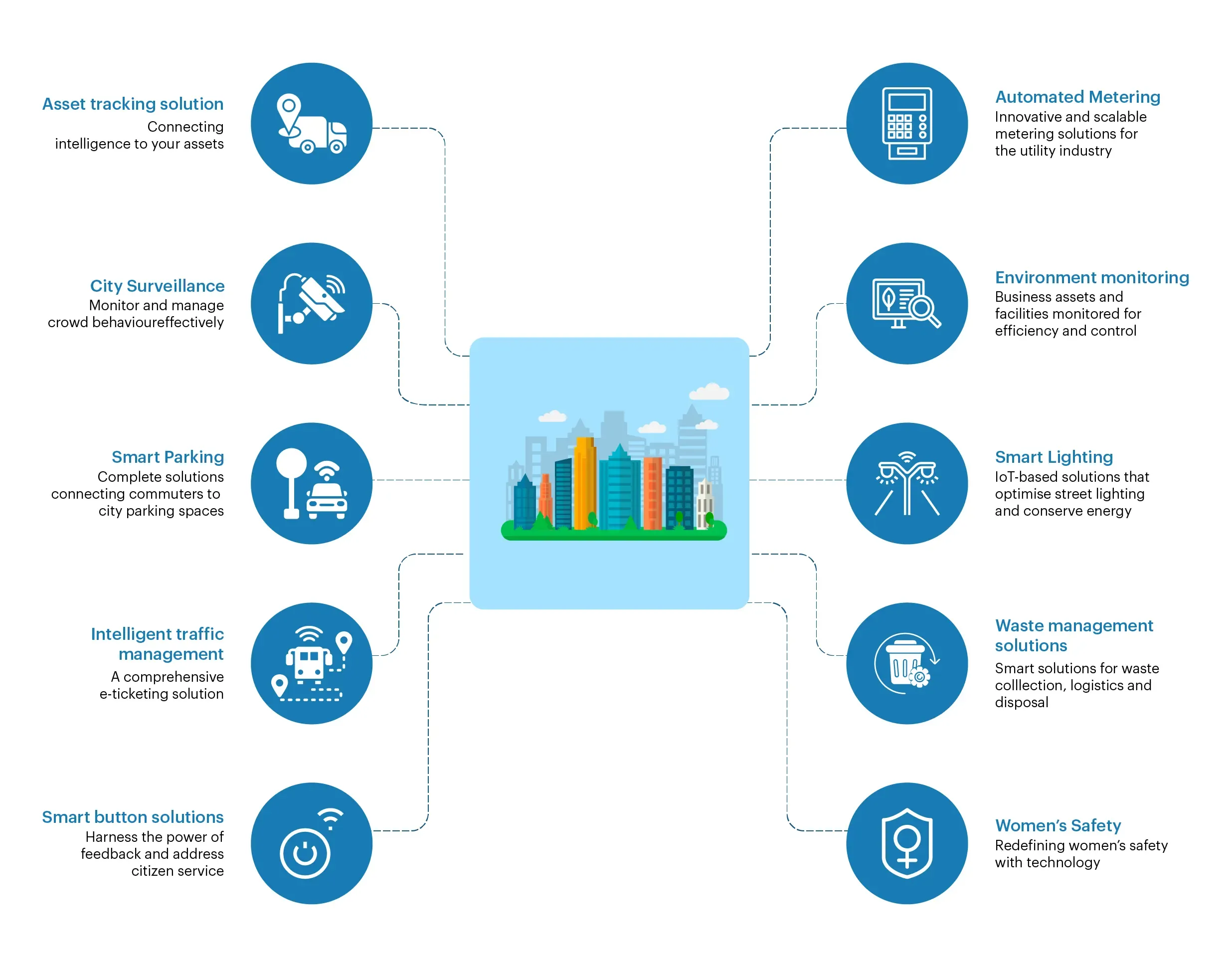
Smart city architecture in IoT links physical devices with communication networks, data management, and applications. Understanding these layers helps buyers evaluate a complete solution and identify which responsibilities belong to the device supplier, connectivity provider, platform vendor, and system integrator.
1. Application Layer: Key IoT Solutions for Smart Cities
The application layer turns connected-device data into useful urban services. Smart city IoT applications include:
- Smart government: Infrastructure dashboards, service alerts, and municipal reporting.
- Smart parking and transportation: Occupancy monitoring, payment integration, guidance, and tracking.
- Smart homes and buildings: Lighting, security, HVAC, and energy monitoring.
- Smart grids and utilities: Consumption monitoring and application-specific control.
- Smart healthcare: Remote monitoring and connected equipment through healthcare IoT applications.
For a smart city IoT platform, define the application interfaces before choosing the communication hardware. Cavli Hubble supports connectivity and module management; the city-service application supplies functions such as billing, parking guidance, or operational dashboards. Agree how device data reaches those applications and who maintains each part.
2. Data Management Layer: Optimizing Data for Smart Cities
The data management layer collects, organizes, and processes information from distributed devices. Event management identifies conditions that require attention, while decision management uses current and historical information to support operational action.
For example, parking occupancy data can update guidance displays, and abnormal water consumption can trigger an investigation. Buyers evaluating an IoT data platform for smart cities should check data formats, timestamps, storage, access permissions, and integration with existing reporting and asset management systems.
3. Communication Layer: Enabling IoT Connectivity in Smart Cities
The communication layer transfers information between devices and applications. Its network layer can include cellular, Wi-Fi, and other networks selected for the deployment. Its supporting computing infrastructure can distribute processing across cloud, edge, and fog environments.
Smart city IoT connectivity must accommodate different traffic patterns. A meter sending small readings has different requirements from a camera transmitting video. Network design should account for uplink capacity, downlink commands, installation conditions, and recovery after an interruption.
4. Perception Layer: The Foundation of IoT Smart City Data Monitoring
The perception layer includes end devices, sensors, and actuators interacting with the physical environment. Sensors collect information; actuators perform actions such as changing a lighting level or operating a control mechanism.
When selecting smart city IoT devices, evaluate sensing accuracy, calibration, power supply, enclosure protection, temperature tolerance, and service access alongside connectivity. A cellular module supplies communication capability; the finished device still needs appropriate electrical, mechanical, and environmental protection.
Core Infrastructure of IoT-Enabled Smart City Solutions

IoT applications in smart cities and the associated smart city IoT use cases depend on a combination of devices, connectivity, software, and operational processes. The following smart city IoT examples show how those components support urban services and what to evaluate before deployment. These smart city applications of IoT share a common purpose: making physical infrastructure visible and manageable through connected information.
1. Smart IoT Infrastructure: The Backbone of Smart Cities
Applications of IoT in smart city infrastructure connect transportation systems, energy assets, public information equipment, and other distributed services. Examples include adaptive traffic signals, public transport tracking, parking guidance, and electric vehicle charging networks. Each application of IoT in smart city operations should have an identified service owner and a measurable operational objective.
An IoT strategy for smarter cities starts with the service requirement: what must be measured, how quickly information must arrive, and what should happen if communication is interrupted. Coverage and operational responsibilities should be validated before expanding a pilot.
Cavli's C42GM module brings LPWAN connectivity and power-management capabilities to devices in smart city networks. Explore how it supports urban applications in the smart cities RAN connectivity case study.
2. IoT Solutions for Public Services and Safety in Smart Cities
Connected cameras and sensors help public-service teams identify incidents and coordinate responses. A traffic event, for example, can generate an alert, provide location information, and inform updates to roadside signage or an authorized traffic-control workflow.
Smart surveillance requires more than camera resolution. Occasional event images and continuous video impose different uplink requirements. Buyers need to evaluate video bitrate, uplink availability, event detection, storage, remote access, privacy, and fallback operation. Edge processing can reduce the amount of video sent to the cloud when the application can act on locally generated events.
Explore Cavli's guide to smart surveillance systems for the relationship between cameras, analytics, cellular connectivity, and remote management.
3. Smart Buildings and Homes

A smart home focuses on an individual residence; a smart city connects services across wider urban infrastructure. Smart buildings use connected sensors and control systems to manage HVAC, lighting, security, and energy consumption. Occupancy and environmental measurements can help adjust operations to actual demand.
IoT solutions for smart buildings should work with the installed building management system wherever practical. Evaluate interfaces, gateway requirements, data access, and whether local controls continue working during a network outage.
At the residential level, connected routers provide communication for home services and IoT devices. Cellular-enabled gateways support broadband access where wired connectivity is unavailable or needs a backup. Explore Cavli's smart home router case study to see this approach in practice.
4. Environmental Monitoring with IoT in Smart Cities
Environmental sensor networks measure air quality, noise, and other urban conditions. Depending on the sensing equipment, measurements can include particulate matter, nitrogen dioxide, carbon monoxide, and ozone.
An IoT-enabled environmental monitoring system for smart cities needs an appropriate sampling schedule, calibrated sensors, reliable timestamps, and a clear alerting process. Connectivity selection should reflect the power budget and reporting interval. Radio sleep modes alone do not determine battery life because sensing, processing, and environmental conditions also consume energy.
For OEMs building compact remote-monitoring devices, CQ16 offers LTE Cat 1bis connectivity, eDRX, and DFOTA; C41QS provides an NB-IoT option for suitable small-payload sensors. For water-quality or flood monitoring, evaluate the required alert delay and operation during adverse conditions. Coverage testing and backup power become especially important where timely information supports emergency decisions.
5. Smart Parking Systems Powered by IoT in Smart Cities

Smart parking systems combine occupancy detection, connected meters, guidance displays, and software to improve visibility into available spaces. They can also integrate with payment and enforcement systems.
The choice between in-ground sensors, cameras, and connected parking meters depends on installation constraints and the services required. Evaluate detection accuracy, reporting delays, battery maintenance, and connectivity under real parking conditions.
C16QS brings LTE Cat 1bis connectivity to a customer's connected parking meters in Cavli's smart parking solution case study. The solution combines contactless interaction, support for multiple parking spaces per meter, and a power arrangement using solar panels and backup batteries. C16QS supports DFOTA and low-power operating modes for this type of connected-device application. For a parking-meter design review, bring the payment-data requirements, reporting interval, power budget, and firmware-update schedule together before selecting the module configuration.
6. IoT-Powered Smart Utility Metering in Smart Cities

Smart utility metering connects electricity, water, and gas consumption data with utility operations. Applications include automated meter reading, consumption monitoring, billing integration, leak investigation, and demand management.
Selecting connectivity for a meter requires attention to its installation location and reporting pattern. Underground chambers, building interiors, and metal enclosures should be tested rather than assessed solely from an outdoor coverage map. Utilities should also validate integration with meter data management and billing systems.
For energy meters, CQ16 combines a compact package with LTE Cat 1bis connectivity and remote firmware maintenance. C41QS provides an NB-IoT option where the network and reporting requirements fit. Explore Cavli's energy and utilities IoT applications for related connected-infrastructure requirements.
7. IoT-Based Smart Street Lights in Smart Cities
Connected streetlights support scheduled dimming, condition monitoring, and fault reporting. Where additional equipment is installed, lighting infrastructure can also support environmental sensing and other urban services.
When evaluating IoT-enabled smart lighting systems for smart cities, check controller compatibility, remote-command response, electrical protection, and operation without cloud access. Existing luminaires may support retrofitting, but suitability depends on the driver and controller interfaces.
Measure savings against an agreed baseline. Energy improvements from replacing lamps with LEDs should be distinguished from the additional benefits of connected control and reduced maintenance visits.
8. IoT-Based Waste Management Systems in Smart Cities

Smart waste management uses connected fill-level sensors and operational software to help plan collection. Fleet information and container status can support route adjustments and maintenance decisions.
For a practical deployment, test sensor accuracy with real waste materials and verify wireless performance from the intended mounting position. Metal containers, battery access, and environmental exposure can affect operation. Integration with collection software is necessary to turn measurements into useful route decisions.
Cavli Cellular IoT Modules for Smart Cities
Cavli's cellular IoT modules connect smart city devices across metering, parking, environmental monitoring, and tracking applications. Choose the module and configuration that match your device's power, bandwidth, interface, and software requirements.
| Module | Key Features | Smart City Applications |
|---|---|---|
| C41QS | LTE Cat NB2; compact 17.7 × 15.8 × 2.0 mm LGA package; optional GNSS and eSIM configurations. | Small-payload metering, parking, and environmental sensor applications where power and space are important. |
| C16QS | LTE Cat 1bis; peak downlink/uplink rates of 10/5 Mbps; DFOTA; optional GNSS and integrated eSIM; low-power operating modes. | Connected parking meters, utility monitoring, and distributed devices requiring LTE connectivity and remote maintenance. |
| CQ16 | LTE Cat 1bis; compact 17.7 × 15.8 × 2.5 mm LGA package; peak downlink/uplink rates of 10/5 Mbps; DFOTA; eDRX; two USIM interfaces. | Space-constrained energy meters, asset trackers, and remote monitoring devices. |
| CQ10 | LTE Cat 1 with variant-dependent 2G fallback; peak LTE downlink/uplink rates of 10/5 Mbps; Linux and OpenSDK support; optional GNSS. | Environmental monitoring, data logging, tracking, and devices requiring application development flexibility. |
Peak data rates are not guaranteed application throughput. Confirm bands, software features, certifications, GNSS/eSIM options, and availability for the selected variant. For new deployments, evaluate LTE coverage and lifecycle requirements independently of any legacy-network fallback capability.
Which Cavli Module Fits Your Smart City Device?
Choose C41QS when the design calls for NB-IoT connectivity and small telemetry payloads. For LTE Cat 1bis, compare C16QS and CQ16 against board space, interfaces, and required options: C16QS offers optional GNSS and integrated eSIM, while CQ16 combines a compact footprint with two USIM interfaces. Both support DFOTA. CQ10 is a Cat 1 option for designs needing Linux and OpenSDK application development; it supports Linux 4.14 and peak LTE downlink/uplink rates of 10/5 Mbps.
C41QS, C16QS, and CQ10 offer optional GNSS, depending on configuration. Positioning supplies location information; cellular connectivity transports it. A legacy redesign also needs board, power, and software compatibility checks. CQ10's variant-dependent 2G fallback does not establish that a legacy network will remain available.
Hardware Interfaces, Embedded Software, and Environmental Requirements
Module integration involves more than selecting a radio category. C16QS combines UART and USB interfaces, a FreeRTOS environment, and support for protocols including MQTT(S), HTTP(S), and TCP(S). CQ10 offers Linux and OpenSDK support, with protocols including MQTT/MQTTS, HTTP/HTTPS, TCP, FTP/FTPS, PPP, and SNMP. C16QS also supports UDP, FTP(S), and PPP. These details help engineers assess how an existing controller or embedded application can communicate with a city-service backend.
For compact connected devices, CQ16 combines a FreeRTOS environment with three UART interfaces, USB 2.0, and two USIM interfaces. Support for TCP(S), HTTP(S), MQTT(S), UDP, and PPP provides options for exchanging telemetry with application backends, while eDRX and DFOTA support power management and remote firmware maintenance.
C16QS and CQ10 operate across a temperature range of −30°C to +85°C. Outdoor device design must also account for the enclosure, power supply, sensors, and complete assembly. GNSS, eSIM, and software-feature availability depend on the selected module configuration.
CQ16 also operates from −30°C to +85°C, with a 17.7 × 15.8 × 2.5 mm footprint for designs where board space is limited.
Evaluation Kits for Smart City Prototypes
Cavli offers IoT evaluation and development kits. Evaluation kits for C41QS and C16QS provide external antenna connections, UART, USB debugging, and connections for an external microcontroller. These provide a starting point for evaluating communication and host integration before designing the final device. Development-kit support is module-specific, so select the kit against the proposed hardware and software architecture.
Ready to evaluate a module? Request a Cavli evaluation kit and share your application, required interfaces, power source, and reporting interval.
How Cellular IoT Connectivity Powers Smart Cities
Cellular IoT connects distributed city devices through mobile networks. It can support direct device-to-cloud communication or provide backhaul for gateways aggregating nearby sensors. The appropriate design depends on coverage, payload size, reporting frequency, mobility, and maintenance requirements.
Comprehensive Connectivity Solutions for Smart Cities
There is no single best connectivity technology for every smart city application. A battery-powered meter and a continuously streaming camera should not be evaluated against the same requirements.
| Connectivity Technology | Smart City Applications | Design Considerations |
|---|---|---|
| NB-IoT | Stationary meters and sensors sending small amounts of data. | Site coverage, operator support, reporting frequency, command delay, and battery budget. |
| LTE-M | Low-power connected devices that may need mobility and more frequent communication. | Network availability, mobility behavior, power-saving support, and application throughput. |
| LTE Cat 1 / Cat 1bis | Parking meters, telemetry equipment, trackers, and other moderate-data devices. | Power demand, supported bands, interfaces, remote updates, and required data rate. |
| LTE Cat 4 and higher categories | Gateways and applications with greater data requirements. | Sustained uplink capacity, power supply, network conditions, and data costs. |
| 5G RedCap | Devices needing an intermediate level of 5G capability. | RedCap network support, actual throughput, device complexity, and application suitability. |
| 5G NR | High-bandwidth gateways, video, and demanding connected infrastructure. | Coverage, uplink performance, latency, thermal design, and end-to-end system requirements. |
LTE-M and NB-IoT: Low-Power Connectivity
LTE-M and NB-IoT are cellular LPWAN technologies relevant to smart utility meters, environmental sensors, parking equipment, and selected tracking applications. Their suitability depends on the device's communication and mobility needs.
Power Saving Mode (PSM) and extended Discontinuous Reception (eDRX) can reduce communication energy use when supported by the device and network. They also affect reachability: a device optimized for long sleep periods may not immediately receive a remote command. Validate this trade-off against the required service response.
LTE Cat 1 and Cat 1bis: Connectivity for Distributed Urban Devices
LTE Cat 1 and Cat 1bis are options for devices needing moderate data throughput, regular communication, and firmware transfers. They can also support migration from older cellular technologies when suitable LTE service is available.
Multi-year battery operation requires a complete energy budget matched to the battery and operating conditions. Evaluate the entire device power profile, including transmission peaks, standby behavior, sensing, and application processing. A low-power module specification does not by itself establish the battery life of the finished product.
5G Networks: High-Speed and Low-Latency Connectivity
5G NR and 5G RedCap address different performance and complexity requirements. They should be evaluated separately for surveillance, gateways, connected transport infrastructure, and other smart city applications.
For video, calculate the required uplink from resolution, compression, frame rate, and simultaneous streams. For responsive control, assess end-to-end delay across the device, network, processing, and application. A network technology label alone does not guarantee a particular latency or level of availability.
Direct Cellular Connectivity or a Shared Gateway?
Direct cellular connectivity places a mobile connection in each device. A gateway architecture aggregates sensor traffic before forwarding it over a backhaul connection. LoRaWAN and cellular can also be used together when the architecture requires both local sensor networking and cellular backhaul.
Compare gateway installation and maintenance, device power, coverage, recurring connectivity costs, and the effect of a gateway failure. Public cellular and private-network options likewise require different ownership, deployment, and support arrangements.
Device Management and Security in Smart Cities
eSIM Connectivity and Subscription Management
An embedded SIM can reduce dependence on removable SIM handling in distributed smart city equipment. Cavli's integrated eSIM connectivity supports programmable carrier information and over-the-air subscription management. This is relevant when planning connectivity across deployment markets or maintaining equipment that is difficult to access. Actual service depends on the module, supported network technology, and connectivity agreement.
For a mixed fleet, connectivity plans should reflect device roles. A meter sending periodic readings and a gateway carrying larger traffic volumes have different requirements. Hubble network subscription management provides usage limits for individual devices or fleets, configurable plans, and usage dashboards. Teams can use these controls to monitor consumption and adjust configurations as devices move from prototyping to production.
Connecting Device Data to Smart City Applications
Hubble Messaging Service routes device data to application endpoints. It separates management commands from telemetry through control and data channels, supports multiple delivery destinations, and allows endpoint settings to be changed through the platform without reprogramming devices. Supported endpoint options include MQTT and HTTP, alongside cloud and data-pipeline integrations.
This can support separate analytics, storage, and alerting workflows using the same device data. Application teams still define how measurements map to assets, dashboards, and operational actions. Shared and dedicated server options accommodate different deployment requirements.
Planning remote operations? Discuss a Cavli Hubble demonstration covering device diagnostics, data routing, firmware maintenance, and subscription controls for your use case.
Remote Device Management for Seamless Operations
A citywide deployment needs visibility into device status and a repeatable maintenance process. Buyers should evaluate onboarding, configuration, connectivity diagnostics, firmware management, and subscription control alongside hardware.
Cavli Hubble supports connectivity and module management through device monitoring, eSIM management, data subscription management, and integration APIs. Its role is to support the connected-device foundation that municipal applications use.
Hubble Lens provides remote AT-command access for supported Cavli modems, enabling engineering teams to inspect connectivity and perform troubleshooting without physical access. Its separation of command traffic and telemetry supports remote diagnostics alongside application data flow.
FOTA and DFOTA support remote firmware maintenance. Delta updates transfer firmware changes rather than an entire image, reducing the transfer required for applicable updates. Confirm compatibility and recovery behavior for the selected device, and validate updates on a controlled group before wider deployment.
Security Features for Safe and Secure IoT Networks
Smart city security architecture in IoT must address the endpoint, communication path, platform, and application. Evaluation should cover device identity, encrypted communication, secure firmware handling, access controls, credential management, and vulnerability maintenance.
Secure boot and hardware-backed protection should be checked for the actual device implementation rather than assumed across every module. Network authentication also does not replace application-level data protection. Public safety, traffic, and utility systems need clear access boundaries and procedures for responding to compromised equipment.
Key Benefits of IoT-Powered Solutions for Smart Cities
Smart cities using IoT can improve service visibility, resource use, public safety, traffic operations, and environmental monitoring. For OEMs and decision-makers, those benefits become useful procurement criteria when tied to a measurable deployment outcome.
| Operational priority | What to measure | Role of the connected solution |
|---|---|---|
| Maintenance and operating cost | Site visits, time to diagnose a fault, update completion | Cavli Hubble and Hubble Lens support remote visibility and diagnostics for supported modems; compatible FOTA/DFOTA supports firmware maintenance. |
| Resource optimization | Meter-reading completion, energy consumption, investigation response | Connected meters and sensors deliver information to utility applications; control and billing workflows remain part of the wider system. |
| Traffic and public-service quality | Data freshness, parking availability, incident response | Connected infrastructure supplies current information to the teams and applications responsible for service delivery. |
| Environmental performance | Measurement continuity, sensor calibration, response to alerts | Sensor networks provide consistent observations for analysis and operational action. |
Measure resource efficiency and cost savings against the existing installation. Separate savings from equipment replacement, such as LED upgrades, from savings attributable to connected control or remote maintenance. These benefits of using IoT for cities depend on device design, integration, and how operators use the data.
Challenges in Implementing IoT Solutions for Smart Cities
Technical Integration Challenges
Existing municipal infrastructure often uses different interfaces, protocols, and data formats. Before selecting a smart city IoT infrastructure provider, document installed equipment and identify what can be retained, retrofitted, or connected through gateways.
Assess hardware compatibility, network coverage, data exchange, and integration with command centers, billing systems, building controls, and maintenance workflows. A successful connection to a dashboard is only one part of a working operational solution.
Security and Privacy Considerations
Connected urban systems face risks including unauthorized access, altered commands, data exposure, physical tampering, and device theft. Controls should address both digital access and the physical installation.
Confirm who maintains credentials, delivers security patches, investigates incidents, and removes retired devices. For video and other sensitive information, define access, retention, and processing arrangements appropriate to the service.
Scalability Issues
Scaling a pilot means handling more than a larger device count. Evaluate simultaneous reporting, provisioning workloads, firmware distribution, data storage, support demand, and the cost of field maintenance.
Test buffering and recovery during outages, confirm which services require local operation, and measure power consumption in realistic conditions. A representative pilot should include difficult installation sites as well as locations with strong coverage.
Interoperability Concerns
Multivendor deployments need agreement on interfaces and data models. A device being connected to the same network does not automatically make its data compatible with another platform.
Ask suppliers to demonstrate integration with the required systems and clarify how data can be exported or migrated. Match the module's supported protocols and the platform's supported endpoints to the application architecture. Compatibility must be verified for the complete implementation.
Supplier Selection and Lifecycle Planning
When comparing smart city IoT solution providers, connect the technical shortlist to the requirements for production and ongoing operation. An IoT solution for smart cities needs both a suitable radio design and a practical ownership model after installation.
| Buyer decision | Information needed before selection | How to assess Cavli for the project |
|---|---|---|
| Module and host compatibility | Bands, interfaces, dimensions, power, software, positioning | Compare C41QS, C16QS, CQ16, and CQ10 against the product design and exact ordering variant. |
| Connectivity and data costs | Coverage, payloads, reporting frequency, update traffic | Discuss eSIM-enabled connectivity options and Hubble subscription controls for the device fleet. |
| Remote maintenance | Diagnostics, firmware management, access responsibilities | Review Hubble Lens and compatible FOTA/DFOTA against the service workflow. |
| Application integration | Protocols, endpoints, data formats, existing systems | Match module protocol support and Hubble Messaging Service to the application backend. |
| Supply and lifecycle | Volumes, rollout dates, approval requirements, warranty and support expectations | Request project-specific availability, commercial terms, and lifecycle information with the quotation. |
What Drives Smart City IoT Deployment Costs?
Build the cost comparison around the complete device and operating period: module, host electronics, sensors, antennas, enclosure, installation, connectivity, platform services, integration, testing, maintenance, and replacement. Include expected firmware transfers and diagnostic traffic in the connectivity estimate. A low module price alone does not establish the lowest deployment cost.
Cavli's integrated module, connectivity, and Hubble offering lets teams discuss these related requirements together. Hubble usage dashboards and configurable plans help manage consumption after deployment; remote diagnostics and compatible firmware updates support maintenance without physical access for tasks that can be completed remotely. Actual savings depend on the implementation and should be measured in the pilot.
How to Start a Smart City IoT Pilot with Cavli
Start with a representative device and an agreed acceptance plan. Share the application, device volume, installation environment, power source, payload size, reporting interval, interfaces, positioning needs, firmware-update requirements, backend integrations, and rollout timeline. These details help define a relevant module and connectivity configuration for the quotation.
For C41QS and C16QS, Cavli evaluation kits provide external antenna connections, UART, USB debugging, and host-microcontroller connections. Use the prototype to check network access at representative sites, host communication, energy consumption, application data delivery, and supported remote-maintenance functions. Include weak-signal locations and outage recovery in the system-level validation.
Use the pilot results to make the purchasing decision concrete:
| Team | Decision supported by the pilot |
|---|---|
| Embedded engineering | Can the module communicate with the host and backend within the device’s power, interface, and space constraints? |
| Product management | Does reporting frequency, command response, and remote maintenance meet the intended service experience? |
| Operations | Which faults can be diagnosed remotely, which require a site visit, and who owns each response? |
| Procurement | Does the quotation identify the exact hardware configuration, connectivity assumptions, recurring services, and supply terms? |
Bring these results to the Cavli project discussion so the next step can focus on unresolved design or commercial requirements.
Before production, confirm the chosen variant, approval status, software features, supply arrangements, and support responsibilities. Minimum quantities, lead times, warranty, service levels, and pricing require project-specific confirmation.
Preparing an RFQ or prototype? Share your smart city device requirements with Cavli to discuss module selection, evaluation hardware, connectivity, and Hubble integration.
Emerging Trends in IoT Technology for Smart Cities
5G Connectivity and Future Device Requirements
5G NR and RedCap expand options for connected video, gateways, and transport infrastructure. Select them against the required uplink capacity, power budget, and available network service. Sub-6GHz and mmWave have different coverage and installation characteristics; network slicing depends on implementation and service availability. A future roadmap should distinguish features needed for the first deployment from capabilities reserved for a later device generation.
AI and Edge Computing for Smart City Applications
AI and machine learning can support anomaly detection, traffic analysis, and maintenance planning. Edge computing can process information locally, reduce unnecessary uploads, and support selected functions during cloud interruptions. For an OEM, the design decision is where analytics runs and what this requires from the processor, memory, storage, power supply, and backhaul. The application team remains responsible for model validation and false-alert handling.
Blockchain for Smart Cities
Distributed ledgers may support specific shared-record applications. Include them only where an identified operational requirement justifies their performance, complexity, and governance needs.
Build Connected Smart City Solutions with Cavli
The Internet of Things for smart cities connects physical infrastructure with information that helps people operate urban services. Choosing IoT for smart cities means evaluating the complete system: suitable sensors, dependable communication, secure integration, and manageable devices.
Cavli Wireless brings cellular IoT modules, eSIM-enabled connectivity options, and Cavli Hubble management together to support that foundation. This integrated ecosystem helps product makers connect urban devices and manage connectivity throughout deployment, with configurations matched to each application's power, coverage, data, and maintenance needs.
Bring your smart city concept closer to deployment with suitable smart city connectivity. Discuss your project with Cavli to review module selection, connectivity, and Cavli Hubble integration. Share your use case, expected device volume, deployment environment, data requirements, and rollout timeline so the discussion can focus on your design.
Frequently Asked Questions About IoT Smart City Solutions
What are IoT smart city solutions, and how do they work?
Which cellular connectivity technology is suitable for smart city devices?
How do you choose a cellular IoT module for smart city applications?
What determines the battery life of smart city IoT devices?
Can existing city infrastructure be upgraded with cellular IoT?
Yes, compatible equipment can be upgraded using communication modules, controllers, or gateways. Feasibility depends on existing interfaces, power supply, available space, software access, and approval requirements. Cavli’s CQ10 provides LTE Cat 1 connectivity for suitable redesigns of legacy connected equipment, with 2G fallback on specified variants. Legacy-network availability still needs verification. Cellular gateways can also provide backup for wired connections, as illustrated by Cavli’s smart home router application. Failover performance depends on the router design and available network service.
Can one provider support modules, connectivity, and remote management for smart cities?
Cavli Wireless combines cellular IoT modules, eSIM-enabled connectivity options, and Cavli Hubble connectivity and module management within an integrated ecosystem. This helps product makers coordinate hardware, connectivity, and remote operations through one provider. The complete smart city solution also requires sensors, application software, installation, and integration with municipal systems. For example, a C16QS-based smart parking solution combines cellular connectivity with contactless payment and solar power with battery backup. Each component contributes to the wider service.
How can smart city IoT devices be monitored and updated remotely?
How can smart city device data connect with existing applications?
What affects smart city IoT deployment and operating costs?
How can teams start a smart city IoT pilot with Cavli?
Start by defining the application, expected device volume, installation environment, power source, payload size, reporting frequency, interfaces, and rollout timeline. Include positioning, firmware-update, and existing-system integration requirements. Cavli offers evaluation kits for C41QS and C16QS, with external antenna connections, UART, USB debugging, and host-microcontroller connections. Use a representative pilot to validate coverage, power consumption, data exchange, and remote maintenance before scaling. Discuss your smart city IoT project with Cavli to explore suitable modules, evaluation hardware, and connectivity management.
Author

Drishya Manohar
Sr. Associate - Content Marketing