
An embedded SIM, commonly called an eSIM, enables cellular credentials and operator profiles to be provisioned and managed digitally instead of requiring technicians to physically replace a traditional SIM card. For IoT deployments, eSIM technology can simplify device manufacturing, connectivity provisioning, remote operations, and lifecycle management-especially when devices are distributed across multiple locations.
For OEMs, however, choosing eSIM involves more than replacing a plastic SIM card with a smaller component. Engineers need to understand the relationship between eSIM, eUICC, MFF2 hardware, Remote SIM Provisioning (RSP), cellular IoT modules, network profiles, and connectivity-management platforms.
This guide explains how those pieces fit together and what engineering teams should consider when evaluating embedded SIM technology for IoT devices.
Key Insights
- An embedded SIM (eSIM) enables compatible cellular subscription profiles to be provisioned and managed remotely, reducing dependence on physical SIM replacement in IoT deployments.
- eSIM, eUICC, and MFF2 are related but distinct terms: eSIM describes the broader remotely provisionable SIM architecture, eUICC provides secure profile-management functionality, and MFF2 refers to a commonly used solderable form factor.
- Remote SIM Provisioning (RSP) can simplify connectivity lifecycle management for large, remote, sealed, or geographically distributed IoT device deployments.
- An eSIM-enabled IoT module should still be evaluated based on cellular technology, regional bands, power requirements, GNSS, interfaces, RF design, certifications, and product lifecycle requirements.
- eSIM does not automatically provide global connectivity. Actual coverage depends on supported cellular bands, available networks, operator agreements, regulatory requirements, and the connectivity service used.
What Is an Embedded SIM?
An embedded SIM (eSIM) is part of a standardized architecture that allows mobile-network subscription profiles to be securely provisioned and managed electronically. Unlike a conventional removable SIM that generally requires physical handling when changing the SIM, an eSIM implementation can support remote profile operations through compatible provisioning infrastructure.
For IoT, this is particularly useful when devices are installed in remote, sealed, outdoor, mobile, or difficult-to-access environments.
Traditional SIM functionality remains important: the device still requires subscriber credentials to authenticate with the mobile network. Identifiers such as the IMSI and ICCID continue to form part of cellular subscription and SIM management.
Planning an IoT Product with Embedded Cellular Connectivity?
Evaluate eSIM architecture together with cellular technology, regional bands, hardware interfaces, provisioning requirements, and device lifecycle management.
eSIM, eUICC and MFF2: What Is the Difference?
These terms are often used interchangeably, but they describe different parts of the technology.
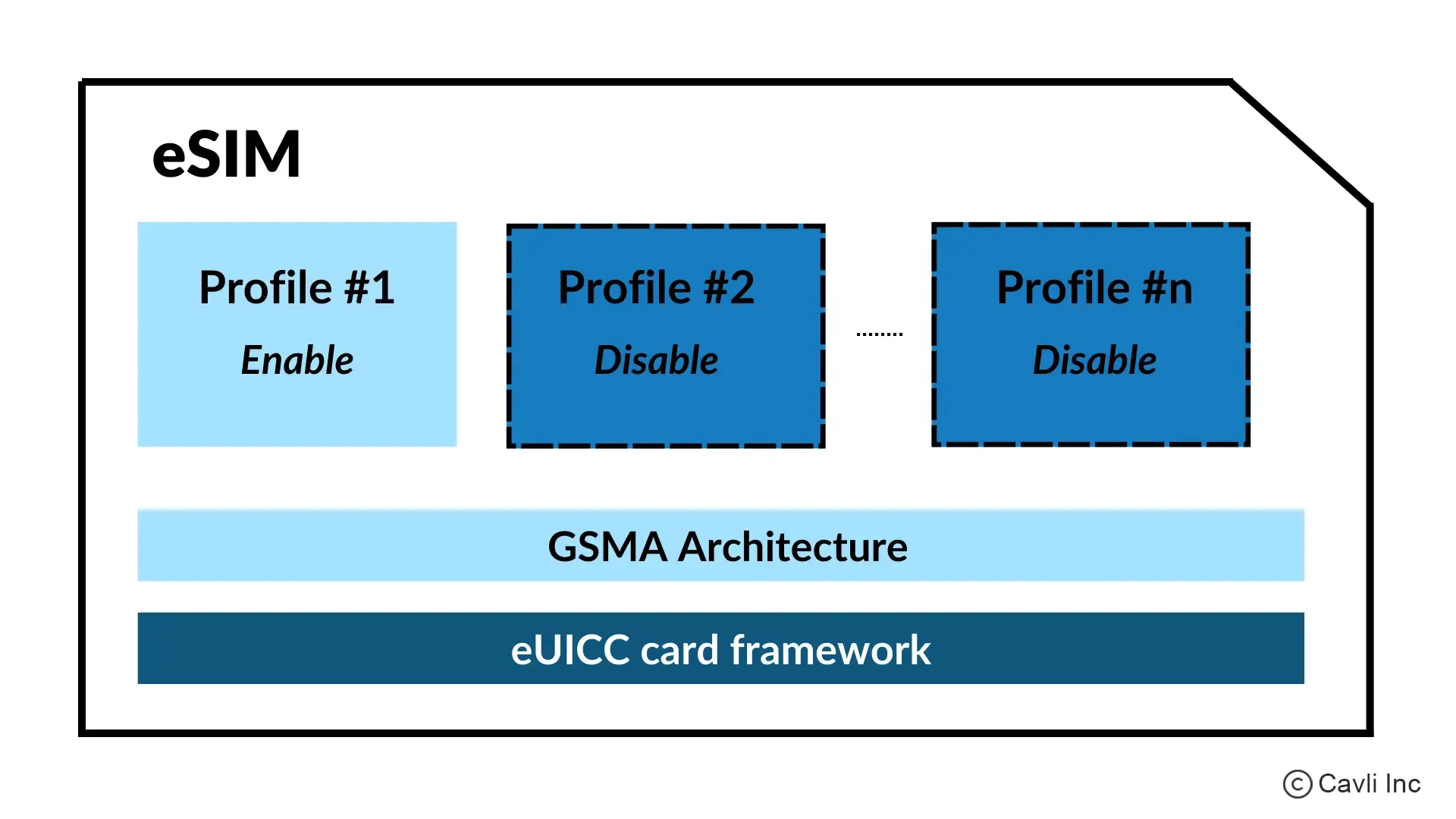
eSIM commonly describes the broader remotely provisionable SIM solution. eUICC, or embedded Universal Integrated Circuit Card, refers to the secure component and functionality capable of supporting remote management of operator profiles. MFF2 describes a solderable hardware form factor commonly used for embedded SIM implementations.
This means an eSIM should not simply be defined as “a SIM soldered onto the PCB.” The soldered MFF2 package is common in IoT, but the major operational advantage comes from the remotely provisionable architecture around the secure element and subscription profiles.
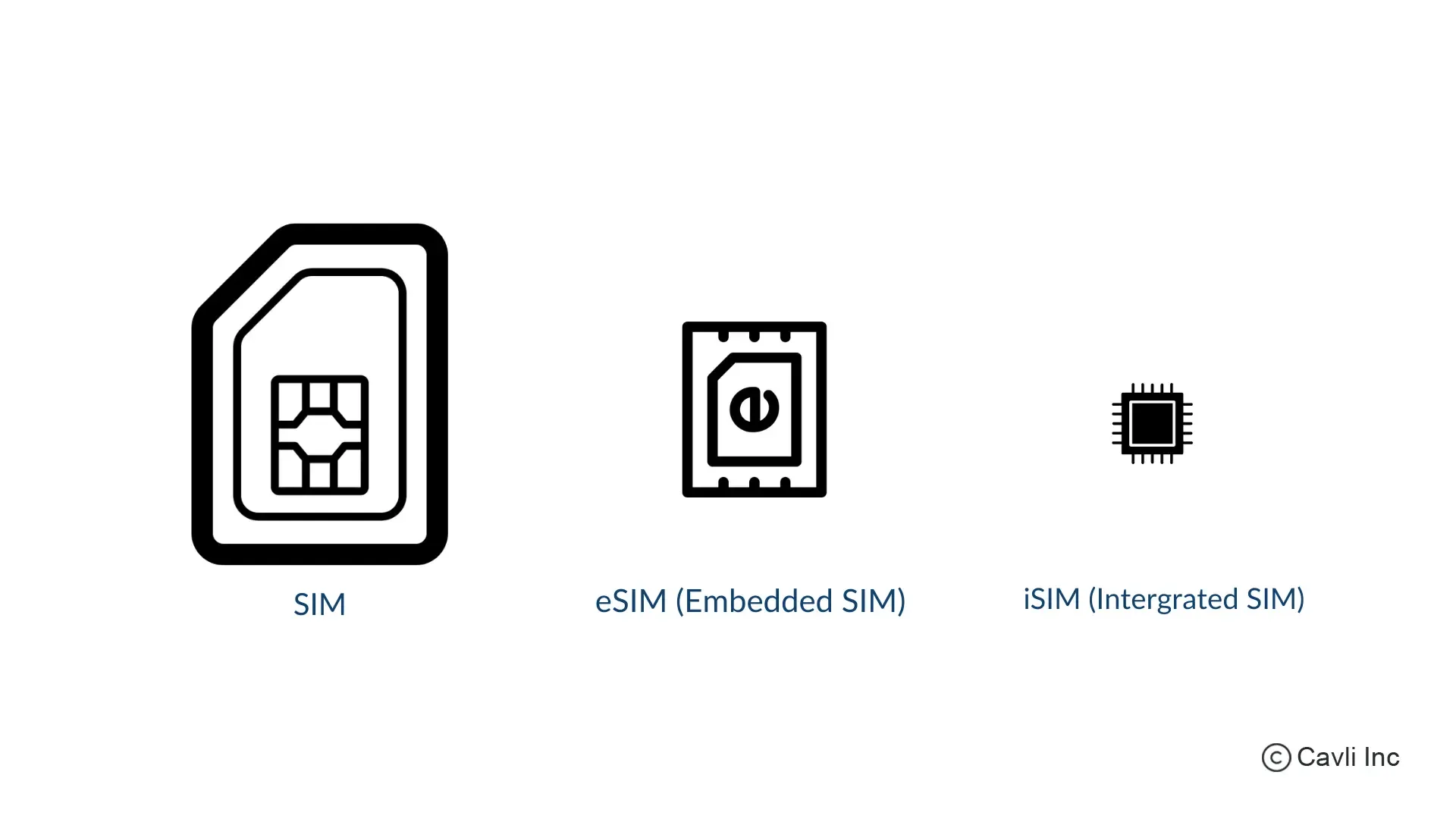
The SIM form-factor journey has moved from full-size SIMs through Mini-SIM, Micro-SIM, and Nano-SIM toward embedded implementations and more highly integrated technologies.
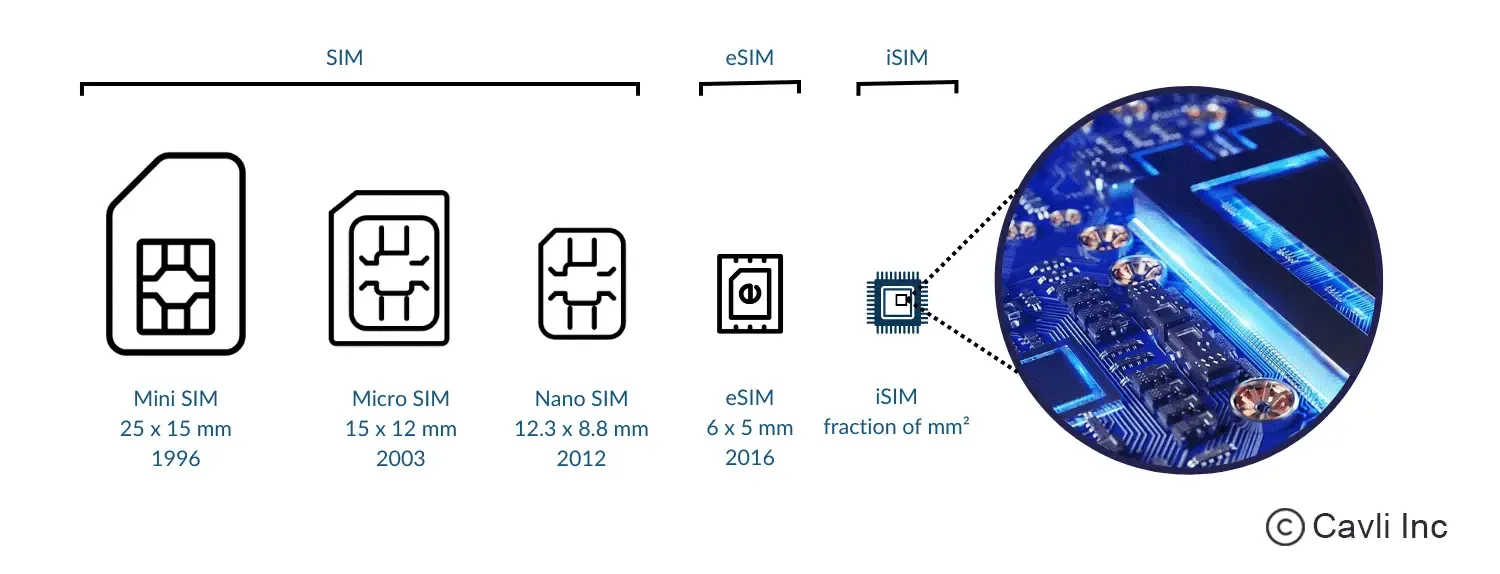
The distinction matters to product teams because physical packaging and remote provisioning capability are related, but they are not the same engineering decision.
How Does an eSIM Work in IoT Devices?
At a high level, an eSIM-enabled IoT device needs secure SIM functionality, an initial method of connectivity, compatible remote provisioning infrastructure, an operator profile, and a cellular modem or IoT module capable of connecting to the target network.
Once the appropriate subscription profile is enabled, the cellular modem uses those credentials to authenticate with the mobile network in much the same way the modem would when using a conventional SIM.
Where eSIM changes the model is profile lifecycle management. Compatible profiles can be securely downloaded and managed without requiring a technician to open the product and exchange a removable card.
How Remote SIM Provisioning Works
Remote SIM Provisioning (RSP) provides the framework for securely managing subscription profiles over the air.
For IoT devices, modern GSMA specifications define architectures for remotely provisioning and managing eUICCs, including devices that may be constrained by network conditions or limited user interfaces.
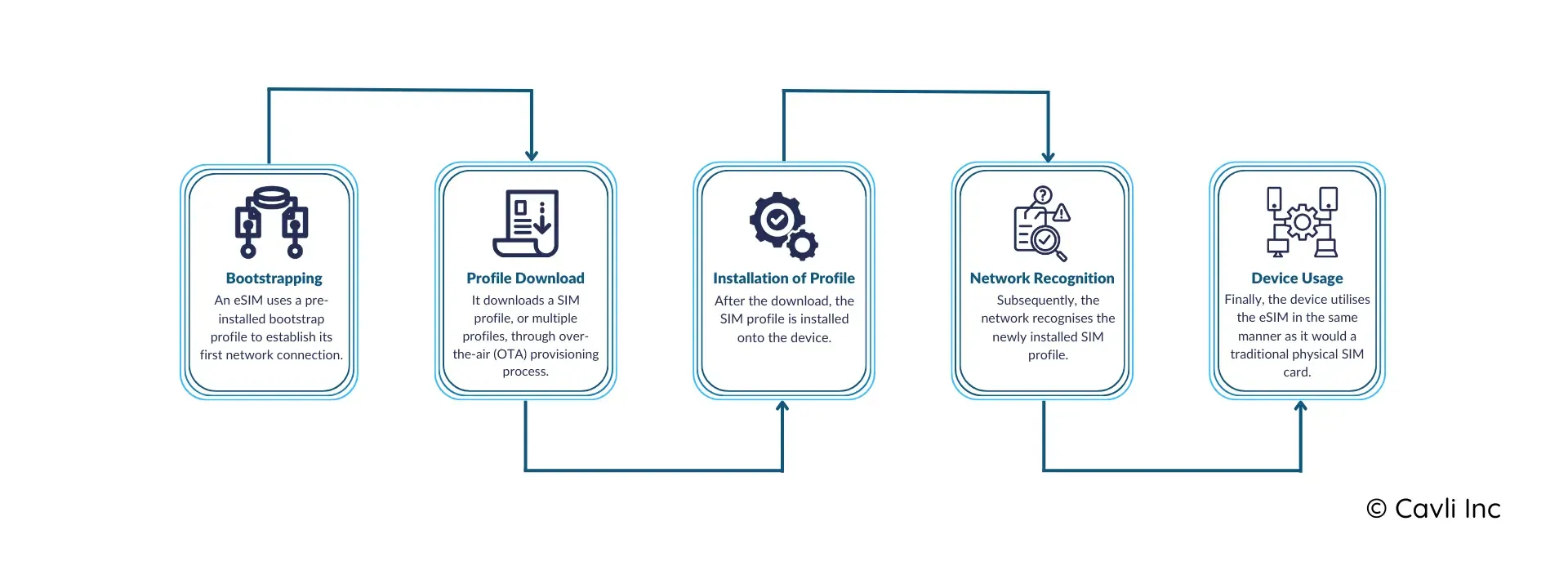
A simplified deployment flow can include:
- The device establishes initial connectivity.
- The provisioning infrastructure securely delivers the required operator profile.
- The profile is installed on the eUICC.
- The appropriate profile is enabled.
- The modem authenticates with the cellular network.
- Profile and connectivity lifecycle operations can subsequently be managed according to the deployed architecture and commercial agreements.
The exact process depends on the RSP architecture, operators, service providers, and implementation. An eSIM should therefore not be described as automatically selecting “the best carrier” simply because it is an eSIM.
For a deeper implementation-specific discussion, see Cavli’s guide to SGP.32 eSIM for IoT.
eSIM vs Physical SIM: What Is the Difference for IoT?
Both technologies can authenticate a device to cellular networks. The important differences for IoT appear in hardware integration and lifecycle operations.
| Feature | Embedded SIM / eSIM | Physical Removable SIM |
|---|---|---|
| Physical implementation | Often integrated or soldered in IoT hardware | Inserted into a SIM holder |
| SIM replacement | No routine physical card replacement for profile changes in supported RSP architectures | Typically requires physical access |
| Remote profile management | Supported with compatible eSIM/RSP infrastructure | Conventional SIM generally relies on the inserted subscription |
| Device enclosure | Can eliminate an externally accessible SIM tray | Requires SIM access in many designs |
| Environmental design | Can reduce reliance on exposed or removable contacts | SIM holder and access design must be considered |
| Deployment operations | Can support remote subscription lifecycle workflows | Physical logistics can be required |
| Multi-market use | Profiles can be managed according to supported RSP and operator arrangements | May require different SIM logistics or roaming arrangements |
The physical SIM is not inherently unsuitable for IoT. For accessible devices deployed in one region with stable connectivity arrangements, it may remain practical.
The value of embedded SIM technology becomes stronger when physical device access is difficult or when deployment scale makes manual SIM logistics operationally expensive.
Why Are Embedded SIMs Useful for IoT?
The most important eSIM benefits for IoT come from removing physical SIM handling from parts of the connectivity lifecycle.
For manufacturers, eliminating a removable SIM slot can simplify certain enclosure designs and reduce dependence on technicians manually inserting cards during deployment.
For operators of distributed devices, remote provisioning can make it easier to manage supported connectivity changes without visiting each asset individually.
For globally distributed products, eSIM can also provide a foundation for more flexible subscription management, although actual countries, operators, roaming arrangements, and profile availability still depend on the connectivity provider.
For more detailed guidance, Cavli’s The Future of eSIM for IoT Solutions resource explores eSIM provisioning and deployment considerations.
How Do Embedded SIMs Work with Cellular IoT Modules?
In many IoT products, the cellular subsystem is implemented using a pre-certified cellular IoT module. Depending on the product, SIM functionality may be provided through a physical SIM interface or an integrated eSIM option.
The architecture can be viewed as:
IoT application → host/device electronics → cellular IoT module → SIM/eSIM credentials → cellular network → cloud/application
An eSIM IoT module can reduce the number of separate connectivity components an OEM needs to integrate while creating a path toward remotely managed connectivity.
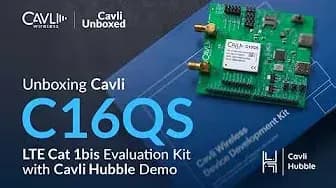
Cavli’s C16QS LTE Cat 1bis IoT module, for example, is available with integrated eSIM variants and can work with the Cavli Hubble platform for connectivity and device management.
The right module should still be selected based on cellular technology, band coverage, target markets, interfaces, GNSS requirements, power, form factor, certification needs, and product lifecycle-not simply because it includes eSIM.
Building an eSIM-Enabled IoT Device?
Compare cellular technology, regional bands, GNSS, form factor, interfaces, and eSIM management requirements before selecting your module.
eSIM for Global IoT Deployments
Global IoT products create a connectivity problem that does not exist to the same degree in single-country consumer devices.
A product may be manufactured in one location, activated in another, and later operate across multiple network environments. Large deployments also need a practical way to provision and manage connectivity after devices leave the factory.
eSIM and RSP can help separate aspects of connectivity provisioning from physical SIM logistics. However, eSIM does not automatically guarantee worldwide connectivity. Network availability still depends on supported bands, operators, commercial agreements, regulatory requirements, and the connectivity provider.
Cavli’s global IoT connectivity offering provides a commercial pathway for deployments that need supported network coverage and centralized connectivity management.
Planning a Global IoT Deployment?
Evaluate target countries, supported bands, network availability, provisioning requirements, eSIM lifecycle management, and remote device operations before production.
eSIM Security and Device Lifecycle Management
Security is an important part of eSIM architecture. Remote provisioning relies on secure elements, trusted provisioning interfaces, authentication, and cryptographic mechanisms to protect operator profiles and subscription credentials.
For IoT engineers, however, eSIM is only one layer of device security.
The wider product must still address secure boot, firmware integrity, authenticated cloud communication, credential protection, access control, OTA update security, and backend infrastructure.
Connectivity management is similarly broader than the SIM itself. Cavli Hubble centralizes connectivity and device-management capabilities across supported Cavli deployments and integrated eSIM implementations.
This is especially valuable for long-lived IoT products where connectivity problems, firmware issues, or provisioning changes may need to be handled after the device has already been deployed.
Where Is eSIM Used in IoT?
eSIM is particularly relevant where devices are deployed at scale, operate remotely, or need long service lives.
In asset tracking and logistics, a remotely deployed tracker may be difficult to retrieve simply to replace a SIM.
In smart metering and utilities, sealed or geographically distributed hardware benefits from reducing routine physical interaction.
For connected vehicles and mobility applications, embedded connectivity helps support telematics, diagnostics, and other network-enabled services.
Industrial monitoring devices, POS systems, smart-city infrastructure, healthcare devices, and remote equipment can face similar lifecycle-management challenges.
The benefit is therefore not tied to one industry. It comes from designing cellular connectivity so that device deployment and network-subscription management do not always require physical access to the hardware.
eSIM vs iSIM: What Changes?
eSIM and iSIM address similar goals but integrate SIM functionality differently.
A conventional embedded eSIM implementation typically uses a separate secure eUICC component. iSIM, or integrated SIM, takes integration further by moving SIM functionality into a secure area within the device’s main chipset or system architecture.
That can reduce separate component requirements and may be useful in highly space- or power-constrained designs, depending on the chipset and implementation.
It does not mean that eSIM is obsolete. Product architecture, available modules, certifications, connectivity-provider support, and lifecycle requirements determine which approach is appropriate.
For a deeper comparison, read Cavli’s dedicated iSIM guide.
How to Choose an eSIM-Enabled IoT Module
Start with the application rather than the SIM feature.
Define where the product will operate, which cellular technologies are available, required bands, expected data volumes, power constraints, positioning requirements, and product lifetime.
Then evaluate the module itself: physical dimensions, interfaces, antenna requirements, GNSS support, certifications, firmware-management capabilities, and integration effort.
Finally, evaluate connectivity operations. Ask how eSIM profiles will be provisioned, what networks are supported, how deployed SIMs and modules are monitored, and how firmware and connectivity issues will be diagnosed remotely.
The best eSIM module is therefore not simply the smallest module or the module with the longest feature list. It is the module and connectivity architecture that fit the device’s complete deployment lifecycle.
Need Help Selecting an eSIM-Enabled IoT Module?
Evaluate your application requirements, target regions, cellular technology, GNSS, interfaces, power budget, form factor, and connectivity-management needs with Cavli.
Related Cavli Resources for eSIM and IoT Connectivity
If you are evaluating embedded SIM technology for a new or existing IoT product, these Cavli resources provide deeper information on specific parts of the connectivity architecture.
- The Future of eSIM for IoT Solutions - Explore eSIM technology, provisioning, and considerations for IoT deployments.
- SGP.32 eSIM for IoT - Learn more about IoT Remote SIM Provisioning and SGP.32.
- iSIM Guide - Understand how integrated SIM architecture differs from conventional embedded eSIM implementations.
- Global IoT Connectivity - Explore Cavli’s connectivity options for IoT products deployed across supported markets and networks.
- Cavli Hubble - Explore connectivity and device-management capabilities for supported Cavli deployments.
Moving from eSIM Research to IoT Product Development?
Evaluate your cellular technology, module architecture, target regions, eSIM requirements, GNSS, interfaces, power requirements, and device-management strategy with Cavli.
Conclusion: Build Embedded SIM Connectivity Around the IoT Lifecycle
Embedded SIM technology is valuable in IoT because it changes how cellular connectivity can be provisioned and managed throughout a device’s operational life.
Instead of treating the SIM as a component that must always be installed, removed, or replaced manually, an appropriately designed eSIM architecture can support remote profile-management workflows for distributed connected products.
For OEMs, the decision should nevertheless be made at system level. The eSIM, cellular IoT module, radio technology, frequency bands, antennas, provisioning infrastructure, device-management platform, security model, and deployment geography all need to work together.
When those elements are evaluated as one architecture, eSIM for IoT can provide a more scalable foundation for connected devices-from trackers and smart meters to industrial equipment and mobility platforms.
Ready to Build or Scale an eSIM-Enabled IoT Product?
Explore Cavli’s cellular IoT modules with integrated SIM options and manage supported connectivity and deployed devices through Cavli Hubble.
Frequently Asked Questions About Embedded SIMs
What is an embedded SIM?
Is an eSIM the same as an eUICC?
Is every embedded SIM soldered to the PCB?
What is an eSIM IoT module?
What are the benefits of eSIM for IoT?
Does eSIM provide global connectivity automatically?
What is Remote SIM Provisioning?
What is the difference between eSIM and iSIM?
Is eSIM better than a physical SIM for IoT?
Author

Drishya Manohar
Sr. Associate - Content Marketing