
As connected devices scale into the millions, one reality has become impossible to ignore: most of them end up deployed in places where on-site intervention is difficult or operationally expensive. Smart meters sealed in cabinets, EV chargers spread across continents, POS fleet terminals distributed across retail chains, telematics units housed inside sealed automotive enclosures, and sensors operating in harsh industrial sites all share the same challenge: IoT connectivity solutions that must evolve without physical access. With operators changing, roaming rules tightening, and global deployments accelerating, plastic SIMs have become a bottleneck. eSIM solves this by making connectivity programmable, remotely manageable, and future-ready, shifting network control away from fieldwork and toward software.
What is eSIM?
eSIM technology is on the upswing, with more and more enterprises transitioning from plastic SIMs to embedded and software-defined connectivity. It enables remote activation, profile switching, and more over-the-air updates. The eSIM standards, along the way, eliminated the need for physical SIMs and significantly simplified the over-the-air SIM profile management.
An eSIM (embedded SIM) is a tiny, non-removable SIM chip that’s built directly into an IoT device. Unlike a physical SIM card you insert or replace, an eSIM is permanently soldered onto the circuit board and can download and switch mobile network profiles over the air.
In hardware terms, eSIM is implemented using the MFF2 package, a rugged, surface-mounted SIM chip, more compact than removable SIMs, making it ideal for IoT solutions such as POS terminals, telematics units, smart meters, asset trackers, wearables, and other industrial IoT devices. To learn more about the eSIM for IoT, read the blog here.
eSIM as a Technology Standard
Beyond hardware, eSIM is also a GSMA-defined technology standard that enables Remote SIM Provisioning (RSP). This standard lets devices securely download, activate, and switch operator profiles without any physical handling, enabling global deployments at a massive scale.
The Global System for Mobile Communications Association (GSMA) recently introduced a stable new-generation IoT eSIM standard, SGP.32, in 2024, marking a major step toward efficient IoT fleet deployment.
The eSIM ecosystem is built around two main provisioning standards: SGP.22 for consumer devices, which uses user-driven QR-based provisioning, and SGP.32 eSIM for IoT, which supports automated, cloud-triggered provisioning for large fleets of headless, UI-less devices.
SGP.32 eSIM for IoT introduces a centralized fleet-scale operator-agnostic framework that shifts control from individual devices to the cloud.
It enables true global interoperability by supporting remote SIM provisioning (RSP) and the embedded Universal Integrated Circuit Card (eUICC) management in network-constrained IoT devices or devices with no user interface. This allows large fleets to be provisioned, updated, and managed centrally using lightweight, secure messaging.
For IoT systems like POS devices, this is a tangible win: zero-touch rollout at stores, instant operator changes by region, or resilient failover when a network underperforms.
While payment terminals stay focused on transactions, the connectivity backend orchestrates profiles, policies, and fallbacks, resulting in faster deployments, higher uptime, and a lower total cost of ownership for multi-country POS fleets.
How SGP.32 eSIM Evolved from the SGP.22 eSIM Standard
SGP.22 is a device-based eSIM standard where provisioning relies on on-device logic, user interaction, and a client-driven pull workflow tied to the device’s UI and operating system.
As mentioned above, the SGP.22 eSIM standard follows a user-driven activation process that involves a human at the endpoint. It is a simple process when every IoT device is treated as a “smartphone.”
In this model, the IoT device itself must initiate the eSIM provisioning flow, usually by requesting an activation code or prompting a QR scan. This means a store associate (for POS devices) or a field executive from the operator must manually assist in changing the settings on each device. As a result, SGP.22 creates a dependency on one-by-one device-level configuration during every provisioning or operator-switch event.
The SGP.31 became the architectural foundation of the eSIM for IoT ecosystem. It defined the high-level framework, the core entities, and how they would interact. It outlines what IoT remote SIM provisioning should look like for fleets of headless devices, including POS terminals, and establishes the logical interface structure. SGP.31 is aimed at architects and planners: it is the blueprint that explains roles and flows.
What is SGP.32? The New IoT eSIM Standard Explained
We can compare the SGP.32 eSIM standard to a “company-owned car fleet solution.” As with the earlier analogy of standalone mobile phones under SGP.22, individual IoT endpoints in SGP.32 no longer request a SIM profile change on their own. Instead, every action is centrally orchestrated through the SGP.32 IoT eSIM provisioning framework.
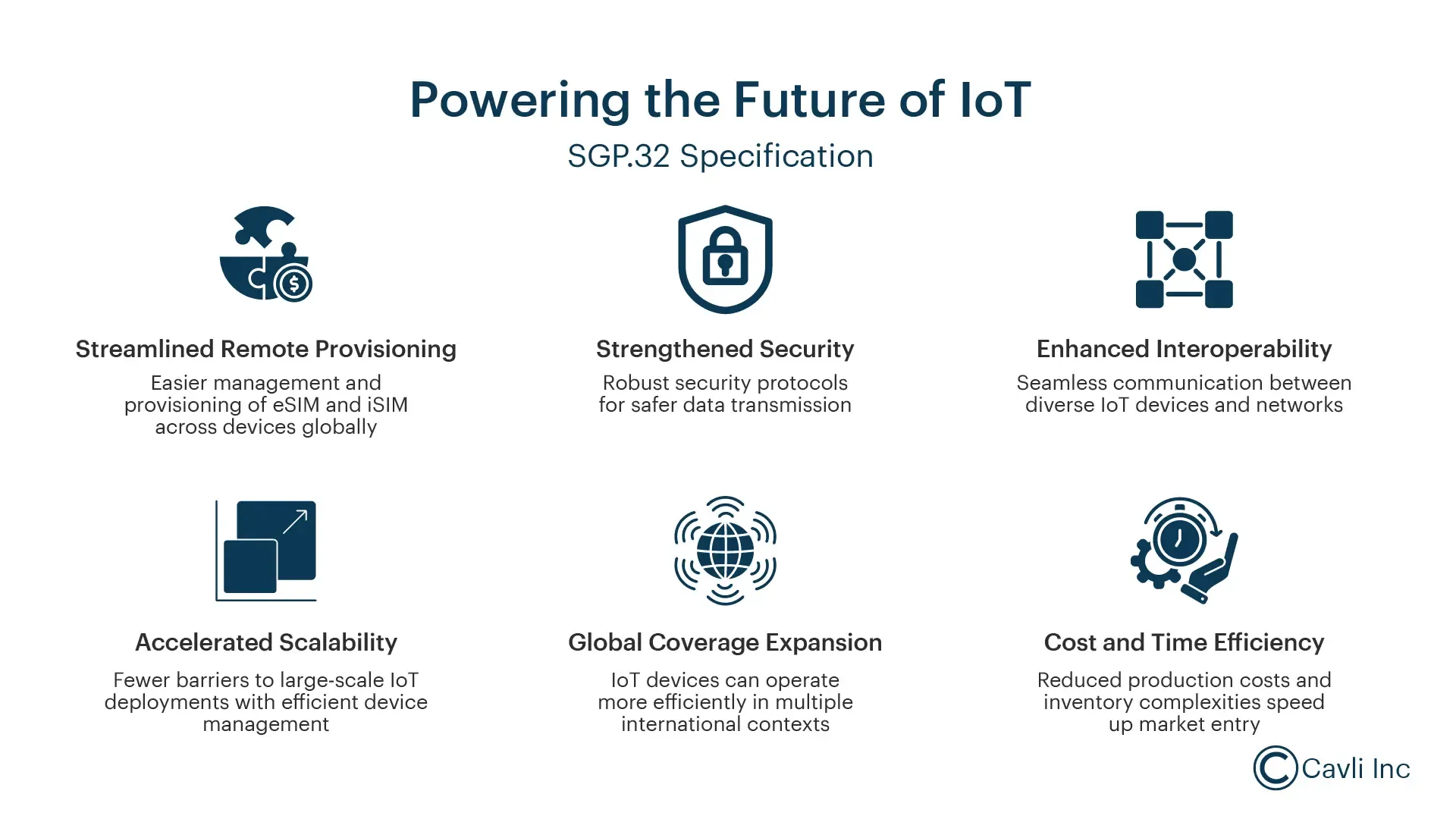
The SGP.32 eSIM standard includes a central brain, called the eIM (eSIM IoT Remote Manager), that coordinates the overall process. It is responsible for deciding:
- which operator/SIM profile each fleet device (POS machines, smart meters, etc.) should use.
- when to switch carrier profiles
- when to enable/disable an eSIM profile
It is a hybrid remote SIM provisioning model with push and pull mechanisms, mainly designed for the narrowband IoT, LTE-M, and 4G/5G IoT deployments. The major overhaul in the SGP.32 eSIM standard is that no manual intervention is required at the user endpoints, unlike the SGP.22 eSIM standard. It enables remote SIM provisioning over-the-air and is fully capable of managing network-constrained IoT fleets or any large-scale deployments with limited or no user interface, with its cloud-agnostic provisioning framework.
Working of SGP.32 eSIM IoT Standard
Network Architecture of SGP.32 eSIM IoT Standard
PSMOs (Profile State Management Operations)
These are profile-lifecycle commands executed inside the eUICC, such as enable/disable/delete a profile and list profiles. It is packaged and signed by the eIM and executed atomically by the eUICC.
eCOs (eIM Configuration Operations)
These carry eIM configuration data and control the association between an eIM and an eUICC.
eCOs can be cryptographically signed (signed eCOs) by the associated eIM, while unsigned eCOs are permitted only once, essentially during the initial association phase.
eIM- eSIM IoT Remote Manager
eIM, also called the eSIM IoT Remote Manager, prepares a signed eUICC Package that targets a specific eUICC, containing either Profile State Management Operations (PSMOs) or eIM Configuration Operations (eCOs). It then sends this package to the device via the IoT Profile Assistant (IPA) and later verifies the signed eUICC package result returned by the eUICC and acknowledges receipt.
What is an eUICC?
An eUICC (embedded Universal Integrated Circuit Card) is the secure element inside a device that stores one or more operator profiles and supports remote SIM provisioning (RSP). It is not simply a “SIM card”; it is a programmable and remotely manageable SIM platform defined by the GSMA. The eUICC can hold multiple profiles, enable/disable them securely, switch operators over the air, and execute cryptographic operations to protect the integrity of the SIM and the mobile network. To know more, read our blog here.
IPA- IoT Profile Assistant
The IPA is the SGP.32 component that bridges the device/eUICC with the cloud eIM. It communicates with the eIM over ESipa interface and can also interact with SM-DS over ES11 (with TLS server-auth), where the IPA essentially assumes the Local Profile Assistant (LPA) role from SGP.22 for discovery/auth flows.
LPA, the eSIM component responsible for all remote profile management activities in the earlier SGP.22 eSIM standard, is now replaced by the IPA.
Two deployment options in SGP.32 eSIM architecture
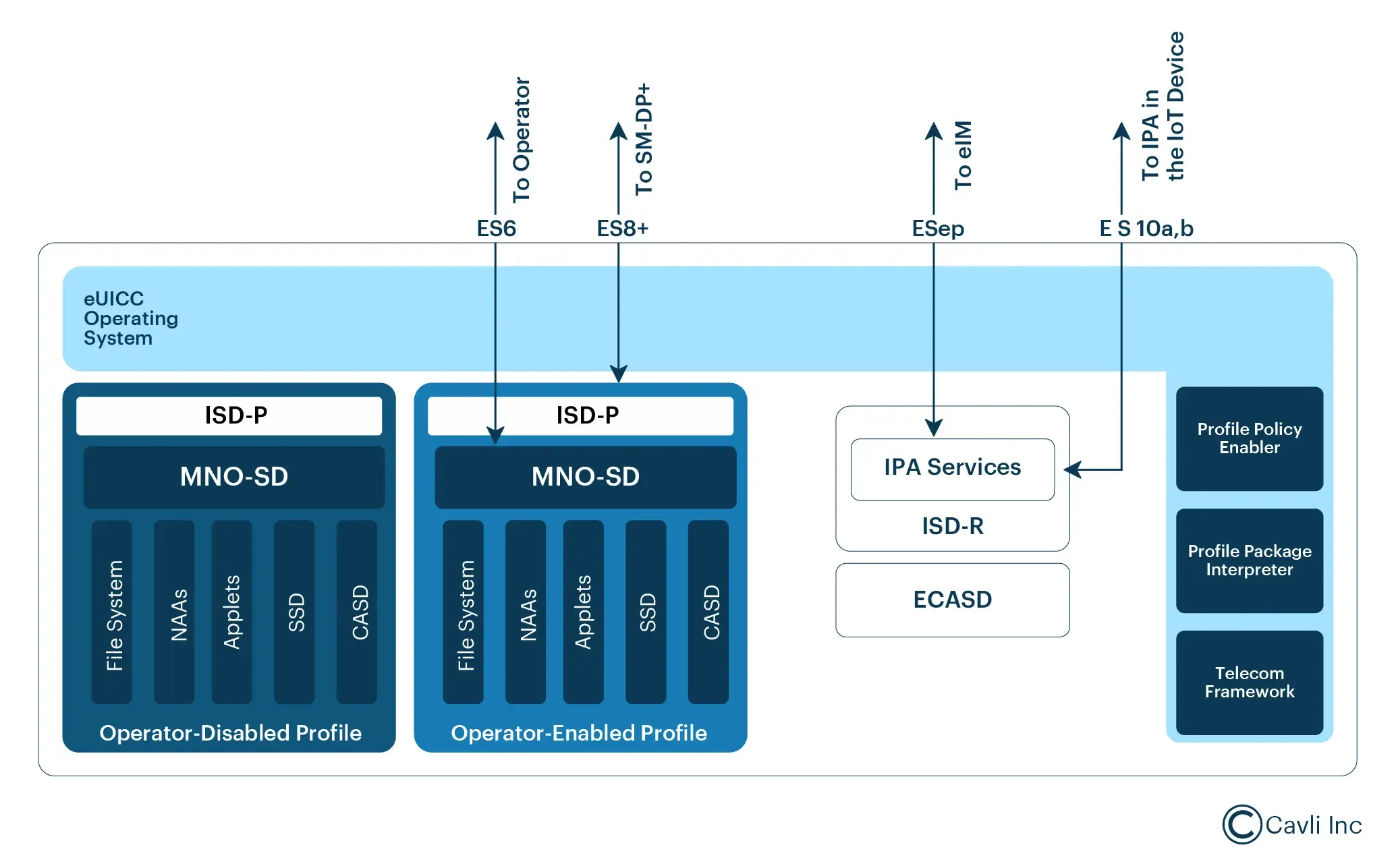
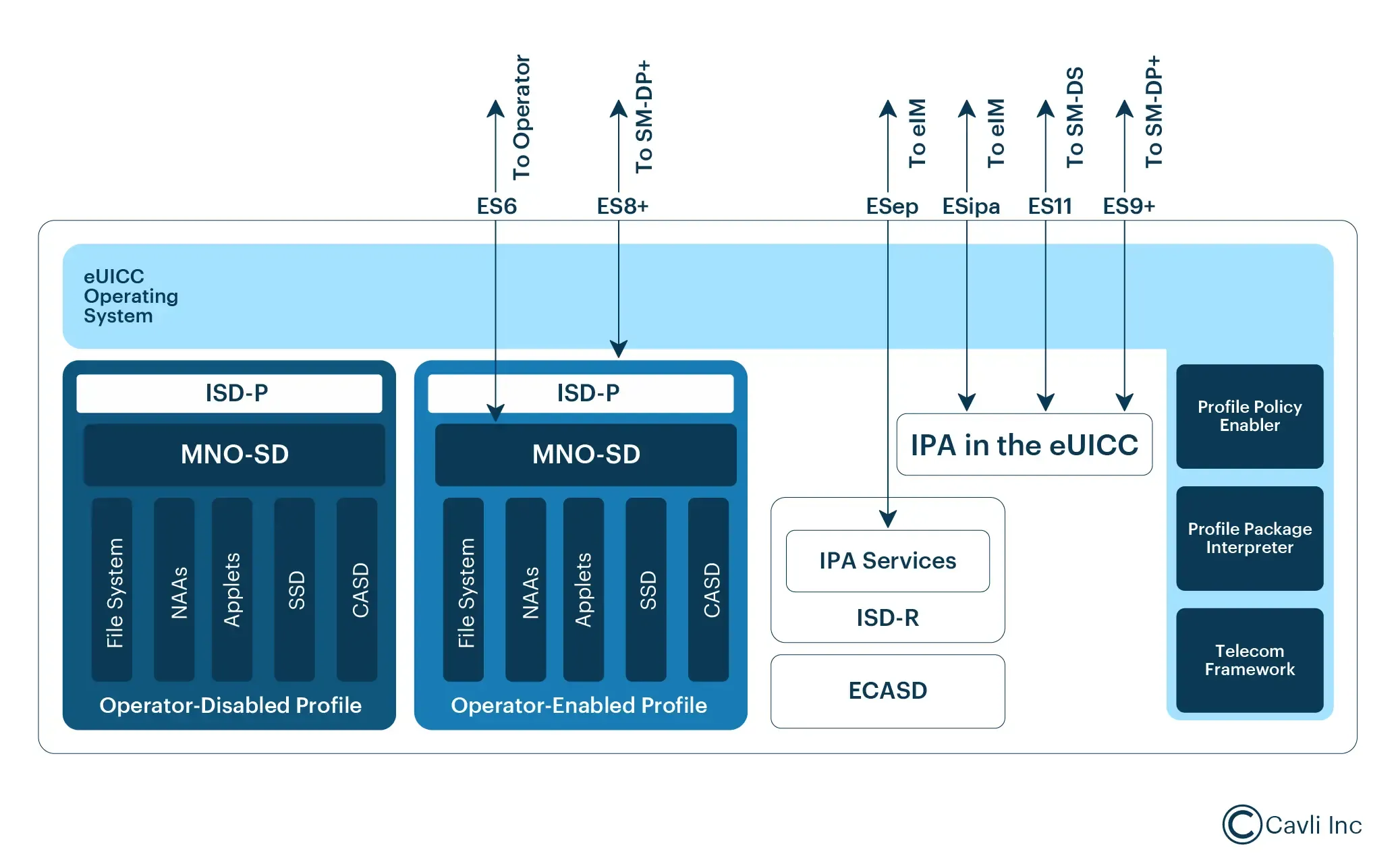
SGP.32 supports two placements for the IPA; while the rest of the ecosystem (eIM, SM-DP+, SM-DS, ES-interfaces) remains the same:
IPAd — IPA in the IoT Device (host OS/firmware)
The IPA runs on the device side and talks to the eUICC via ES10a/ES10b, while it talks to the eIM via ESipa; SM-DS/SM-DP+ interactions follow the standard ES11/ES12/ES9+ paths.
IPAe — IPA in the eUICC (inside the SIM)
The IPA is implemented inside the eUICC. The eUICC exposes ESipa/ ES11 directly to the device, reducing integration effort and removing the need for additional host-side interface logic. It simplifies device development while preserving the same eIM-orchestrated flows.
SM-DP+ (Subscription Manager – Data Preparation Plus)
SM-DP+ is an evolution of the legacy SM-DP (profile preparation) and SM-SR (secure routing and lifecycle management) functions used in the M2M SGP.02 standard. It consolidates both roles into a single server while also introducing new capabilities for modern eSIM workflows. It allows an end user or device to download profiles directly, even via QR codes or activation codes in the SGP.22 model.
In SGP.32, SM-DP+ is reused, but provisioning is orchestrated by the eIM, not by the device-side UI logic. The SM-DP+ continues to handle secure packaging and delivery of eSIM profiles, while the eIM functions as the central orchestrator for IoT deployments.
SM-DS (Subscription Manager – Discovery Service)
The SM-DS stores event records for eUICCs and provides the addresses of one or more SM-DP+ servers that hold available eSIM profiles for that device. In the SGP.32 eSIM architecture, both the IPA and the eIM can query the SM-DS to retrieve these events.
The SM-DS also incorporates some capabilities previously handled by the SM-SR in the older M2M SGP.02 standard. In profile availability discovery, removing the dependency on SMS or device-side polling enables automatic, lightweight discovery of new profile downloads without requiring a UI or manual actions.
RSP Workflow in SGP.32 eSIM for IoT Standard
Under SGP.32, Remote SIM Provisioning moves away from the device-driven (SGP.22) and operator-controlled (SGP.02) models. Instead, RSP is orchestrated entirely from the cloud through the eIM (eSIM IoT Manager) while the IPA (IoT Profile Assistant) inside the device executes instructions.
Device boots up with a bootstrap profile
Every SGP.32 POS terminal typically comes with a minimal bootstrap profile stored in the eUICC (per GSMA spec). This profile allows basic connectivity, access to SM-DS, and communication with the eIM.
eIM begins RSP orchestration
From the cloud, the eIM selects the appropriate operator profile for the device. Decision inputs include region/country compliance, signal quality, and roaming restrictions. The eIM replaces the older SM-SR role from SGP.02 and the on-device LPA role from SGP.22.
eIM queries SM-DS (via ES11′)
Using the ES11′ interface (unique to SGP.32), the eIM checks available operator profiles, pending download events, and configuration updates attached to the device’s EID.
eIM connects to SM-DP+ and requests a profile
The eIM establishes a secure connection with the SM-DP+ server using the ES9+′ interface. It authenticates itself and requests the correct operator profile based on rules such as region, network availability, cost, or retailer policy. This stage ensures the cloud system initiates and governs the entire provisioning process.
SM-DP+ prepares the secure profile package
Once the request is validated, the SM-DP+ prepares the operator profile in the form of a protected eUICC Package. This package includes the encrypted profile, plus signed instructions such as PSMO and eCO. Everything is cryptographically secured, so only the intended eUICC can install it.
eIM sends the package to the device via ESipa
The eIM then delivers the encrypted package to the device’s IoT Profile Assistant (IPA) through the ESipa interface. This transport is optimized for IoT networks and uses HTTPS, CoAP/DTLS, or other lightweight protocols to ensure that even low-bandwidth POS devices receive the package reliably.
IPA transfers the package to the eUICC
After receiving the package, the IPA, either running inside the device OS (IPAd) or inside the eUICC itself (IPAe), passes it on to the SIM hardware using ES10 commands. The IPA handles error recovery, retries, and fragmentation to ensure the package reaches the eUICC intact and ready for installation.
eUICC verifies and installs the new profile
Inside the secure element, the eUICC verifies the signature, checks for integrity, validates permissions, and then performs the profile installation according to the PSMO and eCO instructions. This step ensures the network operator profile is installed safely, with no possibility of tampering or unauthorized modification.
The new profile activates automatically
Once installation is complete, the eUICC activates the newly added operator profile and deactivates the bootstrap or previous profile. The device immediately transitions to the new mobile network without any user interaction, QR codes, or physical SIM replacement.
eUICC sends signed results back to the eIM
After activation, the eUICC generates a signed result report indicating the status of the installation, whether success, failure, or any intermediate states. This report travels back through the IPA to the eIM, ensuring the cloud has a trusted, cryptographically verified record of what happened on the device.
eIM updates fleet status and policies
On the cloud side, the eIM logs the entire event, updates dashboards or fleet records, and applies any operator selection or fallback policies for future IoT connectivity solutions. This gives fleet managers full visibility and control over thousands of POS devices at once.
The POS terminal is now fully live on the new network
With the new profile active, the device reconnects using the updated operator, enabling smooth payment processing, OTA updates, remote monitoring, and higher transaction reliability. The POS terminal is now fully provisioned and ready for operation, without any manual intervention.
M2M eSIM vs Consumer eSIM vs IoT eSIM
| Category | M2M eSIM | Consumer eSIM | IoT eSIM (SGP.32) |
|---|---|---|---|
| What it is | First-generation eSIM system for machine-to-machine devices | eSIM system designed for phones, tablets, wearables & consumer electronics | New-generation eSIM for IoT devices with resource-constrained or no UI |
| Year Published | 2013 | Completed in 2017 | Released in 2023 (stable version 2024) |
| Ideal Use Case | Devices without UI, fixed-function M2M modules | Devices with UI like phones, tablets, and watches | IoT devices with constrained networks, no UI, or fleet-scale requirements |
| Key Architecture Elements | SM-DP, SM-SR | SM-DP+, LPA, optional SM-DS | SM-DP+, SM-DS, IPA (IPAd/IPAe), eIM |
| eUICC Support | Yes | Yes | Yes |
| RSP Support | Yes | Yes | Yes |
| Provisioning Model | Push Model (server-driven via SMS/HTTPS) | Pull Model (QR code, activation code, UI-driven) | Pull + Push Hybrid via eIM; supports LPWAN and SMS-less devices |
| Profile Switching | Vendor locked; multiple profiles allowed, but usually contractually restricted | User-centric; stores multiple profiles, but only one is active at a time | Not vendor locked; flexible switching; supports bulk ops and queued operations |
| Constraints | RSP is complex; vendor lock-in, long integration cycles | Needs UI interaction; not scalable for fleet deployments | Ecosystem still maturing; full compliance specs expected 2025 |
Transition of Physical SIMs to eSIMs in POS
The Physical SIM Era: Manual, Costly, and Time-Consuming
For years, POS terminals relied on removable SIM cards, tiny plastic chips that had to be physically inserted, swapped, or replaced. Each deployment required on-site technicians, store-level configuration, and manual verification. If connectivity failed, authorized personnel had to travel to the location, access the terminal, and troubleshoot or replace the SIM. This made large-scale POS rollouts expensive and slow.
Growth of 4G/Android POS Devices Opened the Door
As POS terminals evolved into smarter, Android-based devices, the industry began adopting embedded components. Manufacturers used integrated eSIM modules, where connectivity was configured digitally rather than physically. But this still couldn’t solve multi-country retail and fintech companies wanting flexibility without shipping different SIM cards to each region.
Introduction of Consumer eSIM (SGP.22) Enabled First Real Shift
Between 2017 and 2019, GSMA’s consumer eSIM standard (SGP.22) made it possible for POS devices to download operator profiles via QR codes or activation codes. This reduced shipping complexity and SIM logistics, but it still required user interaction and per-device activation, manageable for small fleets but not ideal for national/global rollouts.
The Breakthrough: SGP.32 Made eSIM Truly Fleet-Ready
The launch of the SGP.32 IoT eSIM provisioning changed everything. Unlike SGP.22, SGP.32 does not depend on:
- QR codes
- Device UI
- Local user actions
- Complex on-device apps
Instead, it provides cloud-driven, fully automated, zero-touch provisioning for complete POS fleets through the eIM and IPA, using lightweight and secure communication protocols. This approach makes eSIM deployments practical, scalable, and cost-effective across global POS connectivity solutions.
Why SGP.32 eSIM is Transforming POS Connectivity
Zero-Touch Rollouts with One Global Device
SGP.32 eSIM for POS terminals activates at power-on, eliminating SIM insertion, QR code scanning, or any other manual setup. A single global SKU can be shipped for global operations, and an operator profile for any region can be downloaded, drastically simplifying production, logistics, and deployment.
Always-On Connectivity with Smart Network Switching
With multiple profiles and SGP.32’s cloud-driven provisioning, POS devices can automatically switch operators when coverage weakens or when they move across regions. This eliminates technician visits and keeps transactions flowing without downtime.
Lower Lifetime Operating Costs
By removing physical SIM handling, field service calls, store-level provisioning, and roaming dependencies, SGP.32-compatible IoT hardware significantly reduces both deployment and operational expenses for global POS connectivity solutions.
Future-Ready and Centrally Managed Fleets
SGP.32-compatible IoT hardware supports next-gen technologies like emerging 5G IoT networks while enabling full cloud governance, activation, switching, policy updates, and diagnostics of IoT connectivity solutions; all from a central dashboard.
SGP.32 Security Benefits for Payment-Terminal Compliance
Tamper-Proof Connectivity Built for Payment Security
POS terminals operate in high-risk environments where SIM theft, cloning, and tampering can directly compromise money flow. With soldered eSIMs under SGP.32, the SIM is locked inside the secure element (a tamper-resistant, dedicated hardware chip), making physical tampering nearly impossible and drastically reducing fraud vectors.
Encrypted Profile Delivery That Meets PCI Expectations
Under the SGP.32 eSIM standard, every operator profile is delivered as a cryptographically signed package (PSMO/eCO), ensuring that payment terminals only accept trusted profiles.
Secure Fallback Policies That Prevent Transaction Outages
A failed network should never cause failed payments. SGP.32 allows POS fleets to define secure operator fallback rules from the cloud, ensuring devices automatically switch to approved networks without exposing them to unauthorized profiles.
Stronger Device Identity = Stronger Merchant Security
With SGP.32, every POS terminal maintains a verifiable, immutable identity tied to its eUICC. This eliminates SIM-swapping attacks, counterfeit devices entering the fleet, and impersonation risks, which is critical for compliance-heavy payment systems.
Cavli Cellular Modules for Designing POS Solutions
As connected payments evolve into the backbone of modern retail, cellular technology paired with eSIMs is becoming fundamental to building scalable, resilient POS ecosystems. Cellular connectivity ensures secure, low-latency communication across diverse environments-whether indoors, outdoors, stationary, or mobile- while eSIM adds the flexibility to switch network profiles remotely, enabling zero-touch activation and maintaining consistent service across regions. Together, they eliminate the friction of physical SIM handling and simplify lifecycle management for fleets spanning basic card readers, handheld terminals, smart POS devices, and retail kiosks.
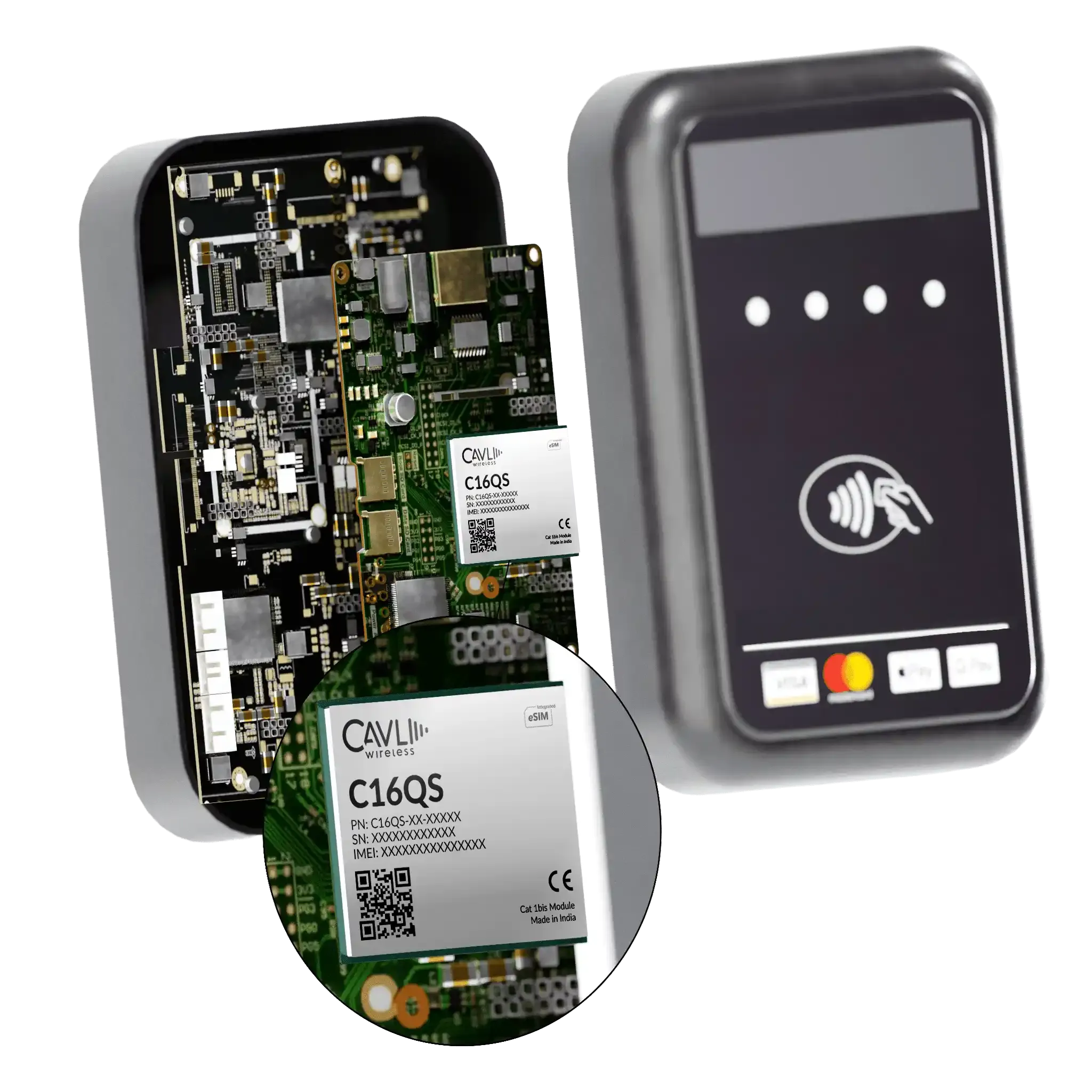
Cat 1bis Cellular IoT Modules for POS Devices
LTE Cat 1 bis represents the most economical cellular IoT solution designed for basic POS applications where cost optimization is paramount. The LTE Cat 1bis module, C16QS, is an integrated eSIM module that can be designed in a modem-only configuration, with an external microcontroller unit (MCU) carrying out display functions and transaction processing.
This architecture provides excellent flexibility for manufacturers who want to maintain control over their application logic while leveraging Cavli’s proven cellular network connectivity. With data rates reaching up to 10 Mbps downlink and 5 Mbps uplink, C16QS delivers sufficient bandwidth for essential POS connectivity operations, including transaction processing, receipt printing, and basic inventory management.
The external MCU design enables customized user interfaces and specialized payment workflows, making LTE Cat 1bis modules particularly well-suited for small retail establishments, food trucks, market stalls, and other cost-sensitive applications where basic payment functionality is necessary without compromising reliable connectivity.
To understand more about how C16QS optimizes smart payment solutions for retail and kiosk applications, read our customer case study here.
Cat 1/Cat 4 Cellular IoT Modules for POS Devices
Linux-based Ca1/Cat 4 Cavli IoT modules with integrated eSIM offer enhanced functionality for intermediate POS applications by directly driving display operations and supporting comprehensive payment processing capabilities. Cavli LTE Cat 1 and Cat 4 IoT modules, such as C10QM and C20QM, integrate advanced display controllers that support Display Bus Interface (DBI) displays, eliminating the need for external display drivers and reducing overall system complexity.
A critical advantage of POS solutions based on Cat 1/Cat 4 IoT modules with integrated eSIM is their 2G fallback capability, which automatically switches to 2G networks when LTE coverage is unavailable. This redundancy significantly improves transaction reliability, helping merchants quickly determine whether an issue is connectivity-related or device-level, reducing troubleshooting time, and minimizing transaction downtime.
The integrated architecture supports physical button interfaces, enabling tactile user interaction alongside basic display capabilities. This hybrid approach is particularly valuable in high-traffic retail environments where durability and ease of use are essential.
These modules excel in soundbox development through their I2C and SPI interfaces, enabling the creation of comprehensive audio feedback systems. Soundbox functionality transforms the payment experience for both retailers and customers by delivering customizable audio messages after each transaction, providing confirmation, and optionally conveying promotional content or loyalty program updates.
LTE Cat 1 and Cat 4 technology-enabled integrated eSIM modules deliver higher-throughput connectivity and greater processing headroom for sophisticated POS applications that demand performance, multimedia capability, and advanced service delivery, such as vending machines, interactive kiosks, and EV charging stations.
To learn more about POS Solutions and its market trend, download the whitepaper “Standalone Cash Registers to Connected Checkout Terminals: The Modern POS Playbook” here.
Conclusion
SGP.32 introduces a connectivity model that finally matches the pace of modern retail, delivering faster deployments, smarter networks, and POS fleets that manage themselves rather than relying on technicians. With SGP.32 eSIM for POS terminals, the industry transitions from SIM cards tied to hardware to eSIM profiles orchestrated entirely from the cloud. This shift marks a true turning point for POS connectivity, replacing device-bound, manual provisioning with a scalable, automated system designed for speed, flexibility, and operational continuity.
By enabling fully remote, operator-agnostic provisioning, SGP.32 transforms how POS devices connect and evolve across global markets. Every terminal can now be activated, updated, and optimized from the cloud, eliminating regional SKUs, on-site interventions, and unpredictable network gaps. For retailers, it delivers uninterrupted transactions; for OEMs, it unlocks global product simplicity; and for payment systems, it ensures stronger, more consistent security across every device. Thus, SGP.32 becomes the new foundation for next-gen POS connectivity, setting the stage for globally scalable, secure, and truly autonomous payment ecosystems.
Go Beyond and Explore
What is the eSIM IoT Standard?
The eSIM IoT standard refers to the GSMA’s latest specification, SGP.32, designed specifically for IoT devices. Unlike earlier eSIM standards built for either M2M devices (SGP.02) or consumer smartphones (SGP.22), the IoT standard creates a lightweight, cloud-controlled, operator-agnostic system that works for large fleets of devices with limited user interfaces, constrained networks, or wide geographic distribution.
It enables IoT devices to download, switch, and manage cellular profiles remotely without relying on QR codes, SMS, or on-device user interaction. The system is built around two key components, eSIM IoT Manager (eIM) and IoT Profile Assistant (IPA), which shift provisioning logic from the device to the cloud, allowing enterprises to onboard and manage thousands of devices at scale.
In simple terms, the eSIM IoT standard allows connected devices, like POS terminals, sensors, trackers, and smart meters, to automatically activate and maintain the best network connection with zero touch, anywhere in the world.
Compare the SGP.02, SGP.22, and SGP.32 standards
The SGP.02 M2M standard was the first-generation eSIM framework, designed for machine-to-machine devices that have no user interface. It uses a server-driven control model where provisioning is pushed from backend systems through entities like SM-DP and SM-SR. Because it relies heavily on SMS/HTTPS transport and operator-led discovery, it is integration-heavy and tends to lock deployments into long-term relationships with the provider.
The SGP.22 consumer standard modernized eSIM for smartphones, tablets, wearables, and laptops. It introduced a device-driven pull model, where the user triggers provisioning through QR codes, activation codes, or device settings. This model depends on the LPA (Local Profile Assistant) and the SM-DP+ server, with optional discovery via SM-DS. Transport is largely HTTPS-based, aligning with consumer operating systems and UI flows.
The SGP.32 IoT standard is the newest and most flexible model, engineered for IoT devices such as eSIM for POS terminals, smart meters, asset trackers, and industrial gateways. It shifts provisioning to a cloud-driven approach through the eIM (eSIM IoT Manager) and IPA (IoT Profile Assistant), while still reusing SM-DP+ and SM-DS for compatibility. SGP.32 supports both HTTPS and lightweight IoT transports such as MQTT, CoAP, and DTLS over UDP, making it suitable for constrained devices or low-bandwidth networks.
What are the SIM challenges faced in deploying POS solutions globally?
Fragmented Network Coverage Across Regions
POS terminals depend on stable cellular connectivity, but coverage quality varies dramatically across geographies. A network that works well in one market may perform poorly in another, causing dropped transactions, slower authorizations, and inconsistent service reliability.
SIM Logistics and Carrier Fragmentation
Traditional SIM-based POS deployments require different SIM cards, different operators, and different rate plans for each country. Managing physical SIM inventory, negotiating multiple carrier contracts, and handling per-region connectivity rules quickly become complex and costly as deployments scale.
High Operational Costs for Field Support
Every SIM swap, configuration change, or troubleshooting incident often requires a technician to physically visit the store. These field operations create delays, increase downtime, and raise the overall cost of ownership, especially when devices are spread across international markets.
Regulatory and Roaming Restrictions
Many regions enforce strict local connectivity rules, restricting permanent roaming or requiring devices to use domestic carriers. Global POS connectivity solutions struggle with these telecom regulations, which force operator switching, new compliance checks, and region-specific connectivity planning.
Security and Fraud Vulnerabilities
Global POS connectivity solutions are exposed to risks such as SIM theft, unauthorized swapping, cloning, or tampering. Ensuring PCI compliance, securing device identity, and maintaining encrypted communication channels become more challenging when hardware is deployed at scale across diverse environments.
Inconsistent Hardware SKUs and Manufacturing Overhead
POS OEMs often need to produce multiple regional variants of the same device—each tied to a different modem band, SIM form factor, or carrier requirement. This increases manufacturing complexity, raises stock fragmentation, and slows down global distribution.
Limited Visibility and Remote Control
Managing global POS connectivity solutions across markets becomes difficult without uniform connectivity. Companies struggle with real-time diagnostics, profile updates, status monitoring, and centralized control when each region uses different connectivity infrastructure and backend processes.
SGP.32 vs Physical SIM: Which Is Better for IoT and POS?
For IoT and global POS connectivity solutions, SGP.32 eSIM is significantly better than a physical SIM, because it removes nearly all operational friction that comes with scaling connected devices. Physical SIMs depend on manual handling, inserting cards, swapping carriers, and provisioning at each site, which becomes expensive and slow when deploying thousands of POS devices across different regions.
In contrast, SGP.32 enables zero-touch activation using a bootstrap profile, allowing every device to self-activate from the cloud the moment it powers on. This also unlocks a single global hardware SKU, since operator profiles can be assigned remotely based on region, coverage, or cost, instead of shipping different SIM cards to different countries.
SGP.32 eSIM for IoT also improves network resilience because profiles can be switched over the air whenever connectivity weakens, ensuring global POS connectivity solutions stay online without technician visits. Security is another major advantage: all profiles and lifecycle actions are delivered as signed, tamper-proof eUICC packages, and soldered eSIMs prevent physical SIM theft or unauthorized swaps, a common risk in unattended terminals.
Overall, SGP.32 reduces the total cost of ownership by eliminating SIM logistics, roaming dependency, store-level provisioning, and field support cycles. Physical SIMs still work for small, static, single-country deployments, but for global POS connectivity solutions and IoT fleets that move, scale, and operate globally, SGP.32 is the far superior, future-proof connectivity model.
Author

Drishya Manohar
Sr. Associate - Content Marketing