

For over a decade, the IoT industry has assumed that connectivity would converge into a seamless global layer. Devices would connect anywhere, switch networks effortlessly, and operate without friction. However, this vision is being tested.
According to Ericsson, IoT deployments span a range of connectivity requirements-from massive, low-power networks to ultra-reliable, low-latency industrial systems-making it difficult for any single network to serve all use cases. Multi-connectivity architectures combining terrestrial and satellite networks are able to deliver over 95-99% service availability across diverse environments, highlighting the limitations of single-network approaches.
What is emerging is a layered model of connectivity-shaped not only by technology but by regulation, economics, and operational realities. Enterprises, governments, and smaller operators are increasingly building their own connectivity stacks, from private LTE and 5G networks to localized core deployments, multi-operator models, and hybrid cellular-satellite architectures. These micro-networks are redefining how global connectivity is used, not replacing it.
The Reality Check: Why Global Connectivity Hasn’t Fully Materialized
The idea of global IoT connectivity gained momentum with eSIM, promising that devices could switch operator profiles dynamically, eliminating dependency on a single network. But the reality has been more complex.
As Satyajit Sinha, Senior Principal Analyst at IoT Analytics, points out, while profile switching has improved flexibility, it hasn’t eliminated the complexity. Roaming still plays a significant role, and building partnerships across operators remains a challenge. Enterprises are often still creating localized network cores across regions to approximate global coverage rather than relying purely on roaming.
Regional dynamics further complicate the picture. In markets like India, regulatory constraints fundamentally reshape connectivity choices. As Surendar Kannan, VP-Sales, APAC at Cavli Wireless, explains, in markets like India, data localization requirements make roaming-based architectures impractical, forcing enterprises to deploy localized connectivity models. What may appear as a technical decision is, in reality, driven by compliance.
Taken together, these factors highlight a deeper truth: connectivity is no longer just a technology issue-it is a regulatory, commercial, and operational one.
From Convergence to Coordination: The Rise of Layered Connectivity
The rise of micro-networks might seem like fragmentation, but it is actually the evolution of a more coordinated, layered architecture where different network types serve distinct roles within a unified system. As Dr. Anand Nayyar, Professor and Scientist at Duy Tan University, Vietnam, these layers are becoming complementary rather than substitutive - public cellular provides scale, private networks deliver control, and satellite extends reach. The value lies not in any one layer, but in how they operate together.
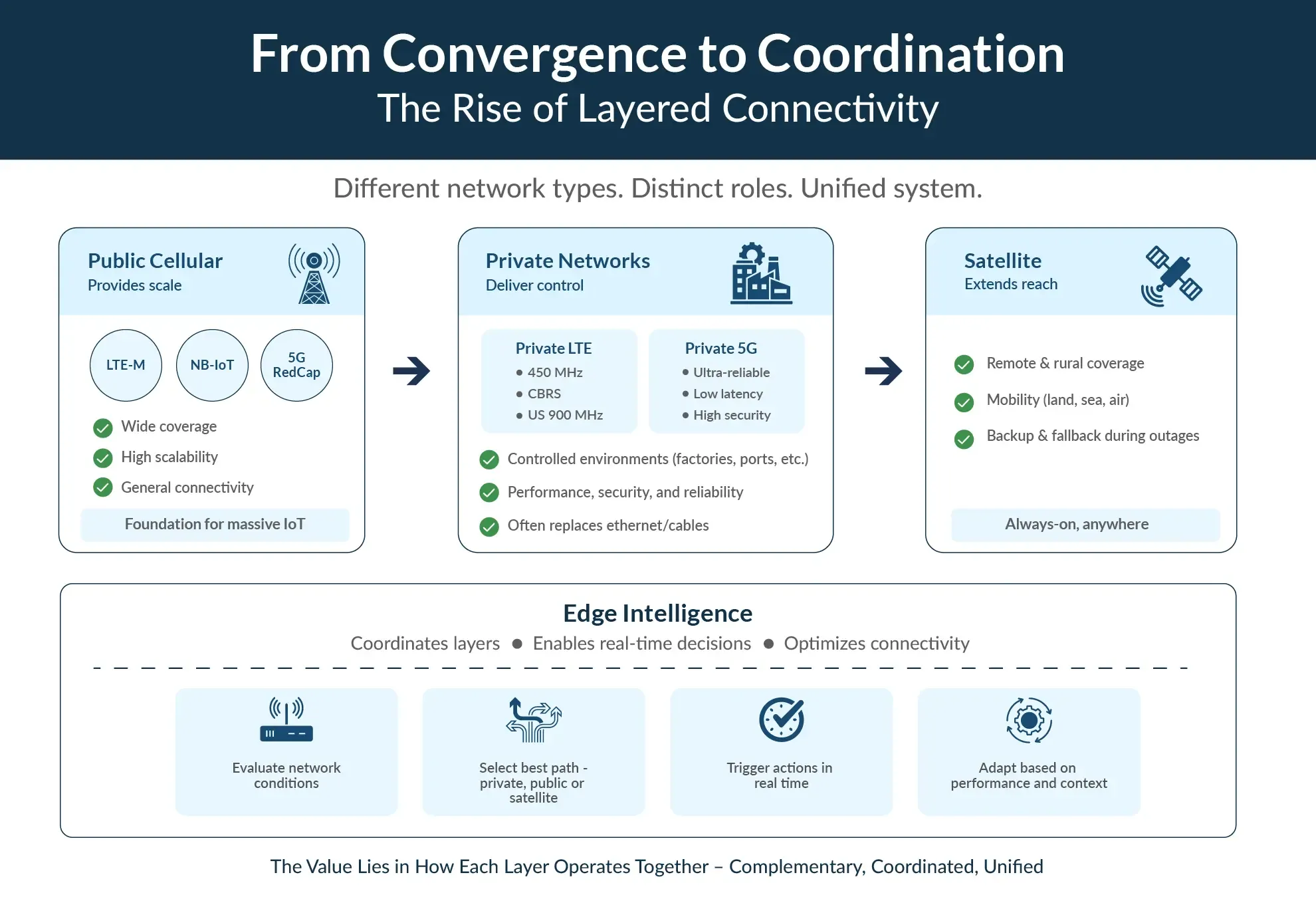
Public cellular networks remain the foundation for general connectivity, offering scalability through LTE-M, NB-IoT, LTE Cat 1bis, and 5G technologies such as 5G RedCap and full 5G NR. Each of these technologies addresses a different segment of the IoT spectrum, from ultra-low power deployments to high-performance, latency-sensitive applications.
While 5G and LPWAN often dominate IoT discussions, technologies across the cellular spectrum are evolving to serve distinct roles. LTE Cat 1bis is emerging as a practical bridge for cost-sensitive, mid-bandwidth applications, offering a balanced mix of coverage, power efficiency, and simplified single-antenna design, especially relevant in regions transitioning away from 2G/3G. At the other end, 5G NR enables ultra-high throughput and low-latency connectivity for data-intensive and real-time applications, while 5G RedCap introduces a streamlined 5G tier optimized for mid-range IoT deployments requiring longevity, efficiency, and global scalability.
This evolution is reflected in module ecosystems as well. Cavli’s Cat 1bis portfolio-including the C16QS, C17QS, and CQ16-supports scalable deployments across use cases such as smart metering, asset tracking, and retail devices. For mid-tier 5G adoption, modules like the CQM220 (5G RedCap with LTE Cat 4 fallback) enable long lifecycle deployments with balanced performance and efficiency. At the high-performance end, 5G NR modules such as the CQM212 and CQM215 power bandwidth-intensive and latency-critical applications, from advanced industrial systems to next-generation networking devices. Together, these solutions reinforce the role of public cellular as a flexible and evolving layer within a broader multi-network architecture.
Gopinath Krishnamurthy, Former VP - EMEA, Cavli Wireless, explains that private networks are often driven by regulatory frameworks such as 450 MHz, CBRS, and US 900 MHz, as well as by market forces, especially in large deployments like seaports and factories, where private 5G replaces Ethernet cables for seamless communication.
Edge intelligence binds these layers together. Devices are no longer passive endpoints but decision nodes capable of evaluating network conditions and selecting connectivity paths. As NPUs at the edge grow more powerful, device-level edge intelligence is increasingly used for functions like alarm triggering, monitoring, and application redirection. This allows for real-time decision-making and optimization in use cases like Lidar systems, vending machines, and dashcams.
Connectivity Comparison: Public vs Private vs Satellite
| Parameter | Public Cellular | Private Networks | Satellite (NTN) |
|---|---|---|---|
| Coverage | Wide-area (urban + rural) | Limited to defined premises | Global (including remote & oceans) |
| Deployment Model | Operator-managed | Enterprise-owned / dedicated | Operator-managed (space-based) |
| Latency | Medium (20–80 ms typical) | Low (<10–20 ms) | High (100–600+ ms depending on orbit) |
| Bandwidth / Throughput | Medium to high (4G/5G dependent) | High (especially 5G private) | Low to medium |
| Reliability | Good, but depends on network congestion | Very high (dedicated network) | High for coverage, variable performance |
| Mobility Support | Excellent (designed for moving devices) | Limited (within coverage zone) | Excellent (global mobility) |
| Security & Control | Moderate (shared infrastructure) | Very high (full control, data sovereignty) | Moderate (depends on provider) |
| Scalability | High (network already deployed) | Limited to deployment size | High (global scale, but capacity constrained) |
| Cost Structure | Subscription-based (OPEX) | High upfront (CAPEX + OPEX) | High per device / data cost |
| Best for | Mobility + wide deployments | Industrial + mission-critical environments | Remote + fallback connectivity |
| Typical Use Cases | Logistics, smart cities, fleet management | Manufacturing, ports, mining, healthcare | Maritime, aviation, remote monitoring |
| Limitations | Coverage gaps, congestion | Limited range, high setup cost | Latency, cost, lower bandwidth |
Core Drivers of Micro Networks
The rise of micro-networks reflects a shift in how enterprises evaluate connectivity-not just as a utility but as a strategic layer.
Regulation and geopolitics are key drivers. Enterprises are required to control where data resides, how it flows, and who has access to it. Data sovereignty mandates, national security concerns, and regional telecom policies are reshaping connectivity architectures. As Gopinath Krishnamurthy points out, data sovereignty is becoming a global priority, with enterprises increasingly required to keep customer data within national borders.
Economics also plays a significant role. Roaming-based global connectivity simplifies deployment but introduces variability in cost, latency, and reliability. Localized ownership, though more complex, offers predictability and control. As Dr. Anand Nayyar notes, enterprises often adopt hybrid models-using roaming for initial reach and localized networks for critical operations.
Performance requirements drive the adoption of private LTE and private 5G in industries like industrial automation, defense, and real-time control, where deterministic behavior is critical.
Taken together, these forces show that connectivity is no longer just a background layer-it’s a strategic asset for cost, control, and operational reliability.
Where Layered Connectivity Is Already Delivering Value
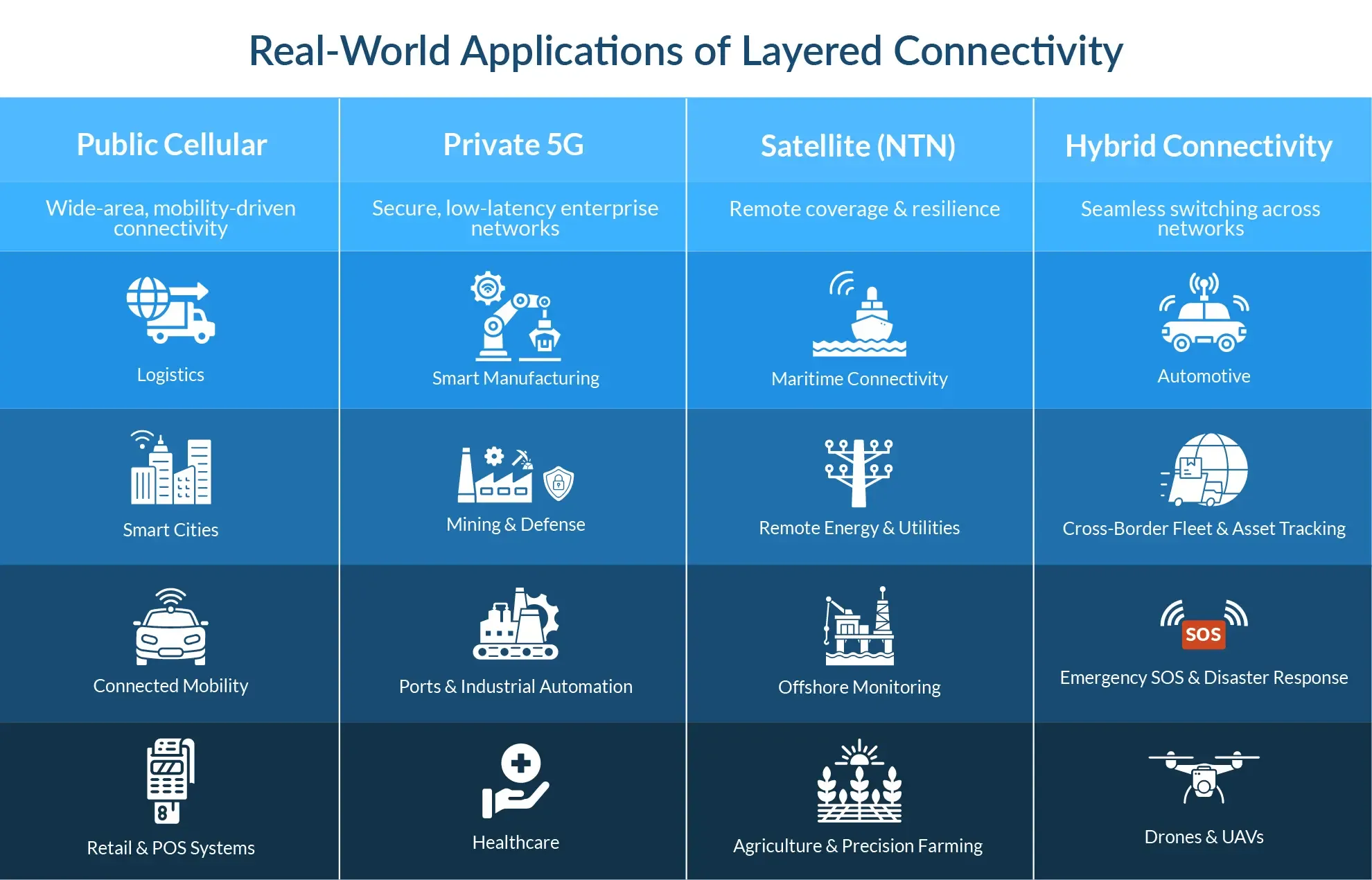
This layered approach is already evident in real-world deployments. Public cellular networks remain the default for wide-area connectivity, with 5G SA now offering features like network slicing to tailor connectivity for various use cases.
As needs become more specialized, architectures diverge. Private networks are increasingly adopted in sectors like mining, defense, logistics, and healthcare, where data sovereignty, security, latency, or dedicated bandwidth are essential. Gopinath Krishnamurthy highlights that private 5G networks are replacing Ethernet cables in large seaports and factories, offering low latency, high throughput, and seamless communication.
Satellite connectivity is transitioning from pure-play satellite modems to dual-mode NTN (non-terrestrial networks), extending coverage to remote areas and providing fallback during outages.
In industrial environments, private 5G networks drive automation, while public cellular supports mobility. Edge computing reduces latency and cloud dependency.
In logistics and asset tracking, devices move between private networks in warehouses, public cellular during transit, and satellite in remote areas, enabled by multi-layered architectures.
Automotive systems combine edge intelligence for real-time decisions, cellular for connectivity, and satellite as a fallback. Hybrid connectivity, including NTN, is gaining traction in emergency SOS services, where devices transmit distress signals without terrestrial coverage.
Similar architectures are expected to expand into agriculture, maritime, and energy, though adoption is still early. A consistent theme emerges: connectivity is no longer tied to geography-it’s aligned with application requirements.
The Hidden Complexity: Interoperability
As connectivity layers expand, so does the complexity of managing them. Enterprises must operate across a mix of public cellular, private LTE and 5G, Wi-Fi, LPWAN, and satellite networks, each with its own protocols, spectrum models, and security frameworks. Even within cellular, true interoperability remains limited due to device constraints and operator-specific implementations.
The challenge now extends beyond protocol compatibility. As Dr. Anand Nayyar highlights, interoperability involves identity management, policy enforcement, device lifecycle control, and cross-domain security. Satellite integration further adds complexity, requiring careful orchestration alongside terrestrial networks.
Interoperability is largely enabled through software orchestration. As Satyajit Sinha notes, connectivity convergence today depends on these layers to bridge networks, but it remains an evolving process, not a solved problem. This shift means that interoperability is no longer an engineering issue-it’s a core architectural challenge.
Redefining Competitive Advantage in Connectivity with Network Intelligence
Historically, competitive advantage in connectivity was tied to spectrum ownership and infrastructure scale-those who controlled networks controlled the market. This equation is now shifting.
Spectrum remains crucial, particularly in markets where licensed access determines performance. The ability to deploy technologies like 5G RedCap is dependent on spectrum availability, making it a continued gatekeeper for innovation.
Infrastructure, however, is evolving. What was once a differentiator, like tower networks and tightly coupled vendor ecosystems, is becoming standardized with open architectures like Open RAN. The focus is now on compute infrastructure, particularly edge processing and embedded intelligence.
The real differentiation is moving toward orchestration. As Dr. Anand Nayyar explains, in layered connectivity environments, the advantage lies in the ability to dynamically manage multiple access domains-automating policy decisions, optimizing cost-performance routing, and unifying security and lifecycle operations. Without orchestration, multi-network systems cannot function cohesively.
The implication is clear - the winners will not be those who own network assets, but those who control the software-defined coordination layer that transforms fragmented connectivity into an adaptive, application-aware system.
The Risks of Multi-Layer Connectivity
Layered connectivity offers resilience-path diversity, carrier redundancy, and geographic failover-improving service continuity across networks, especially in critical environments like logistics, industrial operations, and infrastructure systems.
However, this resilience comes with trade-offs. Each added layer increases complexity, dependency chains, and security risks. As Dr. Anand Nayyar notes, resilience at scale depends less on adding networks and more on governance, observability, and orchestration. Without this, layered architectures can introduce configuration drift and amplify cascading failures.
Security further compounds the challenge. Devices across multiple networks must be protected consistently. While adherence to standards like 3GPP offers a strong baseline, real-world deployments require careful integration to ensure end-to-end security.
Cost and use-case alignment add another constraint. Multi-layer connectivity often involves different licensing models, hardware dependencies, and operational overhead. Satyajit Sinha points out that this approach only makes sense when the use case justifies it-like end-to-end tracking, last-mile logistics, or high-value asset monitoring.
Taken together, these factors highlight that resilience is not achieved by adding more networks-it is achieved by designing, orchestrating, and securing them intelligently.
SGP.32 and the Reality of Connectivity Control
SGP.32 represents a step toward more flexible IoT connectivity, enabling remote profile switching at scale and reducing friction seen in earlier eSIM implementations. However, its impact remains constrained.
As Satyajit Sinha points out, operator-imposed guardrails, like contractual lock-ins, switching fees, and dependencies on value-added services, still limit how profiles can be changed. In many cases, switching is technically possible but commercially restrictive. Device capability further complicates adoption, as many IoT devices are legacy systems, where profile changes may still require manual intervention, making large-scale transitions impractical.
Gopinath Krishnamurthy highlights that once SGP.32 is widely available, it should be embraced. However, until then, multi-IMSI solutions remain a viable option for time-critical and connectivity-at-all-costs applications. This solution offers pre-integrated flexibility, while SGP.32 introduces dynamic control but requires broader alignment across operators, devices, and services.
The broader takeaway is clear: SGP.32 improves flexibility but doesn’t eliminate the commercial and operational constraints of global connectivity. In a multi-layered architecture, it functions as an enabler, not a standalone solution within a larger orchestration framework.
From Complexity to Control: Enabling the Layered Future with Cavli Hubble
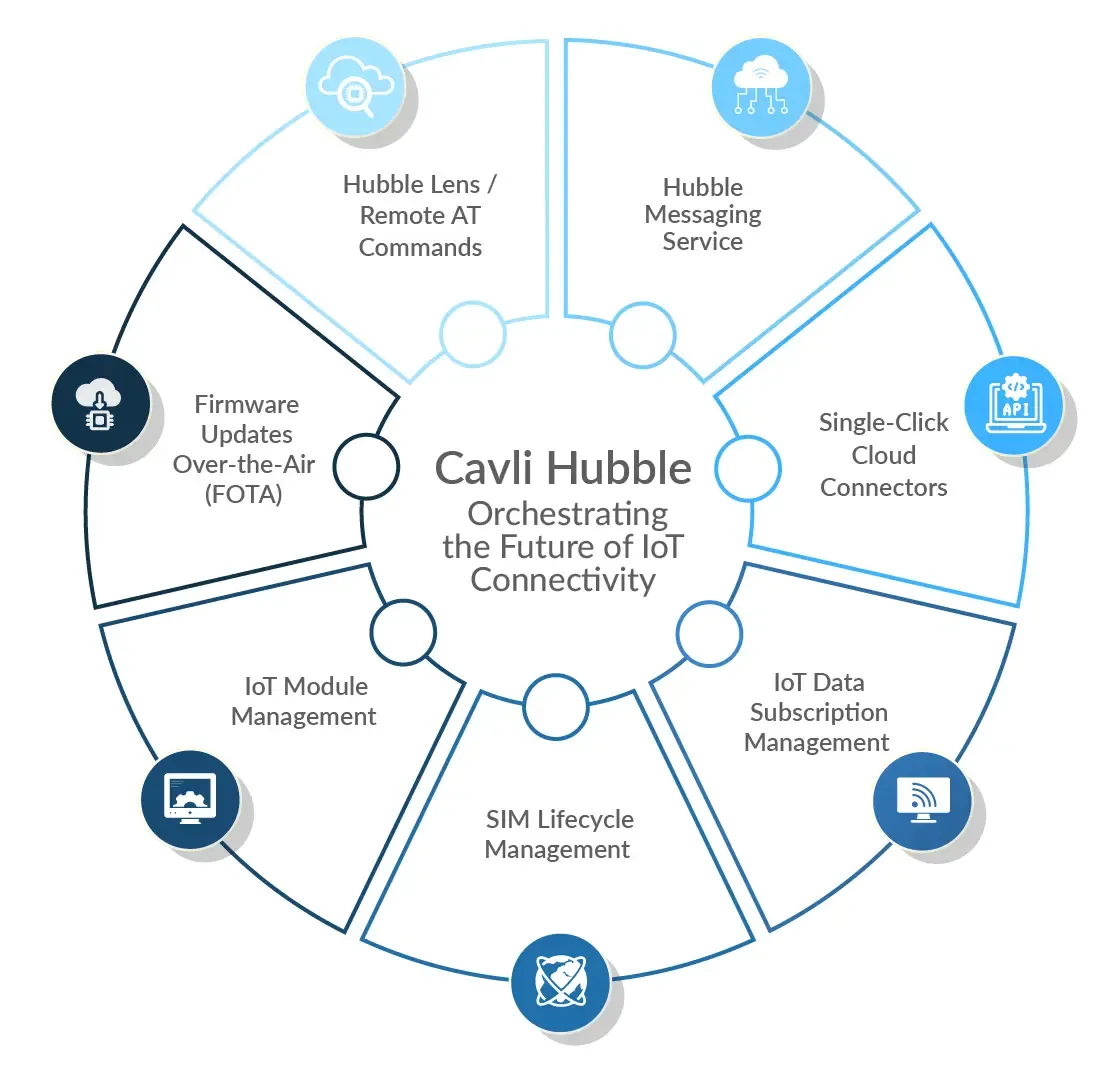
As IoT connectivity evolves into a layered, multi-network architecture, managing complexity at scale becomes crucial. Enterprises must navigate a mix of public cellular, private LTE and 5G deployments, satellite connectivity, and emerging standards like SGP.32. Without a unifying control layer, this complexity limits visibility, increases operational overhead, and constrains scalability.
This is where connectivity orchestration becomes critical. Platforms like Cavli Hubble provide centralized visibility, control, and lifecycle management across multiple connectivity layers. Rather than treating connectivity as static, Hubble enables a dynamic model where network selection, device behavior, and performance are continuously optimized based on real-world conditions.
In a multi-layered architecture, this capability is essential. It allows enterprises to:
- Manage multiple operator profiles and connectivity environments
- Monitor device performance across networks in real time
- Optimize cost, coverage, and reliability dynamically
- Enforce consistent policy and security across deployments
Orchestration shifts connectivity from infrastructure dependency to software-defined control. As the industry moves from convergence to coordination, platforms like Cavli Hubble are the foundation that enables layered connectivity to function cohesively at scale.
Go Beyond and Explore
What is global IoT connectivity?
Why is IoT moving from one global network to micro-networks?
What are IoT micro-networks?
How does eSIM improve global IoT connectivity?
What is the future of global IoT connectivity?
Author

Aarathy Jayakrishnan
Head of Marketing Operations, Cavli Wireless