
5G drones combine unmanned aerial vehicle (UAV) platforms with cellular connectivity to support real-time communication between the aircraft, operator, cloud platform, and enterprise applications. For commercial drone deployments, 5G connectivity can support high-throughput video transmission, drone telemetry, command-and-control data, positioning workflows, and remote fleet operations.
As drone adoption expands across agriculture, logistics, aerial monitoring, infrastructure inspection, and emergency response, connectivity becomes a critical engineering decision. A drone may need to transmit high-resolution video while simultaneously sending telemetry, receiving control inputs, processing local application logic, and maintaining accurate positioning.
For OEMs, ODMs, and IoT design houses, the challenge is therefore not simply adding a modem. The connectivity architecture must account for throughput, latency, network availability, LTE fallback, GNSS, onboard processing, interfaces, form factor, and the requirements of the target mission.
Cavli’s CQM211, CQM212, and CQM215 5G NR modules provide a scalable connectivity foundation for 5G-enabled drones that need high-throughput data transfer, positioning, onboard application support, and cellular connectivity across enterprise deployments.
Key Takeaways
- 5G drone connectivity can support real-time telemetry, live video, sensor data transfer, remote communication, cloud integration, and command-and-control workflows.
- 5G NR provides high data throughput for bandwidth-intensive drone applications, while latency performance is important for time-sensitive data exchange.
- LTE fallback provides an additional connectivity path when 5G coverage is unavailable.
- Inbuilt GNSS can support positioning requirements across agriculture, logistics, inspection, and other UAV applications.
- Onboard Linux/OpenWrt processing gives OEMs additional flexibility for connectivity management and local application logic.
- Cavli’s CQM211, CQM212, and CQM215 address different performance requirements across connected-drone applications.
Why Do Enterprise Drones Need Reliable Cellular Connectivity?
Enterprise drones can generate and exchange several types of data during a single mission.
A connected UAV may transmit flight telemetry, high-resolution imagery, payload data, and system health information while receiving route updates, control commands, or cloud-generated instructions. When multiple data streams operate simultaneously, the communication subsystem must provide sufficient capacity without introducing unnecessary integration complexity.
Traditional point-to-point radio links remain appropriate for many drone applications. However, their range and performance depend on factors such as radio technology, terrain, obstacles, interference, antenna design, and operating environment.
A cellular-connected drone introduces another communication architecture. Instead of relying exclusively on a direct drone-to-controller connection, the UAV can communicate through mobile network infrastructure where compatible network coverage is available.
3GPP has developed support for UAV connectivity within cellular networks, including work related to UAV identification, authorization, connectivity, and 5G NR support. This provides a standards-based foundation for integrating UAVs with cellular network infrastructure.
What Is Drone Telemetry?
Drone telemetry is operational data transmitted between a UAV and another system, such as a ground control station, remote operator, fleet-management platform, or cloud application.
Depending on the aircraft and mission, telemetry data can include:
- Position and altitude
- Speed and heading
- Flight status
- Battery and power information
- GNSS data
- Mission progress
- Payload condition
- Sensor readings
- Connectivity status
- System health information
For enterprise operations, real-time drone telemetry provides visibility into aircraft and mission status. When telemetry is integrated with cellular connectivity, that information can also be shared with remote applications and centralized fleet-management systems.
This makes drone connectivity particularly important for organizations operating distributed UAV fleets or applications where aircraft data must be available beyond a local ground-control link.
Why Does 5G Connectivity Matter for Drone Video Transmission?
Telemetry messages can be relatively small, but cameras and advanced sensors create significantly higher data requirements.
Inspection, emergency-response, agriculture, and monitoring drones may capture continuous video, high-resolution imagery, or multiple sensor streams. These workloads can require substantially more bandwidth than basic flight telemetry.
5G NR provides the throughput needed to support high-bandwidth cellular applications. Depending on the network environment and overall system architecture, a 5G-connected drone can use this capacity for live video streaming, aerial imaging, mission telemetry, and sensor data transfer.
Cavli’s current 5G drone portfolio spans peak 5G downlink rates from 3.4 Gbps on the CQM211 in NSA mode to 7.01 Gbps on the CQM215, giving designers different performance tiers for bandwidth-intensive applications.
How Does 5G Improve Drone Communication?
5G connectivity can address several requirements that become important as UAV platforms handle more data and operate across wider enterprise environments.
Higher Throughput for Video and Sensor Data
Enterprise UAVs increasingly carry cameras, imaging payloads, and other high-data-rate sensors.
Higher cellular throughput provides greater capacity for transmitting video, imagery, sensor information, telemetry, and application data between the aircraft and remote systems.
Low-Latency Communication
Latency affects how quickly information can move between the drone, network, operator, and connected applications.
Lower latency is particularly relevant to time-sensitive telemetry, remote intervention, navigation updates, and command-and-control workflows. Actual end-to-end latency depends on network conditions and the complete system architecture rather than on the cellular module alone.
Wide-Area Cellular Communication
A drone cellular network architecture allows compatible UAVs to communicate through available mobile network infrastructure.
This can help engineering teams build systems that exchange telemetry and application data with remote servers without depending solely on a local point-to-point radio connection.
5G With LTE Fallback
5G availability can vary by deployment region and operating environment.
For this reason, LTE fallback remains valuable in a 5G drone design. The Cavli CQM211 includes LTE Cat 16 fallback, while the CQM212 and CQM215 provide LTE Cat 20 fallback.
Connectivity for BVLOS Workflows
Beyond Visual Line of Sight, or BVLOS, refers to drone operations in which the aircraft operates beyond the pilot’s direct visual line of sight.
Cellular connectivity can form part of the communications architecture supporting BVLOS workflows by carrying command-and-control information, telemetry, and payload data over wide-area networks.
Connectivity alone, however, does not make a drone operation BVLOS-compliant. Regulatory requirements depend on the applicable jurisdiction and operating authorization. In the United States, the FAA published a proposed BVLOS rule in August 2025 as part of its effort to establish a more scalable framework for such operations.
5G Drones vs. Traditional PointtoPoint Drone Connectivity
| Requirement | Traditional PointtoPoint Connectivity | Cellular-Connected 5G Drone |
|---|---|---|
| Communication model | Direct UAV-to-controller connection | Communication through cellular network infrastructure |
| Coverage | Depends on radio system, terrain, interference, and environment | Depends on cellular network availability and aerial radio conditions |
| Video/data capacity | Depends on selected radio technology | 5G can provide high-throughput cellular data |
| Remote cloud integration | May require additional connectivity | IP connectivity can support remote application integration |
| Drone telemetry | Typically tied to the local communications architecture | Can be exchanged with remote or cloud systems |
| BVLOS architecture | Depends on communication system and operational design | Cellular connectivity can form part of wide-area BVLOS communications |
| Fallback | Implementation dependent | 5G modules can provide LTE fallback |
| Fleet connectivity | Architecture dependent | Can integrate with cellular and cloud-based fleet systems |
Neither architecture is universally better. The correct approach depends on mission requirements, available networks, payloads, operating conditions, safety architecture, regulations, and system design.
Introducing Cavli’s 5G Modules for Drone Connectivity
Cavli’s 5G module portfolio includes the CQM211, CQM212, and CQM215, providing OEMs with multiple options for building 5G-enabled drones and other high-bandwidth connected systems.
The portfolio combines 5G NR connectivity, LTE fallback, GNSS, operating system support, processing capabilities, and high-speed interfaces.
CQM211: 5G Connectivity for Compact and Agricultural Drones
The CQM211 is a 3GPP Release 16 5G NR Advanced Sub-6 GHz module with LTE Cat 16 fallback.
It provides peak speeds of:
- 5G NR SA: 2.4 Gbps downlink and 900 Mbps uplink
- 5G NR NSA: 3.4 Gbps downlink and 550 Mbps uplink
The CQM211 integrates an Arm Cortex-A7 processor, Linux/OpenWrt support, L1+L5 GNSS, USB 3.1/2.0, PCIe Gen 3, UART, SPI, I2C, GPIO, and other interfaces. Cavli offers the module in both LGA and M.2 form factors.
For agricultural and crop-survey drones, this combination can support field imagery, live drone telemetry, GNSS positioning, mission logs, connectivity monitoring, and application-specific processing without unnecessarily overbuilding the communications subsystem.
CQM212: Higher-Bandwidth Connectivity for Connected UAVs
The CQM212 is a 5G NR Advanced Sub-6 GHz module compliant with 3GPP Release 18.
It provides peak 5G NR speeds of:
- 5.36 Gbps downlink
- 1.25 Gbps uplink
The module supports LTE Cat 20 fallback, 3CC carrier aggregation, Linux/OpenWrt, GNSS, USB 3.1, PCIe 4.0, PCIe 3.0, dual USIM, UART, SPI, I2C, GPIO, and other interfaces.
Its supported location services include GPS, GLONASS, NavIC, BeiDou, Galileo, SBAS, and QZSS capability.
These specifications make the CQM212 relevant to higher-bandwidth UAV communication requirements such as logistics drones, video-enabled inspection platforms, and systems handling several concurrent data streams.
CQM215: High-Performance 5G for Data-Intensive Drone Operations
The CQM215 extends the portfolio for more demanding connectivity requirements.
It is a 3GPP Release 18 5G NR Advanced Sub-6 GHz module supporting:
- Up to 7.01 Gbps downlink
- Up to 1.25 Gbps uplink
- LTE Cat 20 fallback
- 4CC carrier aggregation
- Linux/OpenWrt
- Inbuilt GNSS
- USB 3.1
- PCIe 4.0 and PCIe 3.0
- Dual USIM
- UART, SPI, I2C, GPIO, and additional peripheral interfaces
Its GNSS capabilities include support for GPS, GLONASS, NavIC, BeiDou, Galileo, SBAS, and QZSS.
For advanced UAV platforms, this additional throughput and carrier-aggregation capability provides greater performance headroom for multiple simultaneous communication tasks.
How Edge Processing Supports Real-Time Drone Operations
Connectivity performance is only one part of a drone’s communications architecture.
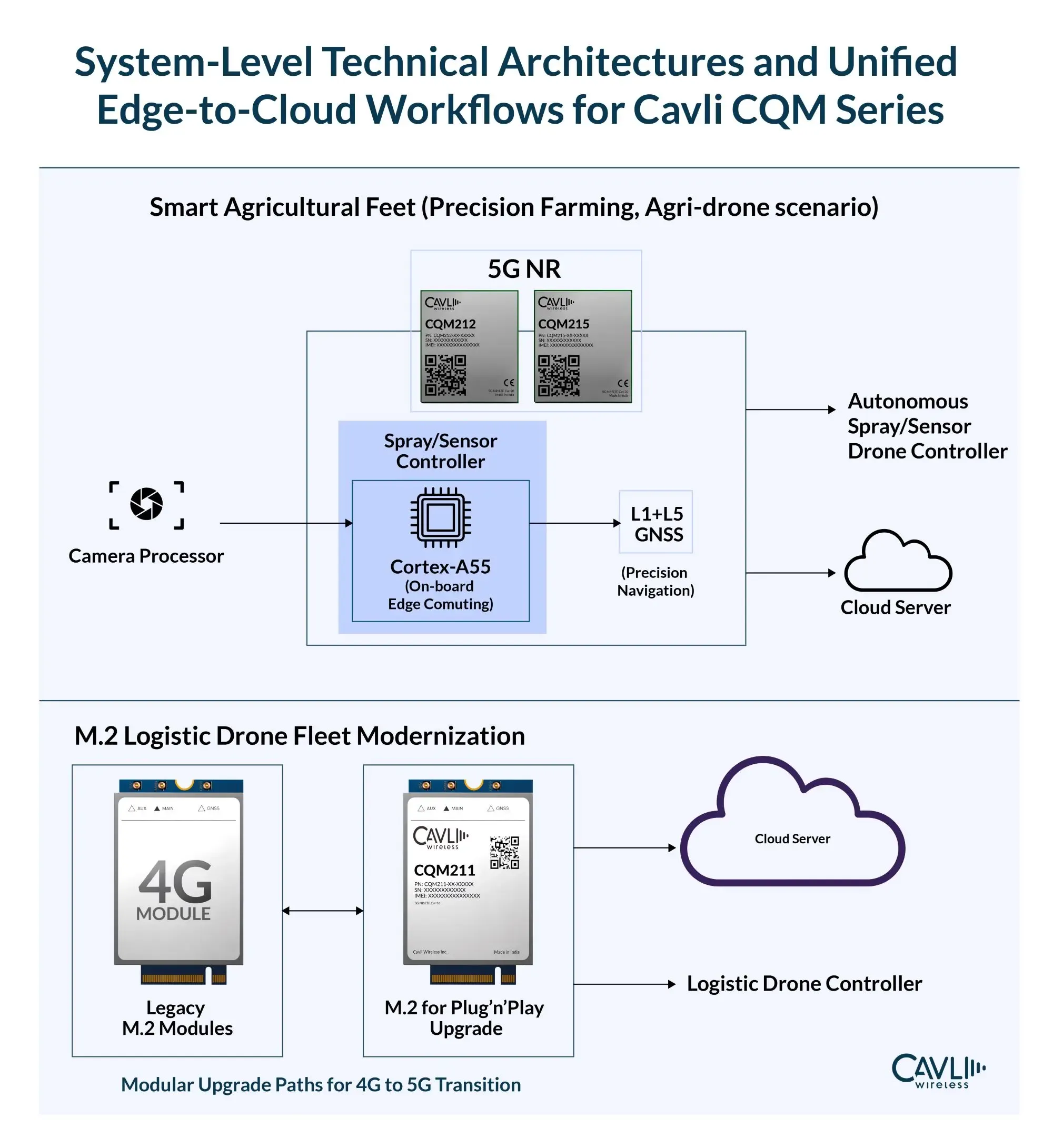
Onboard processing allows engineering teams to decide which functions should operate locally and which data should be sent to remote applications. Depending on the platform, local application logic can support connectivity monitoring, mission-state reporting, diagnostic functions, traffic management, and data-handling rules.
An agricultural drone, for example, may need to capture crop imagery, transmit telemetry, upload field data, receive route adjustments, and maintain GNSS positioning during the same mission.
A logistics drone may simultaneously handle payload status, flight-path changes, landing-zone information, live video, health logs, and remote intervention.
The combination of onboard application support and high-throughput cellular connectivity gives OEMs more flexibility in determining how these workloads are distributed between the drone and the cloud.
Engineering Considerations for 5G Drone OEMs
For OEM and ODM engineering teams, the cellular module influences much more than network access.
Instead of designing every connectivity function around a discrete cellular modem, separate positioning receiver, and external processing architecture, an integrated 5G module can provide cellular communication, GNSS, operating system support, processing capabilities, and peripheral interfaces within the same subsystem.
This can give firmware teams a platform for functions such as:
- Link monitoring
- Missionstate reporting
- Network failover rules
- Connectivity diagnostics
- Traffic prioritization
- Packetloss recovery
- Data buffering
- Watchdog processes
- Remote health monitoring
Hardware teams must also account for interfaces connecting the cellular module to flight controllers, companion processors, cameras, payload controllers, sensors, and service-access ports.
The CQM211 includes interfaces such as USB 3.1/2.0, PCIe Gen 3, UART, SPI, I2C, dual USIM, and GPIO. The CQM212 and CQM215 extend the available interface architecture with USB 3.1, PCIe 4.0 and PCIe 3.0, UART, SPI, I2C, dual USIM, GPIO, and additional peripheral connectivity.
How 5G-Enabled Drones Support Enterprise Applications
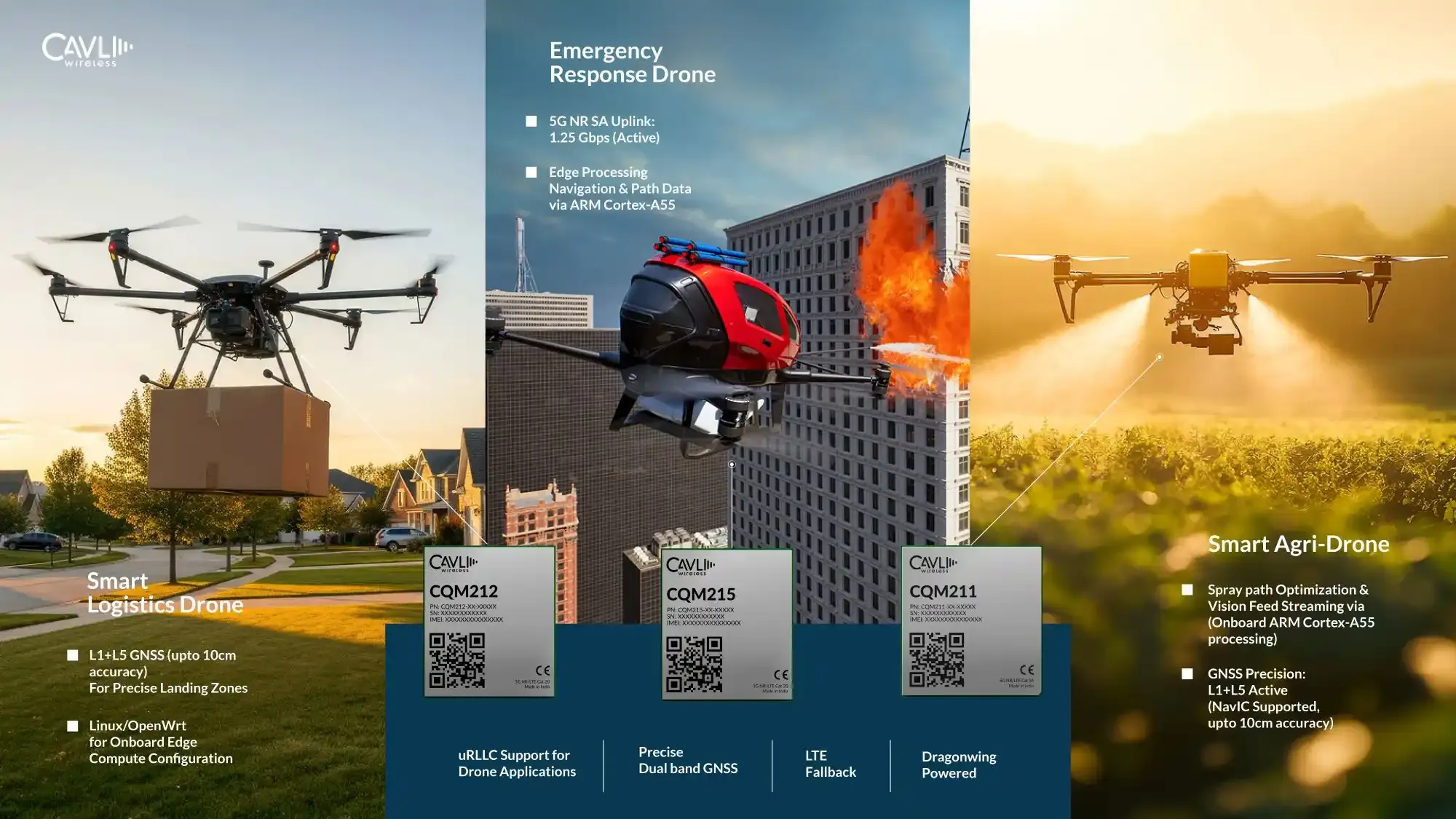
Agriculture and Crop Monitoring
Agricultural drones can use cellular connectivity to exchange crop imagery, drone telemetry, mission logs, sensor information, positioning data, and route updates.
The CQM211 can provide a practical connectivity foundation for agricultural UAV designs that require 5G NR, LTE fallback, GNSS, and onboard application support.
Cavli also provides a dedicated Smart Agriculture IoT application portfolio for connected agricultural systems.
Logistics and Delivery Drones
Logistics UAVs may need to manage several communication streams simultaneously, including:
- Flight telemetry
- Live video
- Route coordination
- Payload monitoring
- Geofence updates
- Proof-of-delivery information
- Landing-zone data
- Device-health reporting
The CQM212 and CQM215 are better aligned with these higher-throughput, multistream requirements.
For broader connected logistics applications, see Cavli’s IoT in Transportation and Logistics solutions.
Infrastructure Inspection
Inspection drones used around utilities, industrial facilities, transportation infrastructure, and other remote assets can generate high-resolution visual information while transmitting flight telemetry and equipment health data.
5G connectivity can provide the bandwidth needed to move these data streams between the UAV and remote applications where network availability supports the operation.
Emergency Response
Emergency-response drones can support wildfire inspection, flood mapping, search-and-rescue operations, damaged infrastructure assessment, and temporary situational awareness.
These environments can create unpredictable communication requirements. System designers may need to prioritize command-and-control or telemetry traffic over less-critical data, buffer information when radio conditions change, and manage several concurrent data flows.
The higher performance headroom of the CQM215 makes it relevant to such demanding UAV architectures.
CQM211 vs. CQM212 vs. CQM215 for 5G Drone Applications
| Module | 5G NR Peak Performance | LTE Fallback | GNSS | Potential Drone Requirement |
|---|---|---|---|---|
| CQM211 | SA: 2.4 Gbps DL / 900 Mbps UL; NSA: 3.4 Gbps DL / 550 Mbps UL | LTE Cat 16 | L1+L5 | Agricultural drones, compact connected UAV platforms, telemetry and imaging |
| CQM212 | 5.36 Gbps DL / 1.25 Gbps UL | LTE Cat 20 | Inbuilt multi-constellation GNSS | Logistics, inspection and higher-bandwidth multistream UAVs |
| CQM215 | 7.01 Gbps DL / 1.25 Gbps UL | LTE Cat 20 | Inbuilt multi-constellation GNSS | Advanced, data-intensive, multistream and emergency-response UAV platforms |
Peak throughput should not be the only factor when selecting a 5G module for drones. OEMs should also evaluate network bands, interfaces, module dimensions, GNSS requirements, software architecture, processing needs, thermal characteristics, regional certifications, antenna design, and the direction and volume of mission data.
What Should OEMs Consider When Choosing a 5G Module for Drones?
1. Uplink and Downlink Requirements
Determine how much video, imagery, telemetry, sensor data, and control information the platform must send and receive.
For many drone applications, uplink capacity deserves particular attention because the aircraft may be transmitting video and sensor information back to an operator or cloud application.
2. 5G and LTE Network Support
Assess 5G availability across intended deployment regions and determine whether LTE fallback is required for operational continuity.
3. GNSS Requirements
Identify the positioning systems and GNSS performance required by the application.
4. Processing Architecture
Determine which functions should operate onboard the drone and which should depend on remote or cloud infrastructure.
5. Hardware Interfaces
Verify compatibility with flight controllers, companion processors, cameras, payload controllers, sensors, storage, and service interfaces.
6. Size, Weight, and Power
Airborne platforms impose stricter physical and power constraints than many fixed IoT installations. Module and supporting system requirements must therefore be evaluated at the complete UAV level.
7. Environmental Conditions
Temperature, vibration, dust exposure, weather, and operating altitude can influence hardware design and component selection.
8. Regional Network Compatibility
Confirm cellular bands, carrier requirements, certifications, and deployment-region compatibility before finalizing the communications architecture.
9. Device and Connectivity Management
Large drone fleets require more than initial connectivity. Engineering teams should consider remote diagnostics, provisioning, connectivity management, and software lifecycle requirements.
Cavli’s broader 5G NR IoT module portfolio can be evaluated alongside its global connectivity and device-management ecosystem.
10. Operational and Regulatory Requirements
For BVLOS and other advanced drone operations, connectivity design should be evaluated as part of the complete operational and safety architecture.
Network connectivity does not replace regulatory authorization, detect-and-avoid systems, operational risk controls, or other jurisdiction-specific requirements.
Building 5G-Connected Drones With Cavli
The connectivity module sits at the intersection of the UAV, cellular network, operator, and enterprise application.
Cavli’s CQM211, CQM212, and CQM215 provide three performance tiers for connected UAV designs.
The CQM211 can address compact and cost-conscious applications that require 5G NR, LTE fallback, dual-band GNSS, Linux/OpenWrt, and flexible LGA or M.2 integration.
The CQM212 increases cellular throughput and provides 3GPP Release 18 5G NR Advanced capability for higher-bandwidth applications.
The CQM215 extends that architecture with up to 7.01 Gbps 5G downlink performance and 4CC carrier aggregation for more demanding multistream workloads.
By combining cellular connectivity with positioning, application support, LTE fallback, and high-speed interfaces, OEMs can build 5G-connected drones around a more integrated communications platform.
Related Cavli Resources
For additional technical and commercial information, explore:
- Cavli 5G NR IoT Modules — compare Cavli’s 5G module portfolio.
- CQM211 5G NR IoT Module — specifications for compact, high-bandwidth connected-device applications.
- CQM212 5G NR IoT Module — 5G NR Advanced connectivity for higher-throughput designs.
- CQM215 5G NR IoT Module — high-performance 5G NR Advanced connectivity.
- Smart Agriculture IoT — cellular IoT applications for connected agriculture.
- IoT in Transportation and Logistics — connected-device solutions for transportation and logistics.
- 3GPP: NR Support for UAVs — authoritative information about UAV integration with 5G cellular networks.
- FAA: Beyond Visual Line of Sight (BVLOS) — regulatory information for advanced UAV operations in the United States.
Conclusion: Building the Next Generation of 5G Drones
As commercial UAV systems become more connected and data-intensive, 5G drones can use cellular connectivity to support real-time telemetry, high-resolution video transmission, remote monitoring, cloud communication, positioning, and connected fleet operations.
The best connectivity architecture depends on the mission, payload, network environment, data requirements, hardware constraints, and applicable regulations.
For OEMs developing cellular-connected UAV platforms, Cavli’s CQM211, CQM212, and CQM215 5G modules for drones provide a scalable path from compact agricultural and monitoring platforms to higher-throughput logistics, inspection, and emergency-response applications.
By combining 5G NR, LTE fallback, GNSS, onboard application support, and high-speed interfaces, the portfolio enables engineering teams to build drone platforms designed not only to fly, but also to sense, communicate, and respond in real time.
Explore Cavli 5G Connectivity for Your Drone Platform
Compare the Cavli 5G NR module portfolio, review the CQM211, CQM212, and CQM215 specifications, or connect with Cavli’s Solution Consulting team to discuss the cellular connectivity, positioning, processing, and integration requirements of your next UAV platform.
Go Beyond and Explore
What is a 5G drone?
Why do drones need 5G connectivity?
What is drone telemetry?
How does 5G improve drone video transmission?
Can 5G connectivity support BVLOS drones?
Is 5G better than 4G LTE for drones?
Which Cavli module is suitable for agricultural drones?
Which Cavli 5G modules are suitable for logistics and inspection drones?
What should OEMs look for in a 5G drone module?
Author

Soorya Kumar A
Sr. Associate- Product Marketing
Cavli Wireless