
Which 5G IoT Module Is Right for Your Product?
Choosing a 5G IoT module requires more than comparing peak download speeds. OEMs and engineering teams need to evaluate the application's real data requirements, uplink traffic, 5G network architecture, LTE fallback, RF and antenna design, GNSS, operating system, hardware interfaces, regional bands, certifications, and product lifecycle.
For many mid-tier IoT applications, 5G RedCap provides a practical bridge between LTE and full 5G NR. Applications that genuinely need multi-gigabit connectivity, higher uplink capacity, or advanced networking can instead evaluate full 5G NR. This expert Q&A answers the most important questions engineers and decision-makers should ask before choosing a 5G cellular module and explains where Cavli's 5G RedCap and full 5G NR modules fit.
Quick Decision Summary
- Choose 5G RedCap when LTE is becoming limiting but multi-gigabit full 5G NR would add unnecessary complexity and cost.
- Choose full 5G NR when high-throughput video, cloud computing, routing, or large data transfers are core product requirements.
- Evaluate uplink as carefully as downlink, especially for cameras, industrial gateways and edge systems.
- Check 5G SA/NSA availability, LTE fallback, bands and operator compatibility before finalizing the cellular architecture.
- Evaluate GNSS, Linux/OpenWrt, interfaces, form factor, antennas, power and certification alongside modem speed.
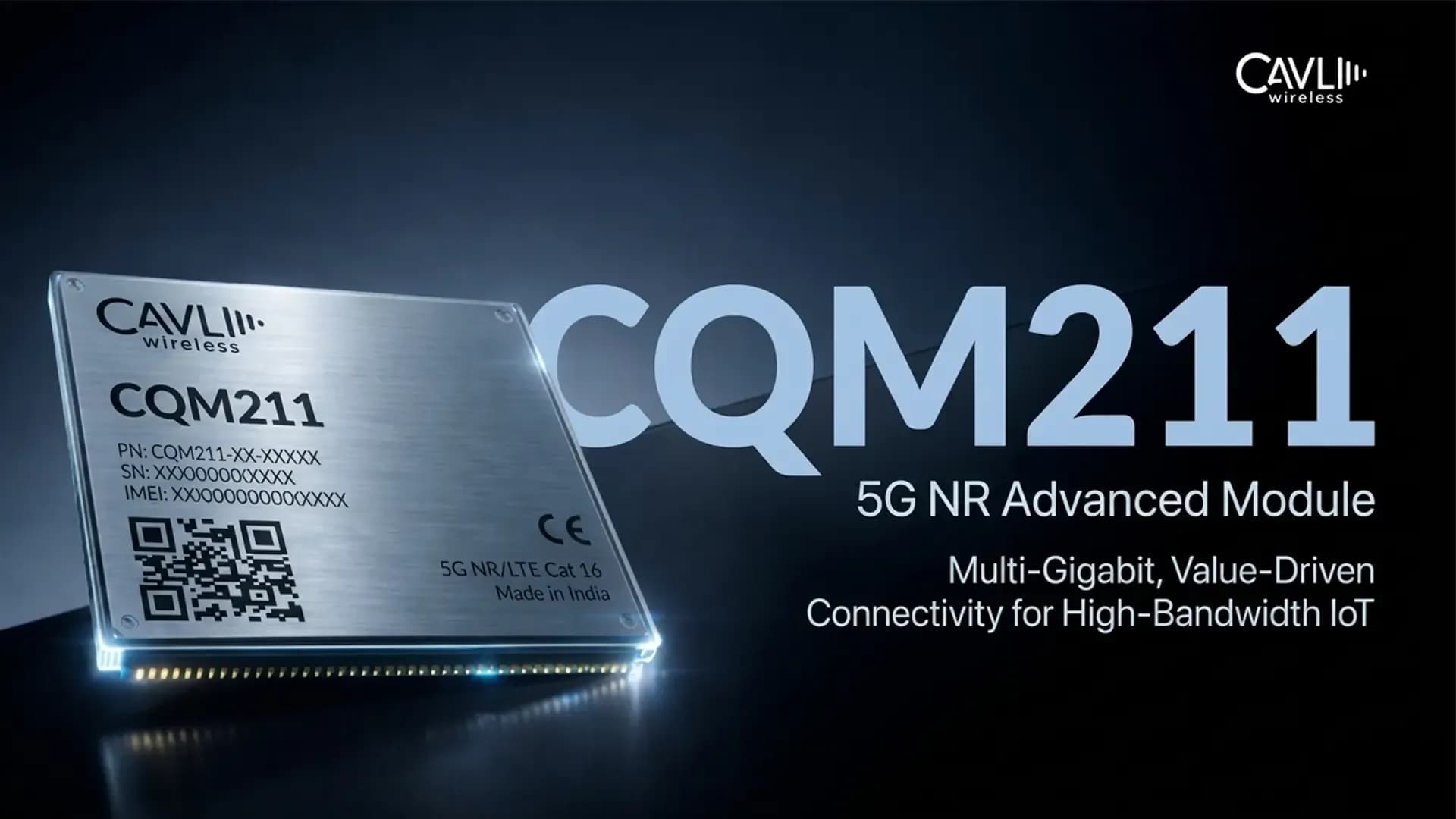
- Cavli's CQM220 targets RedCap-class IoT, while CQM211, CQM212 and CQM215 address progressively higher-performance full 5G NR applications.
Have Your Requirements Ready?
Share your application, target country, operator, bandwidth, and hardware requirements with Cavli.
5G IoT Module Selection at a Glance
| Requirement | Recommended Modules |
|---|---|
| Mid-tier 5G IoT | CQM220 |
| 5G RedCap + LTE fallback | CQM220 |
| 5G SA + NSA Support | CQM211 |
| Multi-gigabit 5G | CQM211 / CQM212 / CQM215 |
| Up to 5.36 Gbps DL | CQM212 |
| Up to 7.01 Gbps DL | CQM215 |
| Linux/OpenWrt application development | CQM220 / CQM211 / CQM212 / CQM215 |
| GNSS-enabled 5G design | CQM220 / CQM211 / CQM212 / CQM215 |
| LGA or M.2 flexible FF requirement | CQM220 / CQM211 |
| Advanced high-bandwidth edge applications | CQM212 / CQM215 |
Technology Selection
1. How do I choose the right 5G IoT module for my product?
Start with the application requirements, not the modem specification.
Define the required downlink and uplink, target countries and operators, 5G SA/NSA requirements, LTE fallback, GNSS, interfaces, form factor, processing requirements, and expected product lifetime. For moderate 5G performance, CQM220 RedCap is a logical choice. For applications requiring multi-gigabit connectivity, evaluate our 5G NR modules. The right module is the one that fits the complete product architecture, not necessarily the fastest one.
2. 5G RedCap or full 5G NR: which technology fits my IoT application?
Choose 5G RedCap when the application requires more capability than conventional LTE but does not need the full bandwidth and RF complexity of high-performance 5G NR. Choose full 5G NR when the product depends on multi-gigabit connectivity, high-capacity uplink, advanced carrier aggregation, or demanding edge workloads. 3GPP introduced RedCap in Release 17 as a reduced-capability NR framework, including reductions in bandwidth and antenna/device complexity compared with higher-performance NR devices.
A useful rule is:
LTE is limiting + full 5G is excessive → evaluate RedCap.
3. 5G RedCap vs LTE Cat 4: which is better for a new IoT design?
The answer depends on whether the product needs the additional capability and lifecycle advantages of moving toward 5G. LTE Cat 4 typically delivers 150 Mbps downlink and 50 Mbps uplink peak data rates. Cavli's CQM220 RedCap supports peak rates up to 220 Mbps downlink and 120 Mbps uplink, along with LTE Cat 4 fallback.
RedCap becomes particularly relevant where higher uplink, 5G migration, or newer network architecture matters. Transitioning to 5G RedCap is highly recommended, even if LTE meets current product lifetime needs when target regions present difficulties in securing new LTE-only carrier certifications. Such hurdles threaten the long-term sustainability of LTE-exclusive product designs.
4. When does an IoT product actually need full 5G NR?
Full 5G NR becomes valuable when connectivity performance directly affects the application's functionality.
Typical examples include:
- Multi-camera surveillance
- Machine vision
- Edge AI gateways
- High-performance industrial routers
- Large sensor-data aggregation
- Enterprise CPE
- High-volume data transfer
Cavli's full NR portfolio ranges from CQM211 to the Dragonwing-powered CQM212 and CQM215, providing significantly more throughput than RedCap-class connectivity. If the application will never use multi-gigabit performance, RedCap may result in a more appropriate system architecture.
5. How much 5G throughput does my IoT application really require?
Calculate real traffic, not theoretical modem speed.
Consider:
Average downlink, Peak downlink, Average uplink, Peak uplink, Number of simultaneous data streams, Video bitrate, Firmware-update size, Cloud-transfer requirements, Future bandwidth growth
An application that normally transfers 30 Mbps does not automatically benefit from a 7 Gbps modem. Also pay close attention to uplink. IoT cameras, gateways, and edge devices frequently upload far more data than consumer devices.
Application-Based Selection
6. What is the best 5G architecture for an industrial IoT gateway?
For gateways carrying telemetry, alarms, machine diagnostics, moderate software updates and sensor data, 5G RedCap may provide sufficient bandwidth without requiring a full NR architecture. Cavli CQM220 provides RedCap connectivity up to 220 Mbps DL / 120 Mbps UL, Linux/OpenWrt, GNSS options and embedded interfaces.
For gateways aggregating machine vision, high-resolution video, edge AI or multiple high-bandwidth devices, full 5G NR becomes more relevant. Evaluate CQM211, or the Dragonwing-powered CQM212 and CQM215, as the required traffic level increases.
7. RedCap or full 5G NR: what works better for industrial routers and CPE?
A specialized industrial router with moderate WAN requirements can be a strong candidate for RedCap. A router or CPE whose commercial value depends on broadband-class cellular performance should instead evaluate full 5G NR.
Important requirements include:
- WAN throughput
- Ethernet throughput
- Number of users/devices
- Routing and VPN workload
- SA/NSA
- PCIe or SGMII requirements
- Power and thermal limits
CQM211 is particularly relevant where SA/NSA flexibility and multi-gigabit NR are needed.
8. What 5G connectivity is best for smart surveillance and video applications?
Start with the encoded video bitrate and uplink requirements. RedCap may work well for event-triggered video, moderate-resolution streams, or applications performing significant video processing at the edge. Full 5G NR should be evaluated when the system continuously uploads multiple high-resolution streams or large volumes of video.
For example, a camera application using 25 Mbps uplink has very different connectivity needs from an eight-camera gateway producing several hundred megabits of aggregate traffic. Match the modem to the real encoded workload.
9. Does edge AI or machine vision require full 5G NR?
Not always. If AI inference happens locally and the system only sends events, metadata, or small result sets to the cloud, RedCap may provide enough connectivity.
Full NR becomes more valuable when the device regularly transfers:
- High-resolution imagery
- Multiple video streams
- Large AI models
- Training datasets
- High-volume sensor data
The Dragonwing-powered CQM212 and CQM215 are designed for substantially higher-throughput architectures, with published peak downlink rates of 5.36 Gbps and 7.01 Gbps, respectively.
Building a Gateway, Router or Edge Device?
Network & Connectivity Requirements
10. When is LTE fallback important in a 5G IoT product?
LTE fallback matters when a product must continue operating outside the preferred 5G footprint.
It is especially useful for:
- Multi-region products
- Mobile equipment
- Early RedCap deployments
- Mixed 4G/5G coverage
- Remote installations
- Long-lifecycle products
Cavli's current portfolio provides LTE fallback at different tiers: Cat 4 on CQM220, Cat 16 on CQM211, and Cat 20 on CQM212 and CQM215. For commercial deployment, fallback strategy should be evaluated together with target network coverage.
11. Do I need 5G Standalone, Non-Standalone, or support for both?
That depends on the operators your product will use. 5G NSA combines LTE and NR infrastructure, while 5G SA operates using a native 5G core.
Cavli CQM211 supports both modes, with published peaks of:
- SA: 2.4 Gbps DL / 900 Mbps UL
- NSA: 3.4 Gbps DL / 550 Mbps UL
If the product will operate across multiple networks, supporting both architectures may provide additional deployment flexibility. Always confirm the actual operator network before finalizing the module.
12. Does 5G RedCap require a 5G Standalone network?
RedCap deployment planning should include 5G Standalone availability. Do not assume that an operator advertising “5G” automatically provides commercial RedCap service.
Before committing to a RedCap product, confirm:
- 5G SA availability
- Commercial RedCap support
- Required NR bands
- Geographic coverage
- Operator certification requirements
- LTE fallback strategy
This network validation should happen early enough to ensure that a change in cellular architecture does not force a PCB or product redesign.
GNSS, Software & Processing
13. How do I select a 5G module with in-built GNSS?
First determine what positioning capability the application requires.
GNSS can be valuable for:
Fleet systems, Asset tracking, Transportation, Drones, Field equipment, Connected infrastructure
Cavli's CQM220, CQM211, CQM212, and CQM215 provide GNSS-capable configurations.
Evaluate GNSS together with cellular antenna requirements because the final product must accommodate both the positioning and cellular RF architecture. In-built GNSS may also reduce the need for a separate positioning subsystem where module capabilities satisfy the application.
14. What should I look for in a 5G module with Linux-based OpenWrt support?
Look beyond the fact that an operating system is present. OpenWrt is a Linux-based operating system designed primarily for embedded networking devices. It uses the Linux kernel and supports standard Linux principles such as command-line access, SSH, file and process management, while being optimized for resource-constrained networking hardware.
Evaluate:
CPU capability, Available RAM/storage, SDK access, Peripheral support, Networking functions, Application workload, Remote update requirements
CQM220, CQM211, CQM212, and CQM215 support Linux-based OpenWrt environments.
This allows the cellular module to potentially perform networking and application functions in addition to modem connectivity, which can materially affect the complete product architecture.
15. Can application software run directly on a 5G IoT module?
Yes, when the module provides the required processing environment and SDK. For example, Cavli CQM220 uses an OpenWrt-based OpenSDK that supports application-level development, while CQM211 combines Linux/OpenWrt with onboard processing and memory resources.
This can be useful for:
Routing, Protocol handling, Diagnostics, Peripheral interaction, Local data processing, Device-specific logic
The workload still needs to be validated against the processing and memory resources of the selected module.
16. Can an application-enabled 5G module eliminate the need for a host MCU or MPU?
Potentially. If the module can handle both connectivity and the required application logic, an OEM may be able to simplify the system by avoiding an additional host processor.
That depends on:
CPU workload, Memory, Real-time requirements, Peripheral count, Security architecture, Application complexity
Cavli explicitly positions CQM220 and CQM211 for application-level development without necessarily requiring an external host MCU for suitable workloads.
Interfaces & Form Factor
17. What interfaces should I prioritize in a 5G module for gateways and routers?
Start with the product's actual data path. High-performance gateways may prioritize:
PCIe, USB 3.x, SGMII, Ethernet connectivity
Embedded products may prioritize:
UART, GPIO, I2C, SPI
CQM220 includes interfaces such as UART and SGMII, while full NR products such as CQM211, CQM212 and CQM215 provide higher-speed interface options including PCIe. Build an interface matrix before choosing the modem so hardware limitations are discovered before PCB development.
18. LGA vs M.2: which 5G module form factor is right for my device?
Choose LGA when compact, permanently soldered integration is preferred.
Choose M.2 when the design benefits from modularity, easier replacement, or serviceability.
CQM220 and CQM211 are currently offered in both LGA and M.2 form factors. CQM212 and CQM215 are positioned as LGA modules.
The final decision should consider:
- PCB space
- Production volume
- Serviceability
- Mechanical constraints
- Upgrade strategy
- Product lifetime
RF, Antenna, Power & Thermal Design
19. How do antenna requirements differ between 5G RedCap and full 5G NR?
RedCap is designed to reduce device complexity compared with higher-performance NR, including reductions in antenna capability requirements. Full NR architectures can require more complex MIMO and RF implementations.
For Cavli's 5G module portfolio, the antenna requirements are:
CQM220 - 3 antennas, CQM211 - 5 antennas, CQM212 / CQM215 - 8 antennas
Before selecting a module, define:
Cellular antenna count, MIMO requirements, GNSS antenna, Band coverage, Antenna separation, Isolation, Enclosure materials, Available PCB space
A modem can fit physically while its complete RF architecture does not. Antenna planning should therefore begin before mechanical design is frozen.
20. How should power consumption and thermal design influence 5G module selection?
Treat power and thermal limits as selection criteria, not problems to solve after choosing the modem.
Evaluate:
Average traffic, Peak transmit periods, Continuous uplink, Ambient temperature, Power-supply headroom, Enclosure ventilation, Processor load, GNSS usage
A high-performance full NR modem may be unnecessary if the product cannot make use of its bandwidth or comfortably support the resulting system requirements. For power-constrained products, request module-specific operating data before finalizing the architecture.
Global Deployment, Certification & Purchase
21. What should I consider when selecting a 5G module for global deployment?
Start with where the product will operate. Create a matrix:
Country → Operator → LTE bands → NR bands → SA/NSA → RedCap support → Certification
Then select the module and regional SKU. Do not assume that a module marketed for broad geographic coverage automatically works with every operator. Cavli publishes worldwide and regional band configurations across its 5G portfolio, but final compatibility should be validated for the exact module variant, network and certification path.
Planning a Multi-Country Deployment?
22. How do I match 5G bands and module variants to target operators?
Begin with the operator, not the modem. For every deployment market, confirm: Required LTE bands, Required 5G NR bands, SA or NSA architecture, RedCap availability where applicable, Operator approval requirements.
Then compare those requirements against the module SKU. Band support alone does not guarantee commercial compatibility. Network architecture, operator configuration, SIM provisioning, and certification can also determine whether the final device works as intended.
23. What certifications should OEMs verify before selecting a 5G IoT module?
Certification requirements vary by region, operator, and finished product.
Depending on the deployment, teams may need to evaluate:
- Regulatory radio approvals
- Carrier/operator certification
- EMC requirements
- Finished-device compliance
- Industry-specific certifications
A pre-certified module can reduce portions of the development burden, but it does not automatically remove every finished-product obligation. Request the current certification status for the exact module/SKU before freezing the product architecture.
24. How should engineers evaluate a 5G module before designing the production PCB?
Use an evaluation kit or development platform to validate the key assumptions that impact the production design.
At minimum, validate:
Network registration, Target operator SIM, Throughput, SA/NSA or RedCap behavior, LTE fallback, GNSS, Required interfaces, Linux/OpenWrt, Application code, Power and thermal behavior
Cavli offers evaluation kits across its 5G module portfolio, enabling engineers to test and evaluate their 5G applications before moving to production. Evaluation kits are available for CQM211, CQM212, CQM215, and CQM220 to support application testing, performance validation, and design optimization.
25. What is the fastest way to get a module recommendation, EVK, and volume pricing?
Send the module supplier a clear project brief.
For Cavli, provide:
Application, Required downlink/uplink, Country, Operator, Required bands, SA/NSA, LTE fallback, GNSS, Interfaces, Form factor, OS/application requirements, Expected annual volume, Target mass-production date
This allows the technical and commercial teams to recommend a relevant module and evaluation path rather than simply quoting the highest-performance device.
Compare Cavli 5G Modules
| Feature | CQM220 | CQM211 | CQM212 | CQM215 |
|---|---|---|---|---|
| Technology | 5G RedCap | Full 5G NR | Full 5G NR | Full 5G NR |
| 3GPP Release | 17 | 16 | 18 | 18 |
| Peak 5G DL | 220 Mbps | 3.4 Gbps NSA / 2.4 Gbps SA | 5.36 Gbps | 7.01 Gbps |
| Peak 5G UL | 120 Mbps | 550 Mbps NSA / 900 Mbps SA | 1.25 Gbps | 1.25 Gbps |
| LTE Fallback | Cat 4 | Cat 16 | Cat 20 | Cat 20 |
| Linux/OpenWrt | Yes | Yes | Yes | Yes |
| GNSS | Available | Integrated | Available | Available |
| Form Factor | LGA / M.2 | LGA / M.2 | LGA | LGA |
| Best Starting Fit | Mid-tier 5G IoT | SA/NSA full NR | High-bandwidth Release 18 | Highest-performance Release 18 |
Note: Peak rates are module capabilities. Real-world performance depends on the operator network, spectrum, RF conditions and deployment configuration.
Find the Right 5G Module Before You Freeze Your Design
Choosing the right cellular architecture early can help avoid unnecessary RF complexity, incompatible regional variants, interface limitations and late PCB redesign.
Tell Cavli what your product needs to do, where it will operate, and when you plan to launch.