
James, Jr. Network Engineer
Adam, everyone keeps saying 4G will eventually shut down. Should businesses start replacing all their LTE IoT devices now?
Adam, Network Engineer
No, that would be too extreme. 4G LTE remains widely used and will continue supporting many IoT deployments for years. The smarter move is to start planning early, especially because IoT devices often stay in the field for 7 to 15 years or longer.
James, Jr. Network Engineer
So the issue is not that 4G disappears tomorrow, but that today’s devices may still be running when networks start changing?
Adam, Network Engineer
Exactly. A device installed today could still be active when operators begin refarming LTE spectrum, reducing LTE capacity, updating certification requirements, or prioritizing 5G infrastructure. That is where long-term lifecycle risk begins.
James, Jr. Network Engineer
Hmm. Then, why is VoLTE coming up so often in this discussion?
Adam, Network Engineer
Because some 4G devices use LTE only for data but depend on 2G or 3G for voice. Once those older networks are gone, voice-based services like emergency calls, elevator phones, alarms, or vehicle communication may fail unless the device supports VoLTE.
Opening Notes
The transition from 4G to newer network technologies like 5G is inevitable, but it’s not something businesses need to worry about overnight. While LTE remains a major part of global connectivity, businesses that rely on IoT devices should start planning for long-term network evolution well in advance. The reason? IoT devices often stay deployed for many years, sometimes outlasting the lifecycle of the networks they rely on. This long deployment lifecycle can put businesses at risk of having their devices become difficult to support or migrate if they fail to prepare.
Looking back at the 3G shutdown, we saw how waiting too long to migrate caused disruptions, unexpected device replacements, and costly downtime. A similar planning challenge could arise as LTE networks gradually evolve toward 5G and beyond. The key lesson is clear: businesses should use the 3G shutdown as a cautionary tale and start preparing their LTE-connected IoT devices for the future to avoid 4G network changes. Here's a guide on what businesses need to know and the proactive steps they can take to ensure a smooth transition.
Why 4G Shutdown Matters for IoT Devices?
IoT devices are built with long-term deployment in mind, often staying in operation for 7 to 15 years or even longer. This long lifespan means that devices deployed today may still be active and in use when 4G LTE networks begin to evolve more significantly toward 5G. While 4G remains the backbone of many IoT systems globally, the transition to newer technologies like 5G is already underway. As network infrastructure shifts toward next-generation solutions, businesses that rely on IoT devices face several challenges that need to be addressed well in advance.
1. Reduced LTE Coverage and Performance
As operators begin to refarm spectrum or prioritize newer network investments, the geographical coverage and performance characteristics of 4G services may start to shrink. Areas that once had reliable 4G LTE coverage could see reduced signal quality or complete coverage gaps, particularly in remote or underserved regions. IoT devices, which often rely on consistent and reliable coverage to function properly, could face connectivity issues if businesses don’t prepare for these potential gaps. This reduced coverage could lead to system failures, data loss, and a decline in the overall effectiveness of deployed IoT devices.
2. LTE Spectrum Refarming
To make room for 5G and future network advancements, mobile carriers may repurpose existing LTE spectrum for newer technologies. This process is known as spectrum refarming. When this happens, some frequencies used by LTE networks may be reassigned or optimized for 5G or other technologies, reducing the capacity and efficiency of the remaining LTE bands. This could directly impact devices that are still operating on LTE, leading to reduced data speeds, slower connections, and even potential service interruptions as LTE capacity becomes more limited.
3. Lower LTE Capacity
As more carriers prioritize 5G deployments and refarm their LTE resources, the overall capacity of LTE networks may decline in some bands or locations. This is especially relevant for businesses that rely on IoT devices that require consistent, high-capacity data throughput. With fewer resources allocated to LTE, IoT devices may experience slower speeds, reduced bandwidth, and higher latency. For mission-critical IoT applications like remote patient monitoring, fleet management, and industrial control, these reductions in LTE capacity could lead to performance degradation, missed data, and even system failures if the IoT systems are not planned around future network conditions or migrated to suitable technologies.
4. Carrier Certification Changes
As carriers transition from 4G to 5G and adjust their spectrum allocations, the certifications for 4G devices may become outdated. Carrier certifications are critical for ensuring that IoT devices work reliably on a given network. Devices that are certified to operate on LTE networks require firmware updates, additional band or VoLTE validation, recertification, or replacement. The process of re-certifying IoT devices can be time-consuming and expensive, leading to unexpected costs for businesses that fail to plan for these changes
5. Device Compatibility Issues
IoT devices typically rely on cellular connectivity and are designed to work with specific network standards. As 5G RedCap becomes a future-ready migration path and LTE-based IoT options such as LTE-M, NB-IoT, and Cat-1 bis continue to serve specific IoT use cases, older 4G devices may not support the connectivity options required for long-term deployments. Devices that are unable to support the required bands, VoLTE, firmware updates, carrier certifications, or suitable LTE/5G migration paths may face support, roaming, certification, or performance limitations in a changing network landscape. This could force businesses to perform costly upgrades, replacements, or redesigns of their IoT systems.
Preparing for the 4G Sunset
The 4G sunset isn't something that will happen overnight. While 4G is still widely used, its gradual evolution alongside 5G and eventual sunset in some markets will have significant implications for IoT systems. Businesses that deploy IoT devices should start preparing for this transition well before official shutdown dates are announced. Some proactive steps to consider include:
Auditing IoT devices:
Review all devices that depend on 4G LTE connectivity, checking their compatibility with neweReview all devices that depend on 4G LTE connectivity, checking their LTE bands, roaming dependencies, VoLTE support, firmware status, and compatibility with both 5G migration paths, such as 5G and 5G RedCap, and LTE-based IoT options, such as LTE-M, NB-IoT, and Cat-1 bis.
Consulting with network operators:
Engage with carriers to understand their regional timelines for 4G network changes and ensure that your IoT devices align with future network rollouts.
Exploring migration options:
For devices that may be impacted by future 4G network changes, begin evaluating suitable migration paths, including 5G and 5G RedCap for future-ready deployments, LTE-M, NB-IoT, and Cat-1 bis for LTE-based IoT use cases, or other connectivity options based on the device’s requirements.
Ensuring multi-network readiness:
For newer devices, ensure they support the right combination of 4G, 5G, LTE-M, NB-IoT, Cat-1 bis, VoLTE, where needed, and eSIM or iSIM for remote profile management.
Starting early with migration plans will help avoid the disruptions and unanticipated costs that businesses faced with the 3G shutdown.
4G Shutdown vs 3G Shutdown
The 3G shutdown gave businesses a clear preview of what can happen when cellular IoT migration is delayed. Many 3G-only devices were designed and deployed years before shutdown timelines became urgent. Once operators began retiring 3G spectrum, those devices could no longer attach to the network, forcing businesses into quick replacements, firmware checks, SIM changes, field visits, and emergency rollout plans.
The 4G shutdown is not the same type of immediate risk. LTE is still widely deployed and continues to support a large share of IoT, M2M, telematics, POS, industrial gateway, and utility applications. However, LTE networks will gradually evolve as operators allocate more spectrum and infrastructure investment toward 5G. This may not result in an instant shutdown, but it can still affect LTE-connected IoT devices.
For IoT, the biggest challenge is lifecycle mismatch. A smartphone may be replaced every 3 to 5 years, but an industrial meter, gateway, alarm panel, or telematics device may remain in the field for 7 to 15 years. Therefore, should treat 4G IoT migration as a technical planning process, not a last-minute replacement exercise.
| Factor | 3G Shutdown | 4G Shutdown |
|---|---|---|
| Network generation | Legacy cellular technology mainly supported voice, SMS, and lower-speed data | LTE network supportingLTE networks support M2M, and fallback connectivity |
| Current status | Completed or actively phased out in many markets | Not an immediate global shutdown; still widely used, but long-term evolution has started |
| Main technical risk | 3G-only modules can no longer register on the network after shutdown | LTE devices may face reduced coverage, spectrum refarming, lower capacity, or outdated certification over time |
| Impact on devices | Devices without 4G/5G fallback lose connectivity completely | Devices may continue working, but with degraded performance, limited roaming, or future compatibility issues |
| Most affected device types | 3G-only meters, trackers, alarms, ATMs, payment terminals, and telematics units | LTE-only long-life devices, non-VoLTE devices, routers, gateways, smart meters, POS systems, kiosks, vehicles, and emergency devices |
| Voice dependency | Devices using 3G voice or circuit-switched fallback were directly affected | 4G voice-based devices must support VoLTE, because 2G/3G fallback may no longer be available |
| Spectrum impact | Operators reused 3G spectrum for LTE or 5G | Selected LTE spectrum may gradually be refarmed for 5G NR, reducing available LTE resources in some bands |
| Certification impact | 3G device approvals became irrelevant after network retirement | LTE modules may need newer carrier certifications, updated firmware, VoLTE validation, or support for additional LTE bands |
| Migration urgency | Immediate for 3G-only deployments | Phased and strategic for LTE deployments, especially long-life IoT fleets |
| Best migration options | Upgrade to LTE, LTE-M, NB-IoT, or 5G, depending on use case | Plan for 5G, 5G RedCap, LTE-M, NB-IoT, Cat-1 bis, VoLTE, eSIM/iSIM-enabled lifecycle management. |

Source: Telenor IoT
Which 4G IoT Devices Are Most at Risk?
Not every 4G IoT device needs to be replaced immediately. The devices most at risk are the ones with long field lifecycles, limited upgrade paths, narrow LTE band support, missing VoLTE capability, or dependency on older fallback networks such as 2G or 3G. Some devices may continue working reliably for years, while others may become difficult to support.
| Device Type | Main Risk | Possible Migration Option |
|---|---|---|
| LTE-only long-life devices | Future incompatibility | 5G RedCap, LTE-M, Cat-1 bis |
| Voice-based 4G devices | No VoLTE support | VoLTE-certified LTE or 5G-ready devices |
| Industrial gateways | Capacity, security, lifecycle limits | 5G RedCap, full 5G, private 5G |
| Smart meters | Long deployment lifecycle | NB-IoT, LTE-M, Cat-1 bis |
| POS and kiosks | Payment/service disruption | Cat-1, Cat-1 bis, LTE-M, 5G |
Cavli’s Solution for Future-Ready IoT Connectivity
As 4G networks gradually evolve and 5G adoption expands, businesses should focus on migration options that are practical, scalable, and aligned with real IoT requirements.. Not every IoT device needs full 5G NR performance. Some applications need moderate throughput, better efficiency, and long-term 5G readiness, while others require high-speed data transfer, low latency, and stronger edge processing.
Cavli addresses both ends of this migration path through its 5G RedCap and 5G NR module portfolio. These solutions help OEMs move from LTE-based designs toward future-ready cellular architectures without overbuilding the device or compromising performance.
CQM220: Bridging LTE Efficiency and 5G Readiness
Cavli’s CQM220 is a 5G RedCap module designed for IoT applications that need a balance of performance, efficiency, and long-term network compatibility. It is positioned for use cases such as wireless routers, critical monitoring systems, industrial connectivity devices, and other mid-throughput IoT deployments.
The module combines cellular connectivity, processing, and positioning capabilities within a compact architecture. This allows OEMs to design space-optimized products while still supporting reliable throughput and future-ready 5G connectivity.
For businesses planning 4G IoT migration, CQM220 provides a practical bridge from LTE-based systems to 5G. It helps avoid the complexity of full 5G NR when it is not required, while still preparing devices for the long-term direction of cellular networks.

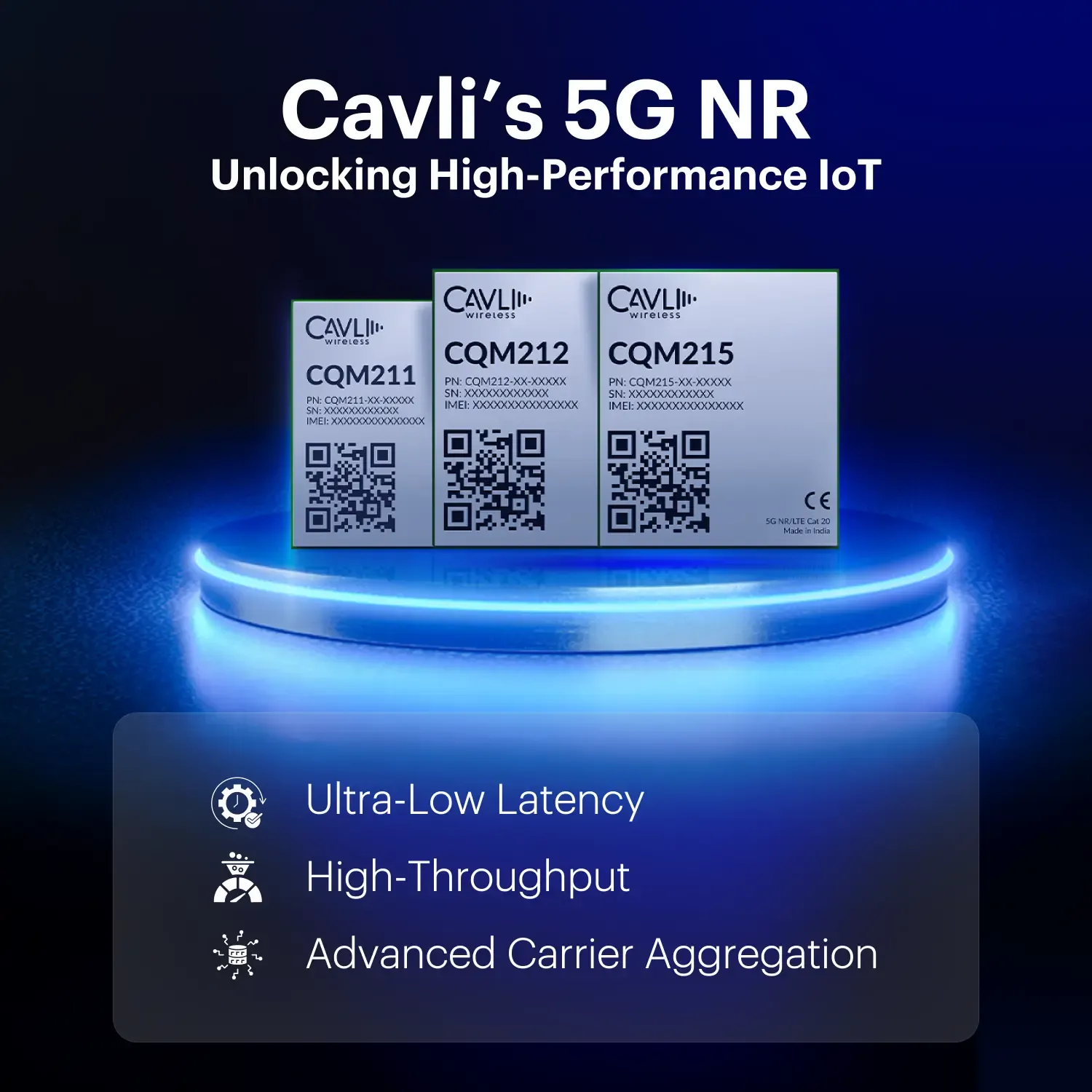
CQM211: A Scalable Entry Point into 5G NR
CQM211 is designed for high-bandwidth edge devices that need high-speed 5G connectivity along with onboard application capability. By integrating connectivity, processing, and positioning into a single module, it helps reduce the need for multiple external components.
This makes CQM211 suitable for CPE devices, industrial routers, and gateways that require fast and reliable broadband connectivity. It supports use cases such as fixed wireless access, secure backhaul, and always-on enterprise or industrial connectivity.
For OEMs moving from LTE Cat 4 or higher LTE-based platforms, CQM211 offers a scalable entry point into 5G NR without overcomplicating the device design.
CQM212: High-Throughput 5G NR for Industrial Applications
CQM212 is built for applications that need more than basic 5G connectivity. It is suited for industrial systems that handle larger data streams, connect to high-bandwidth peripherals, or support cloud-based analytics.
By combining high-throughput 5G NR throughput with stronger processing and high-speed interfaces, CQM212 enables OEMs to build advanced gateways, industrial controllers, AI-enabled cameras, and edge connectivity platforms. This helps reduce system complexity because the module can support connectivity and application-level processing within a more integrated design.
For long-term IoT migration, CQM212 fits applications where bandwidth, compute capability, and scalability are all important.
CQM215: Advanced 5G NR for Demanding Edge Platforms
CQM215 sits at the higher end of Cavli’s 5G NR portfolio. It is designed for demanding IoT and edge-to-cloud applications that require very high data rates, low latency, and the ability to aggregate multiple data sources.
Typical applications include high-resolution surveillance systems, advanced industrial data loggers, high-speed data concentrators, smart infrastructure gateways, and edge platforms that need local processing along with fast cellular connectivity.
With CQM215, OEMs can design advanced connected systems around a single integrated module instead of building a more complex architecture using separate modems, processors, and companion components. This helps simplify design, improve scalability, and support long-term product evolution.
Cavli Hubble™ for Connectivity and Lifecycle Management
Across both the 5G RedCap and 5G NR portfolios, Cavli Hubble™, our connectivity and IoT module management platform, adds an important layer of lifecycle control. With Hubble, OEMs can manage connectivity, monitor device health, support remote diagnostics, and simplify SIM or eSIM lifecycle operations from a centralized cloud environment. This is especially valuable during 4G IoT migration because businesses need visibility into deployed devices, network behavior, connectivity status, and long-term service readiness.
In this era of network transition, the right migration strategy is not about moving every device to full 5G. It is about choosing the right connectivity path for each device category.
Amusing Tech Chronicles
The Old Elevator
An old elevator may still work well today, but if spare parts become harder to find, the building needs a backup plan before it stops during rush hour.
That is how LTE IoT devices should be treated. They may work now, but future network changes can make support harder.
The Hotel Key Card

A hotel key card works until the hotel upgrades its lock system. After that, the old card may need reprogramming or replacement.
IoT devices face the same issue when operators change bands, certifications, or connectivity requirements.
The Railway Platform Change

The train is still running, but the platform may change in the future. Passengers who know early avoid confusion.
4G is still active, but businesses should prepare IoT devices before migration becomes urgent.
Go Beyond and Explore
Does a 4G shutdown mean every LTE IoT device will stop working?
Why is VoLTE important for 4G IoT devices?
Can eSIM help during 4G IoT migration?
Author

Samenta Binoj
Junior Associate - Digital Marketing Cavli Wireless