

OEMs, ODMs, and IoT design houses routinely prove concepts in weeks, only to face friction when scaling from a few pilot devices to thousands in the field. The root issue is rarely the sensor or the enclosure. Instead, it is operational scalability: provisioning connectivity at volume, controlling data costs across diverse usage profiles, and maintaining service continuity as deployments expand across regions and operators.
In the prototype phase, connectivity is often handled manually, with single-SKU SIMs, a standard plan, and reactive troubleshooting. That approach becomes brittle in mass production. Real deployments introduce edge cases: modems that sit idle in warehouses, fleets distributed across countries, varying data consumption driven by firmware versions, and a need to forecast recurring connectivity spend with precision. Without a robust modem and subscription management layer, engineering teams end up compensating with ad-hoc scripts, manual plan changes, and overly conservative data plans that inflate total cost of ownership(TCO). What starts as “just a SIM plan” becomes a recurring scaling bottleneck that impacts timelines, margins, and customer experience.
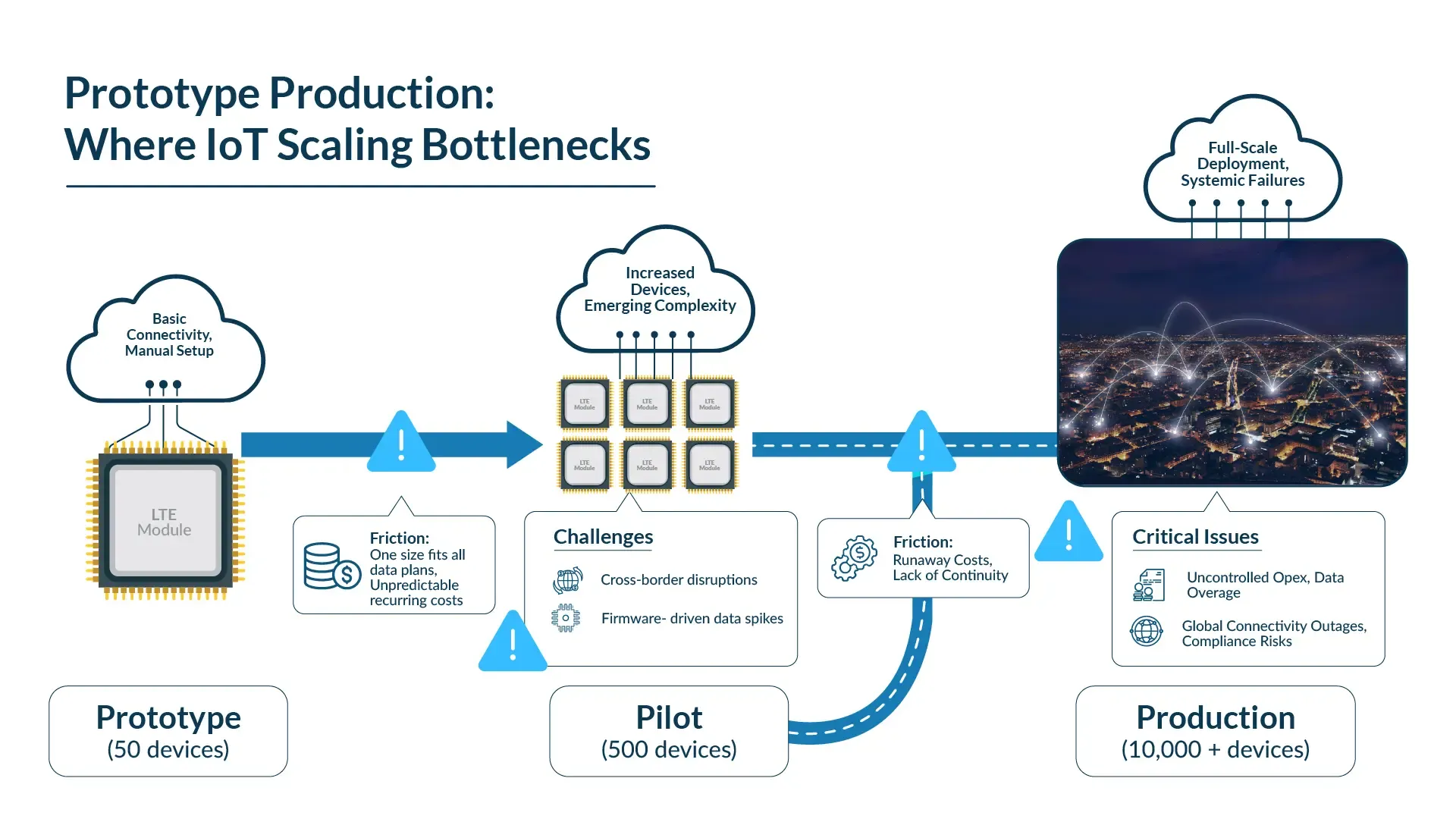
Introducing Cavli Hubble: Cloud-Based Connectivity and Modem Management Platform
Cavli Hubble is Cavli’s proprietary cloud-based connectivity and modem management platform designed to support IoT solutions across their full lifecycle, from early development to large-scale deployments. Beyond C-Series modem visibility and fleet control, Hubble includes built-in subscription management capabilities to operationalize connectivity at scale.
For integrators and OEM teams, this matters because connectivity is not static. It changes with geography, modem state, firmware behavior, and customer usage patterns. Hubble’s subscription management capabilities are designed to help teams developing solutions with C-Series modules configure, monitor, and adapt connectivity policies without forcing plan management to become a parallel engineering project. The goal is straightforward: reduce operational overhead, improve cost control, and keep modems reliably connected as deployments grow.
Key Subscription Management Capabilities in Hubble
Hubble’s subscription management capability set is focused on predictable cost control and scalable operations:
- Usage limits to prevent overconsumption beyond preset plans: Define boundaries so individual modems or entire fleets stay within intended data budgets and operational thresholds.
- Lossless cross-border connectivity: Support service continuity when devices move across regions, reducing deployment friction for solutions that operate internationally.
- Flexible data plan configuration: Align plan rules to device roles, lifecycle stages, and service tiers, without locking every device into a one-size-fits-all profile.
- Usage-based analytics and dashboards: Convert raw consumption data into actionable insights for engineering, operations, and commercial teams, enabling faster issue isolation and more accurate forecasting.
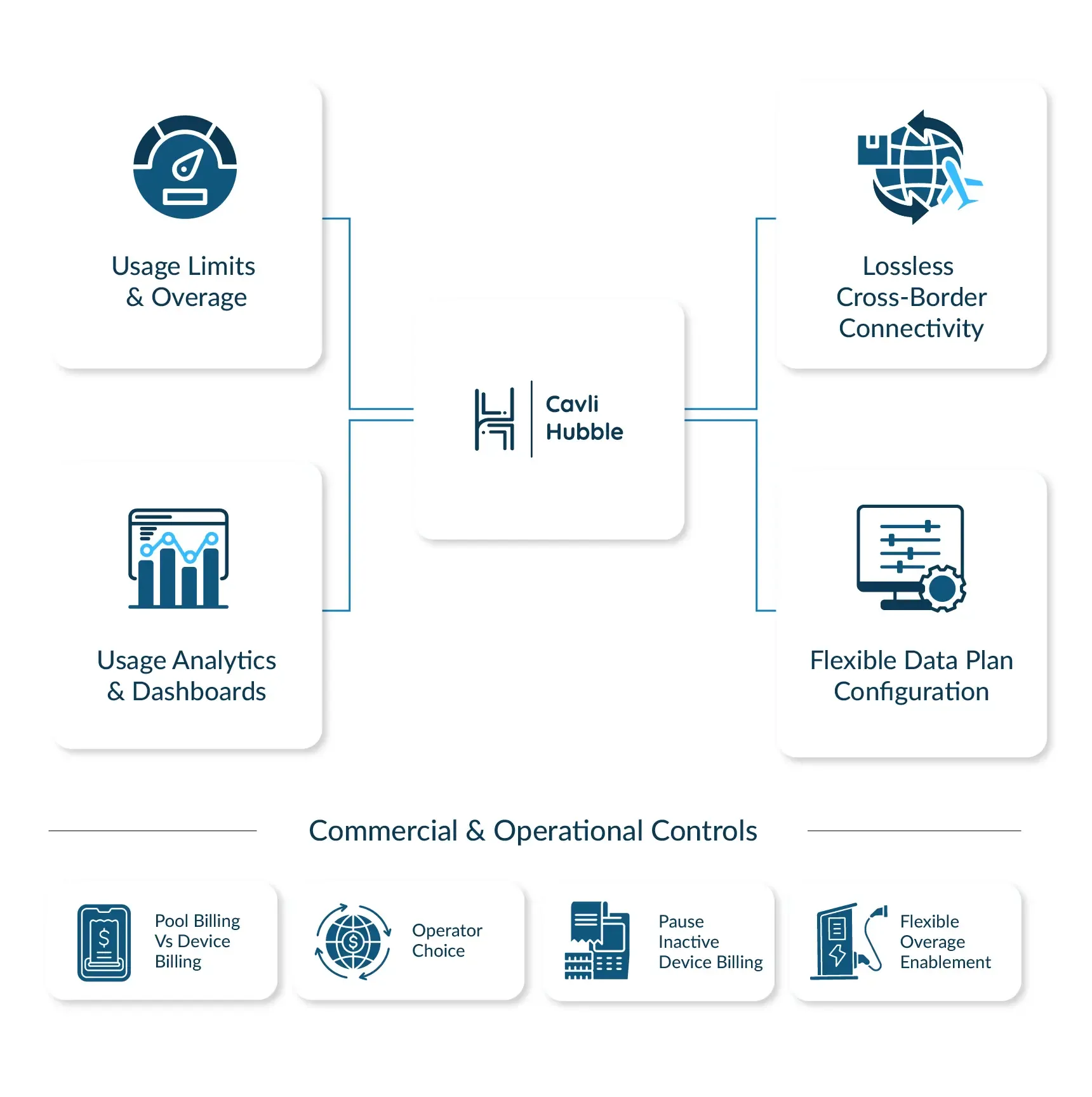
In addition, Hubble’s extended features address common commercial and operational pain points:
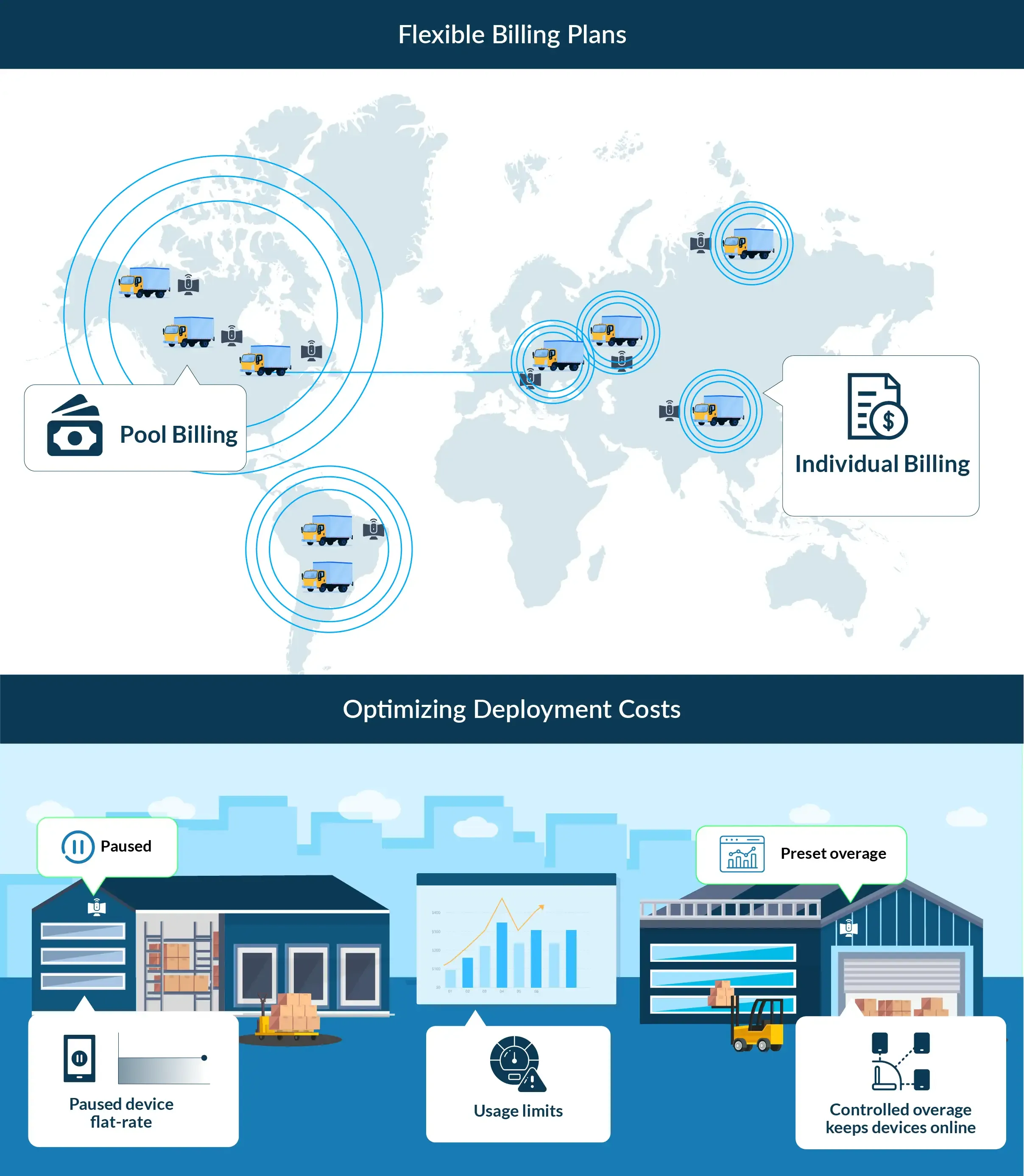
- Pool (fleet) Billing vs. Device-specific Billing: Enable cost-effective connectivity during the in design and production phases, particularly for high-volume customers with mixed usage patterns.
- Choice of Network Operators: Enhance resilience and suitability across diverse geographies and operating conditions by leveraging various operator options.
- Paused Device charge (suspended device flat-rate billing): Manage costs when devices are inactive, staged, or temporarily out of service.
- Flexible Overage Enablement: Allow controlled continuity beyond preset limits, with configurable cost exposure rather than uncontrolled overruns.
Engineering Implications to OEMs
Consider a system integrator building cellular asset trackers for logistics and rental fleets. In the prototype phase, the team may deploy 50–100 units powered by C-Series modules to validate battery life, GPS accuracy, and enclosure durability. Data usage is inconsistent: some devices report every few minutes, some only when movement is detected, and firmware iterations can significantly alter consumption patterns.
When the program moves to mass production, i.e, 10,000+ trackers across multiple countries, the engineering implications multiply:
- Predictable cost modeling: With pool billing, the integrator can avoid purchasing expensive per-device plans sized for worst-case usage. A pooled approach reflects operational reality: a subset of devices will consume more data (e.g., high-movement assets), while others remain low-usage. This supports a more cost-effective production plan without sacrificing service continuity.
- Scaling provisioning and policy control: Using flexible plan configuration, devices can be grouped by behavior, high-frequency trackers, standard trackers, or “on-demand” units, without requiring engineering teams to manually change plans one device at a time.
- Handling inactive inventory and maintenance cycles: Real operations include devices that sit in depots, remain in transit inventory, or are returned for refurbishment. Paused device billing supports a practical operating model: suspend devices at a flat rate rather than paying full active subscription costs while they are not generating value.
- Preventing incidents caused by runaway usage: A firmware bug, misconfigured reporting interval, or unexpected environment can spike data consumption. Usage limits establish a defined boundary so engineering and operations teams can detect issues early and avoid uncontrolled spend. Where business continuity is critical, flexible overage can be enabled to keep devices connected while maintaining explicit and governed cost exposure.
- Cross-border continuity via eSIM Support: Trackers frequently cross borders along logistics corridors. Lossless cross-border connectivity reduces operational interruptions that otherwise lead to blind spots, customer escalations, and time-consuming diagnostics.
In short, subscription management becomes an engineering enabler: it reduces the need for workarounds, lowers support load, and allows the solution architecture to remain stable as the fleet scales.
Advantages to End Customers
Now shift perspective to the end customer, the logistics operator purchasing the finished tracker solution. Their priorities are consistent visibility, predictable service levels, and budget control. Hubble-enabled subscription management supports these outcomes in concrete ways:
- Fewer coverage-related gaps: C-Series Modules with optional integrated eSIM offer multi-operator support and cross-border continuity, helping maintain tracking as assets move, supporting more reliable chain-of-custody records and fewer “unknown location” events.
- Transparent and defensible billing: Pool billing aligns with how customers experience value, fleet-level performance rather than individual device variability. This can reduce billing disputes and simplify internal cost allocation.
- Service continuity without surprise overruns: Usage limits and controlled overage reduce the risk of unexpected connectivity charges while still supporting mission-critical tracking during exceptions.
- Operational flexibility: Devices can be paused during seasonal slowdowns, storage periods, or maintenance windows without customers paying full active rates for dormant assets.
- Better decision-making through analytics: Usage dashboards can highlight anomalies (e.g., devices consuming unusually high data volumes), enabling customers and integrators to act before issues escalate into outages or cost spikes.
These advantages compound over time, especially as fleets grow and deployments expand across regions.
Closing Notes
Massive-IoT success depends on more than modem hardware; it requires lifecycle-ready connectivity operations that scale from prototype to full production and long-term field management. Cavli Hubble provides a cloud foundation for modem management and, critically, subscription management capabilities that address real operational constraints: cost predictability, cross-border continuity, flexible plan configuration, and actionable usage analytics. For OEMs and system integrators, this reduces friction during the transition from design phase to mass deployment. For end customers, it translates into higher service reliability, clearer cost control, and a more scalable IoT experience from day one through the full device lifecycle.
Author

Soorya Kumar A
Sr. Associate- Product Marketing
Cavli Wireless