
What is a Battery Management System (BMS)?
A Battery Management System (BMS) monitors, manages, and safeguards the EV battery pack to ensure safety, performance, and longevity. It tracks SOC (State of Charge), SOH (State of Health), cell balancing, voltage, current, and temperature, enabling real-time decisions that enhance reliability and prevent overcharging or thermal issues.
Electric vehicles are rapidly replacing traditional gasoline-powered cars, and BMS technology is the key to ensuring battery efficiency, reliability, and safety.
From ICE-driven cars to BEVs and eVTOLs, the battery pack remains central. Modern cellular-enabled BMS allows remote monitoring, predictive maintenance, and real-time data analysis for fleets.
Download the Cellular BMS Guide
Learn how Cavli’s C-Series IoT modules integrate with EV BMS for predictive monitoring.
In this blog, we will delve into the complexities of Battery Electric Vehicles (BEVs) and the critical role played by Battery Management Systems for electric vehicles. As the automotive industry undergoes a shift towards electrification, it is imperative to understand the technologies that control the performance efficiency of these sustainable transportation solutions.
Battery Electric Vehicles and the Role of Battery Management Systems (BMS)
BEVs run solely on chemical energy stored in battery packs. A BMS ensures safe operation, tracks critical parameters, and improves battery efficiency and life span.
Key Benefits of BMS in BEVs:
- Ensures safety by monitoring voltage, current, and temperature
- Optimizes battery performance and energy usage
- Enables predictive maintenance to extend battery lifespan
- Supports cellular connectivity for remote monitoring
The latest report from Fortune Business Insights indicates, the EV market size is projected to grow from $500.48 billion in 2023 to $1,579.10 billion in 2030, with a CAGR of 17.8% in forecast period, 2023-2030.
Electrifying Rides and the Future with Battery Management Systems for Electric Vehicles
BEVs are full electric vehicles powered exclusively by rechargeable battery packs instead of the conventional internal combustion engines (ICEs). By harnessing the power of electric motors and motor controllers, BEVs convert the stored electrical energy into mechanical energy, propelling the vehicle without the need for a gasoline engine or any other auxiliary power source.
Battery electric vehicles offer several advantages beyond their environmental benefits. Their electric drivetrain architecture results in higher energy efficiency compared to ICE vehicles, translating into lower operational costs and reduced dependence on fluctuating fuel prices. Additionally, the inherent simplicity of electric motors and the absence of complex mechanical components lead to lower maintenance requirements and potentially longer vehicle lifespans.
Automotive-grade Cellular IoT Modules
Equip your Vehicles with the power of next-generation IoT Modules
Types of Batteries Used in Electric Vehicles
| Battery Type | Key Features | BMS Requirement |
|---|---|---|
| Lithium-ion (Li-ion) | High energy density, long cycle life | Required for voltage, SOC, thermal management |
| Lead Acid | Low cost, robust, legacy systems | Optional for low-power systems |
| Ni-MH | Durable, moderate energy density | Supports SOC/SOH monitoring |
Understanding the Battery Management System for Electric Vehicles
Battery Management System (BMS) is a sophisticated electronic system responsible for monitoring, regulating, and optimizing the battery pack's operation. It is essential to have a well-designed and highly capable BMS that can ensure the battery's safety, longevity, and consistent power delivery.
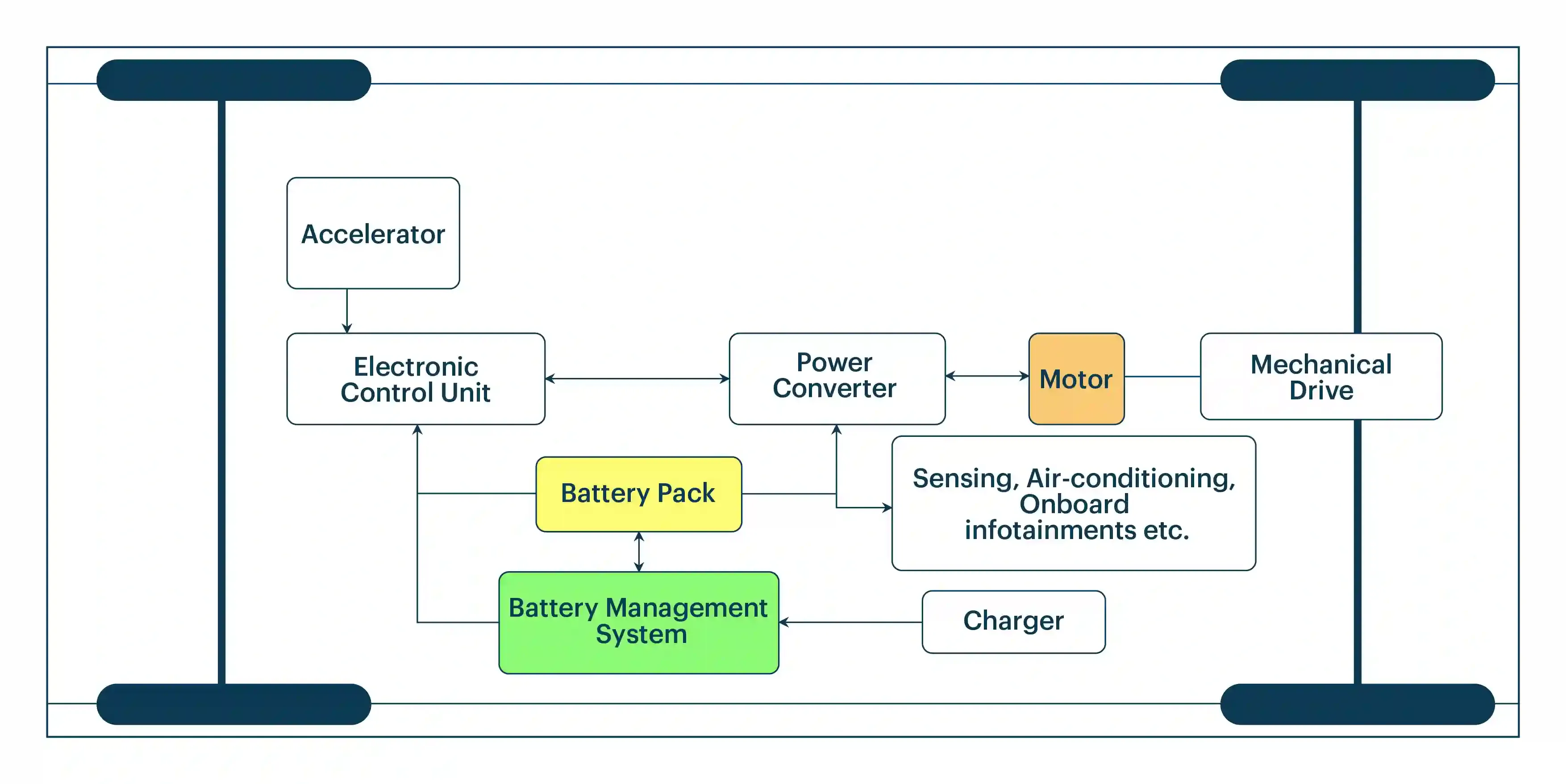
Operation of BMS inside an Electric Vehicle (EV)
Battery Management Systems: The Brains Behind EV Batteries
A Battery Management System (BMS) encompasses a comprehensive set of practices and technologies meticulously designed to optimize the efficiency of battery packs by overseeing various battery parameters.
The Battery Management System (BMS) is like Tony Stark’s Jarvis from Avengers.
As Jarvis monitors the Iron man’s suit systems, here the battery management system constantly monitors and optimizes the battery's performance through certain functions. These functions of the BMS are listed below.
| Function | Description | Benefit |
|---|---|---|
| SOC Estimation | Tracks remaining battery capacity | Prevents overdischarge, plans EV range |
| SOH Monitoring | Measures battery degradation over time | Predictive maintenance, extended lifespan |
| Voltage & Current Management | Monitors electrical parameters | Prevents overvoltage/overcurrent, safety |
| Thermal Management | Controls battery temperature | Avoids overheating, enhances safety |
| Fault Detection | Identifies cell or system faults | Prevents failures, supports reliability |
Monitor your fundamental battery parameters with utmost visibility with
Cavli C-Series Cellular IoT Connectivity Modules
Essential Functions of a Battery Management System (BMS) for Electric Vehicles
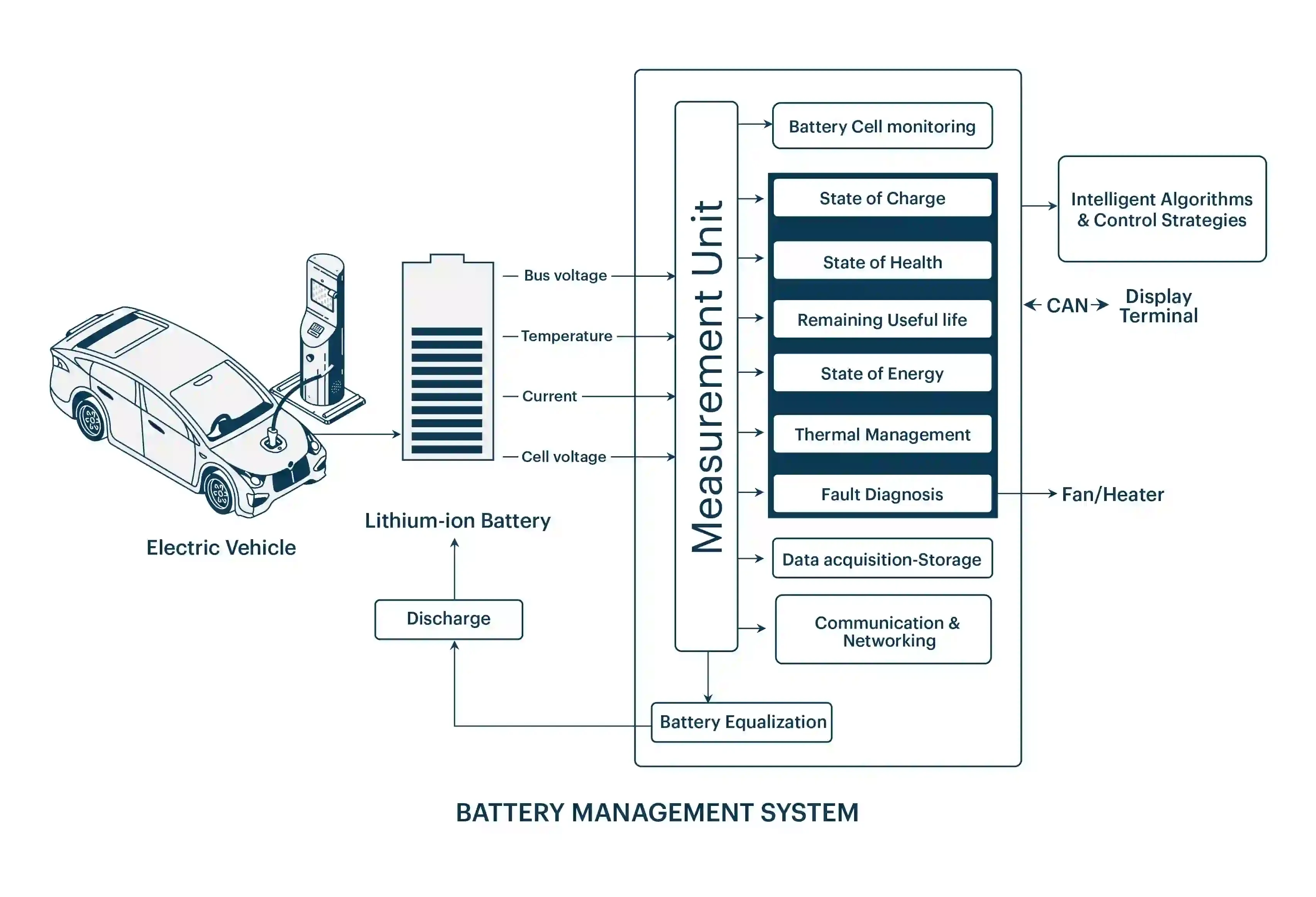
Functions of BMS in an Electric Vehicle
State-of-Charge (SOC) Estimation
The battery management system (BMS) in an electric vehicle (EV) is crucial for accurately calculating and reporting the state of charge (SOC) of the battery pack. SOC estimation prevents overcharging or deep discharging, safeguarding the battery's health and longevity. The BMS in EVs monitors essential parameters like voltage, current, and temperature, providing accurate SOC calculations that determine the remaining charge in the battery. This information is vital for planning vehicle range and strategically halting at charging stations, ensuring a smooth and reliable electric driving experience.
Cell Balancing
A battery management system for electric vehicles is responsible for balancing individual cell charge levels, preventing issues from overcharging or undercharging. This function ensures that all cells operate at uniform voltage levels across the battery pack, enhancing EV battery performance and longevity. The BMS employs methods like active and passive balancing to manage individual cell behavior, providing stable and balanced battery performance, which is essential for the smooth operation of an electric vehicle.
Battery Safety
Safety is a core function of the battery management system for electric vehicles, as it protects against overvoltage and undervoltage by monitoring and regulating safe voltage levels. It also limits excessive current flow, preventing potential damage to both the battery and other EV components. Through continuous monitoring, the BMS detects and mitigates short circuits and other security hazards, ensuring the integrity and safety of the entire EV battery system.
Thermal Management
Thermal management is another critical role of the battery management system in EVs. By constantly monitoring battery pack temperatures, the BMS prevents overheating and helps maintain an optimal operating temperature range. It actively manages cooling and heating systems within the battery pack, protecting battery integrity and ensuring safety by avoiding thermal runaway – a critical factor for enhancing battery life and overall performance in electric vehicles.
Fault Diagnosis
The battery management system for electric vehicles is designed to detect and diagnose faults, providing users with alerts about potential issues. This function is crucial for maintaining safety, as the BMS can isolate or mitigate risks to ensure reliable vehicle operation. Through continuous diagnostic checks, the BMS identifies faulty cells and provides information to guide maintenance and replacement, supporting proactive battery care and maximizing EV battery lifespan.
Cell Monitoring
Real-time monitoring is a key aspect of the battery management system in electric vehicles. The BMS gathers data on essential parameters like cell voltage, temperature, and current to continuously assess battery health. It evaluates the State of Health (SOH) and State of Power (SOP), which are indicators of the overall battery pack's condition. This monitoring allows for preventive maintenance, ensuring a healthy battery that performs reliably and consistently over time.
Types of Battery Management Systems (BMS) for Electric Vehicles: Centralized, Distributed, and Modular
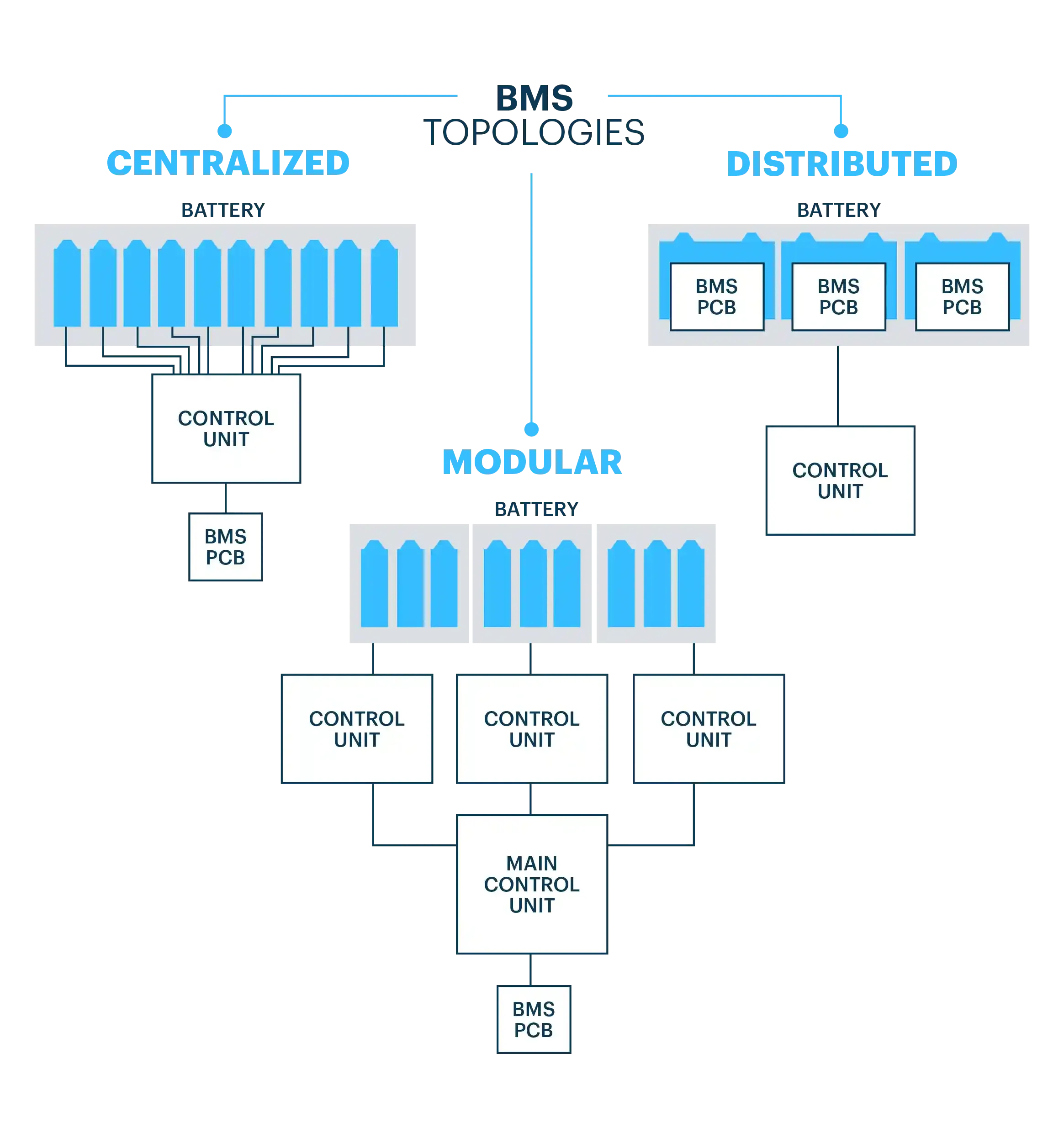
Common types of BMS in an electric vehicle
Image source: tritekbattery.com
| Type | Description | Pros / Cons |
|---|---|---|
| Centralized | Single control unit manages all cells | Simple but higher system failure risk |
| Distributed | Multiple units per module | Improved fault tolerance, scalable, higher cost |
| Modular | Groups of cells with local control | Balanced approach, flexible, easier maintenance |
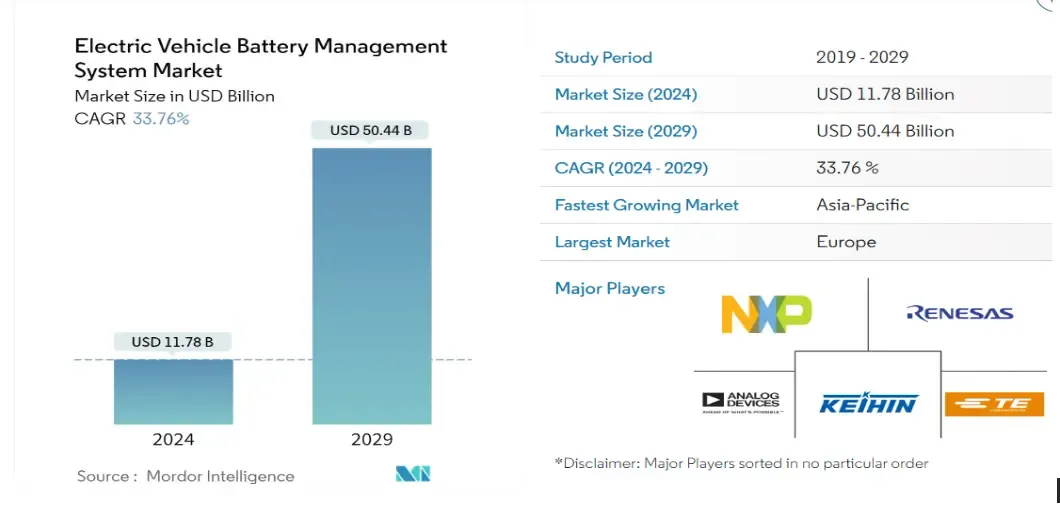
What Lies Ahead: Forecasted Market Size of EV BMS in 2024-29
The EV Battery Management System Market size is estimated to grow from USD 11.78 billion in 2024, and is expected to reach USD 50.44 billion by 2029, with a CAGR of 33.76% during the forecast period 2024-2029.
Emerging Trends in Battery Management Systems for Electric Vehicles
- Cloud-based BMS: Remote monitoring, predictive maintenance, fleet optimization
- Wireless BMS: Reduces wiring, easier maintenance, scalable
- AI & ML Integration: Optimizes SOC/SOH predictions, predicts failures, enhances thermal management
Closing Notes
The success of EVs heavily relies on the efficient management and optimization of their battery systems, which is where the EV Battery Management System (BMS) plays a pivotal role. The BMS is the unsung hero of EVs, responsible for ensuring the safe, reliable, and efficient operation of the battery pack.
As we look towards the future, the BMS is evolving to meet the growing demands of the EV industry. Emerging trends like wireless communication, machine learning integration, predictive analysis, and cloud-based monitoring are pushing the boundaries of what a BMS can achieve. These advancements not only enhance the performance and longevity of battery packs but also pave the way for more advanced and streamlined vehicle systems.
Go Beyond and Explore
Why is a Battery Management System important for electric vehicles?
How does the Battery System work in Electric Vehicles?
How do I select the right Management System for an Electric Vehicle?
Which types of batteries require Battery Management System?
What software is commonly used in Management Systems for Electric Vehicles?
What is the full form of BMS in electrical systems?
What are the different types of Battery Management Systems?
How does BMS improve the battery life of electric vehicles?
Author

Drishya Manohar
Sr. Associate - Content Marketing