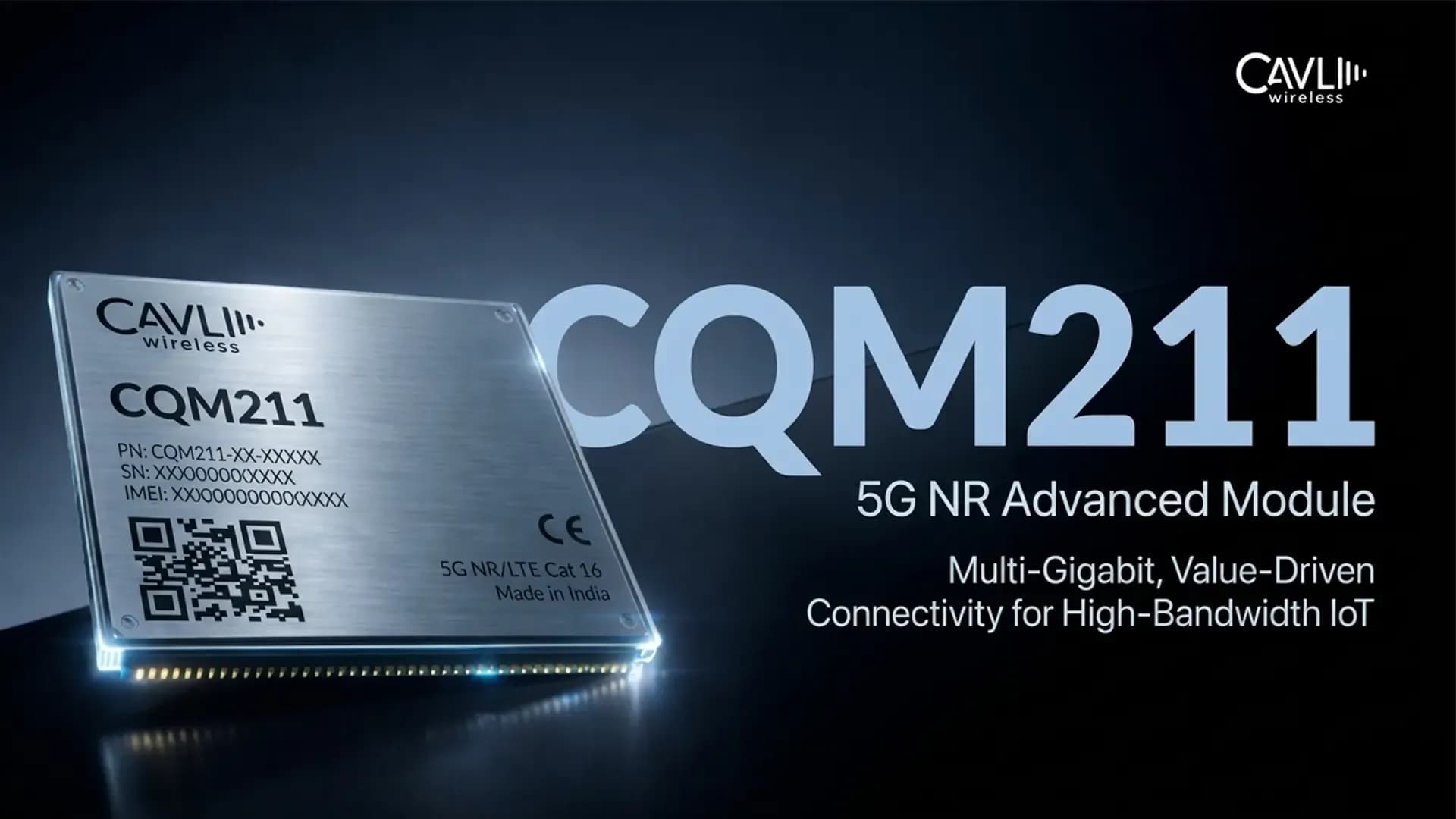

What is connected care in healthcare IoT?
Connected care refers to healthcare systems where medical devices, patient monitoring tools, telehealth endpoints, and hospital infrastructure communicate securely through reliable connectivity. In remote patient monitoring and telehealth, cellular IoT modules help transmit patient data, support diagnostics, enable remote device management, and maintain continuity of care across homes, hospitals, and mobile care environments.
Introduction: Why Connected Care Needs Reliable Cellular IoT Connectivity
The delivery of healthcare has undergone a fundamental restructuring. What was once confined to hospital wards and clinic examination rooms is increasingly happening at home, in transit, and across distributed care settings that extend far beyond the reach of traditional infrastructure. Remote patient monitoring and telehealth have moved from being supplementary tools to becoming primary care delivery mechanisms for chronic disease management, post-surgical follow-up, elderly care, and emergency triage. The technical demands of these applications are correspondingly complex. Connected care is no longer limited to home monitoring kits and video consultations. It now spans wearable patch monitors, patient-carried recovery devices, in-building hospital asset networks, telemedicine endpoints, and latency-sensitive clinical systems. That means a healthcare OEM is not solving one connectivity problem. It is solving several, each with very different requirements for power, size, throughput, software, and deployment longevity. What unifies these diverse device categories is the need for reliable cellular connectivity that performs consistently across geographies, network conditions, and device lifetimes, often without the luxury of on-site technical intervention.
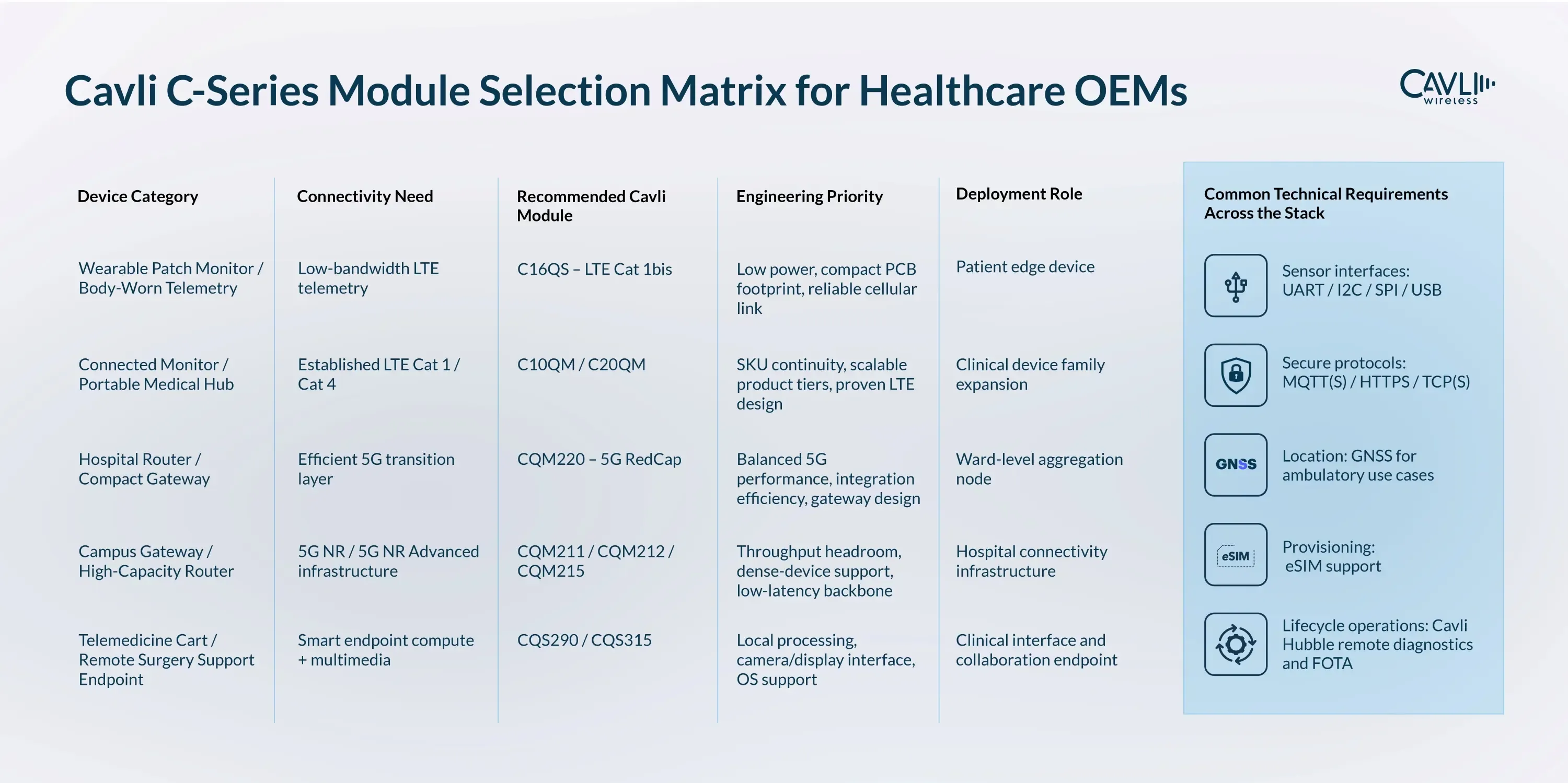
Cavli Wireless addresses this need with a C-Series portfolio that maps clearly across the connected healthcare stack. At the edge, the C16QS Cat 1bis module is especially well-suited for compact, battery-powered patient devices that require low power consumption, small-form-factor integration, and dependable cellular connectivity. For established LTE product families, the C10QM and C20QM continue to offer a practical and scalable path for medical OEMs building across Cat 1 and Cat 4 tiers. At the infrastructure layer, Cavli’s 5G portfolio brings stronger emphasis to the network backbone of connected healthcare, led by the 5G RedCap CQM220 and extended through the 5G NR and 5G NR Advanced CQM211, CQM212, and CQM215. For advanced clinical endpoints that require local application processing, display capability, and multimedia support, the CQS290 and CQS315 smart modules complete the architecture. Together with optional integrated eSIM capabilities and Cavli Hubble for remote connectivity management, diagnostics, and lifecycle operations, the portfolio gives healthcare OEMs a more unified foundation for deploying, monitoring, and scaling connected care solutions.
The result is a portfolio that supports a healthcare OEM from the smallest wearable monitor to the highest-capacity hospital connectivity node, while preserving architectural coherence across product lines, deployment models, and long-term platform evolution.
The Technical Landscape of Healthcare IoT Connectivity
Patient Edge Devices for Wearable and Body-Carried Monitoring
At the edge of the connected care environment are lightweight monitoring devices such as ECG patches, wearable recovery monitors, connected biosignal bands, compact pulse oximetry units, and other patient-carried telemetry products. These devices are designed to collect and transmit relatively small packets of health data over extended operating cycles. In this segment, low power consumption, compact packaging, straightforward sensor integration, and reliable LTE performance matter far more than peak bandwidth. This is precisely where the Cavli C16QS stands out. As a Cat 1bis LTE module optimized for low-cost and low-power IoT applications, it aligns naturally with the requirements of patient-worn and body-carried medical devices that must remain discreet, lightweight, and efficient without compromising continuity of care.
Established LTE Medical Devices for Existing Product Families
For OEMs building across established LTE product lines, the C10QM and C20QM continue to hold practical value. They provide a stable design foundation for devices that require proven Cat 1 and Cat 4 connectivity options, especially where OEMs want to maintain board-level consistency across varied connectivity-tier SKUs. In healthcare programs where one device family may range from a lower-bandwidth monitoring endpoint to a more capable hub or portable diagnostic terminal, this pin-to-pin continuity remains commercially and technically relevant.
5G RedCap Gateway Layer for Hospital Connectivity
As connected care expands from individual devices to coordinated healthcare environments, the role of 5G becomes much more significant. Within a hospital campus, large numbers of devices must operate simultaneously across wards, ICUs, procedure rooms, outpatient blocks, pharmacies, imaging areas, and recovery units. This is not simply a matter of connecting more endpoints. It is a matter of creating an infrastructure layer capable of aggregating data, maintaining coverage integrity, and supporting increasingly real-time clinical workflows. In this context, Cavli’s 5G RedCap CQM220 becomes highly relevant. It provides an efficient bridge between traditional LTE architectures and full 5G deployments, making it an ideal platform for healthcare routers, compact gateways, and strategically deployed network nodes that must deliver stronger performance with controlled complexity.
High-Capacity 5G Backbone for Hospital Infrastructure
Above that layer, Cavli’s 5G NR and 5G NR Advanced modules bring the performance tier required for high-capacity hospital infrastructure. The CQM211, CQM212, and CQM215 are well-positioned for network-intensive medical environments where faster throughput, broader 5G capability, richer interface support, and stronger system headroom are essential. These modules fit naturally into router-class, gateway-class, and aggregation-class designs that must support dense device environments and maintain a reliable data backbone for connected care operations.
Smart Clinical Endpoints for Telemedicine and Remote Collaboration
Smart modules remain important in healthcare, but their role is more specialized. The CQS290 and CQS315 are best suited for advanced clinical endpoints that need operating system support, user interface capability, camera integration, and local processing. In a connected hospital architecture, they complement the wider connectivity stack by powering telemedicine systems, remote clinical consoles, and advanced procedural equipment that benefit from local intelligence while relying on the hospital’s broader wireless infrastructure for network transport.
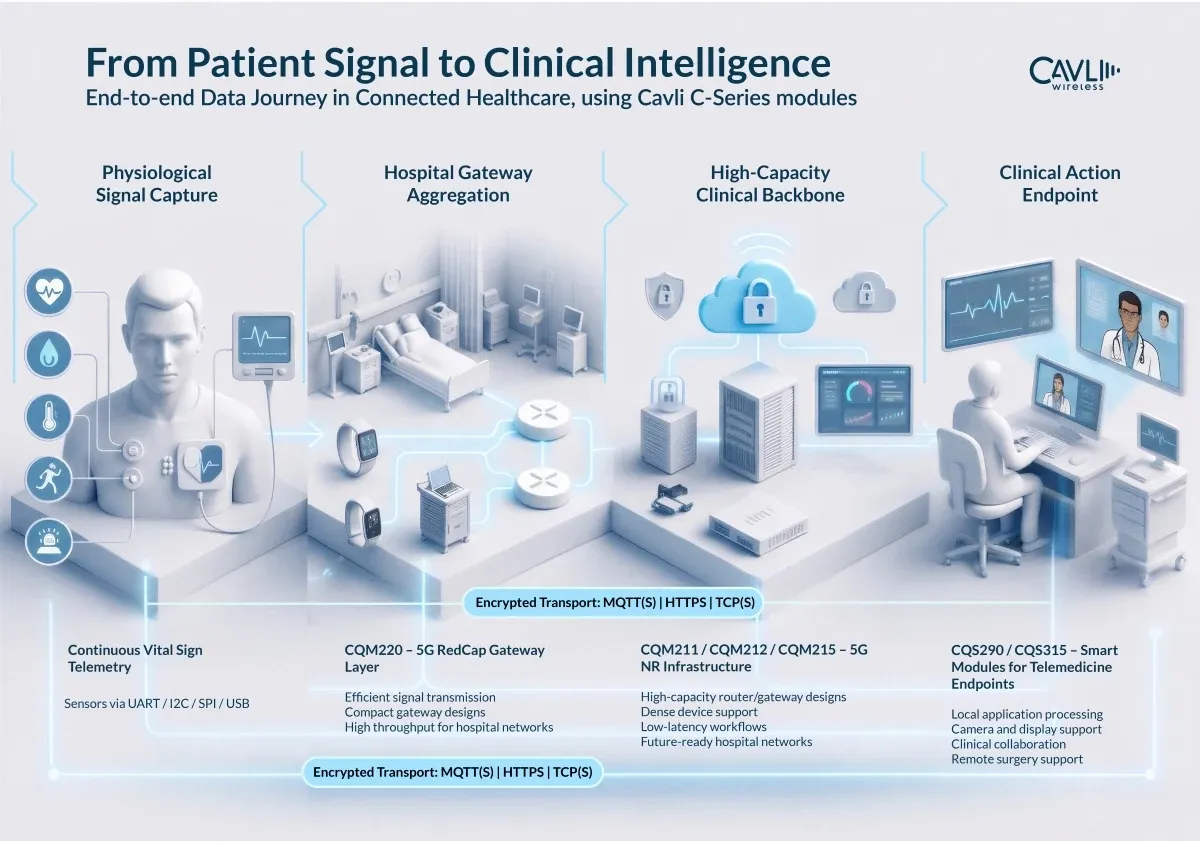
Across all these tiers, sensor integration remains a critical engineering consideration. Medical sensors communicating over UART, I2C, SPI, or USB must connect reliably to the cellular module or an associated application processor. GNSS capability matters for mobile or semi-mobile devices that need location tagging for emergency dispatch or ambulatory monitoring. Security at the connectivity layer, including encrypted data transport over protocols such as MQTT(S), HTTPS, and TCP(S), is non-negotiable in a regulated healthcare environment to ensure patient data privacy. And the ability to manage devices remotely, from firmware updates to connectivity diagnostics via Cavli Hubble, directly impacts the operational cost and reliability of large-scale deployments.
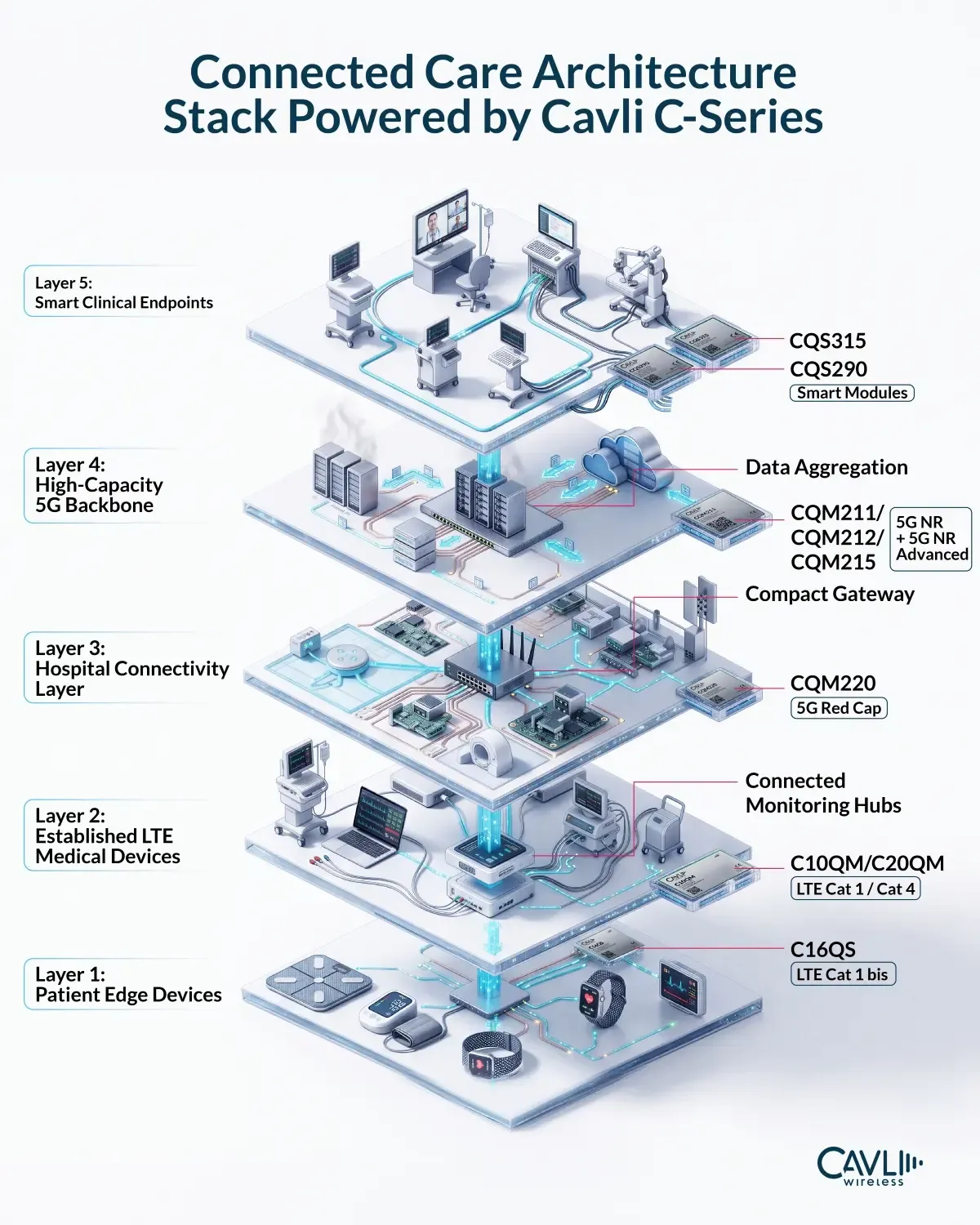
Cavli C-Series Module Selection for Healthcare OEMs
| Healthcare Device Category | Connectivity Need | Recommended Cavli Module | Engineering Priority | Deployment Role |
|---|---|---|---|---|
| Wearable patch monitor / body-worn telemetry | Low-bandwidth LTE telemetry | C16QS – LTE Cat 1bis | Low power, compact PCB footprint, reliable cellular link | Patient edge device |
| Connected monitor / portable medical hub | Established LTE Cat 1 / Cat 4 | C10QM / C20QM | SKU continuity, scalable product tiers, proven LTE design | Clinical device family expansion |
| Hospital router / compact gateway | Efficient 5G transition layer | CQM220 – 5G RedCap | Balanced 5G performance, integration efficiency, gateway design | Ward-level aggregation node |
| Campus gateway / high-capacity router | 5G NR / 5G NR Advanced infrastructure | CQM211 / CQM212 / CQM215 | Throughput headroom, dense-device support, low-latency backbone | Hospital connectivity infrastructure |
| Telemedicine cart / remote surgery support endpoint | Smart endpoint compute and multimedia | CQS290 / CQS315 | Local processing, camera/display interfaces, OS support | Clinical interface and collaboration endpoint |
Engineering Implications for Healthcare OEMs
Consider an OEM developing a portfolio of smart healthcare devices for a leading hospital chain with a mandate to digitize both patient monitoring and hospital operations across multiple facilities. The program includes wearable patch monitors, body-worn telemetry devices for inpatient mobility, connected hospital equipment, telemedicine systems, and remote surgery support platforms. From an engineering standpoint, this is not one product. It is a coordinated device ecosystem that must function as a unified clinical architecture.
Wearable Patch Monitors and Low-Power Patient Devices
The first device tier in this program consists of small patch monitors and devices that collect physiological data continuously or at defined intervals. These devices are expected to measure parameters such as heart rhythm, oxygen saturation, temperature, activity level, and post-operative recovery indicators, then transmit those readings efficiently into the hospital’s digital care platform. In this design context, the C16QS is an immediately appropriate fit. Its Cat 1bis architecture is well matched to the low-bandwidth, telemetry-centric nature of wearable monitoring. Its small form factor supports compact industrial design. The C16QS gives developers a streamlined module foundation for compact medical electronics, reducing unnecessary overhead in products that do not require higher throughput classes. Optional integrated GNSS and eSIM support add deployment flexibility, while the module’s low power modes strengthen its suitability for long-duration patient monitoring.
Hospital-Wide Connectivity and 5G Router Deployment
In the same scenario, the second engineering challenge is hospital-wide connectivity. The hospital chain wants machine assets, monitoring carts, connected diagnostic equipment, and mobile clinical systems to communicate across the premises in a controlled and resilient manner. This requires a planned network layer rather than isolated device-level connectivity. Cavli’s 5G portfolio makes this architecture straightforward to implement. The OEM can deploy hospital routers powered by Cavli 5G modules in strategically selected positions throughout each building, based on floor plans, department layouts, and coverage modeling. In this role, the CQM220 becomes an especially compelling option for compact 5G infrastructure nodes. Its 5G RedCap capability offers a strong balance between performance and efficiency, making it well-suited for router and gateway designs that need to support modern hospital traffic patterns without moving immediately to the most demanding 5G classes. It gives OEMs a practical 5G entry point for healthcare infrastructure, particularly in deployments where space, power, and integration efficiency remain important alongside stronger bandwidth and future-facing network capability.
High-Capacity 5G NR Infrastructure for Hospital Campuses
Where the hospital requires higher-capacity connectivity infrastructure, the CQM211, CQM212, and CQM215 become the natural progression. These modules are designed for the type of router and gateway architectures that must support heavier carrier aggregation, greater throughput, and low-latency connectivity. In large hospital campuses, where data from patient monitors, connected equipment, imaging support systems, and digital operations platforms converge continuously, these modules provide the performance headroom needed to sustain a resilient backbone. Their 5G NR and 5G NR Advanced capabilities also position the OEM to design infrastructure that remains relevant as hospital networks mature and data intensity increases across clinical workflows.
A hospital that begins with connected monitoring often needs to move quickly into centralized equipment visibility, advanced teleconsultation, remote specialist collaboration, and intelligent operational systems. By building its infrastructure layer around CQM220, CQM211, CQM212, and CQM215, the OEM creates a network foundation that can absorb this progression without forcing a complete architectural reset.
Smart Modules for Telemedicine and Remote Surgery Support
The third engineering tier concerns telemedicine, remote collaboration, and remote surgery support systems. The CQS290 and CQS315 are highly effective as smart endpoint platforms. Telemedicine carts can use these modules to power clinician-facing interfaces, camera-enabled consultation systems, and application-level workflows at the edge. Remote surgery support equipment can likewise use them for localized processing and control functions where richer computing capability is necessary.
Within the hospital architecture, these smart modules connect over Wi-Fi to the Cavli-powered 5G routers distributed across the premises. This separation of roles is important. It allows the smart endpoint to focus on local compute, interface responsiveness, and clinical application execution, while the 5G router layer handles high-performance network transport and data aggregation. For the OEM, this produces a clean and scalable system design. For the hospital, it supports ultra-low-latency operational behavior in telemedicine and remote surgery support environments by combining high-performance local endpoint intelligence with a robust 5G-backed wireless infrastructure.
How to Choose the Right Cavli Module for Connected Healthcare
- Choose C16QS when the device is compact, battery-powered, and designed for low-bandwidth telemetry. It is well-suited for patient-worn devices, wearable recovery monitors, compact ECG patches, pulse oximetry units, and other telemetry systems.
- Choose C10QM or C20QM when the healthcare product requires established LTE Cat 1 or LTE Cat 4 connectivity. These modules are suitable for OEMs building medical device families that need proven LTE performance, SKU continuity, and scalable product tiers.
- Choose CQM220 when the application needs 5G RedCap connectivity for compact healthcare gateways, hospital routers, telehealth systems, and efficient LTE-to-5G migration. It is a strong fit for deployments that need better performance than LTE while maintaining controlled power, cost, and integration complexity.
- Choose CQM211, CQM212, or CQM215 when the deployment requires high-capacity 5G NR or 5G NR Advanced connectivity. These modules are best suited for hospital backbone systems, campus gateways, router-class devices, and aggregation nodes that must support dense clinical device environments.
- Choose CQS290 or CQS315 when the endpoint requires local compute, display support, camera integration, multimedia workflows, or smart clinical interface capability. These modules are suitable for telemedicine carts, bedside diagnostic terminals, remote clinical consoles, and remote surgery support systems.
Healthcare IoT Module Selection Checklist
Before selecting a cellular IoT module for connected care, healthcare OEMs should evaluate:
- Device size, PCB footprint, and form factor constraints.
- Required connectivity tier, such as LTE Cat 1bis, LTE Cat 1, LTE Cat 4, 5G RedCap, 5G NR, or 5G NR Advanced.
- Expected data payload size, transmission frequency, throughput demand, and latency requirement.
- Required hardware interfaces such as UART, I2C, SPI, USB, PCIe, camera, or display interfaces.
- GNSS requirements for mobile, ambulatory, or semi-mobile healthcare devices.
- eSIM support for remote provisioning and simplified deployment.
- Secure protocol support such as MQTT(S), HTTPS, TCP(S), and FTP(S).
- Firmware update, remote diagnostics, and lifecycle management requirements.
- Deployment geography, carrier compatibility, and long-term network availability.
- Integration with hospital IT systems, cloud platforms, and clinical data workflows.
- Scalability across multiple device categories within the same healthcare product portfolio.
Customer Implications for Hospitals and Healthcare OEMs
A Scalable Architecture Beyond Individual Module Specifications
For healthcare OEMs and hospital procurement teams, the value of this architecture goes far beyond individual module specifications. What matters commercially is the ability to create a connected device portfolio that is logically structured, operationally scalable, and aligned with the actual realities of care delivery. Cavli’s portfolio supports this need by integrating eSIM capabilities for remote provisioning, eliminating the need for physical SIM management and streamlining device deployment. The OEM can also leverage Cavli Hubble, which centralizes lifecycle management across devices, supporting remote firmware updates, real-time diagnostics, and efficient carrier switching, greatly reducing operational costs at scale.
LTE Continuity for Existing Medical Device Product Lines
The OEM can then maintain LTE continuity where needed through the C10QM and C20QM, particularly in product lines that serve more traditional connectivity requirements or where existing design strategies still benefit from Cat 1 and Cat 4 differentiation. This preserves flexibility without diluting the broader portfolio direction. For applications like wearable ECG patches, the C10QM is well-suited, offering low idle power consumption and support for the required interfaces like UART, while maintaining multi-week battery life. For the hospital chain, this translates directly into better operational outcomes. Patient-worn devices can remain unobtrusive and dependable, which improves patient compliance and supports more continuous monitoring outside the ICU or even beyond discharge. Hospital assets can be connected through strategically placed 5G-enabled routers, improving data visibility and reducing blind spots in device communication across departments.
Telemedicine, Remote Surgery Support, and Smart Clinical Endpoints
Telemedicine systems, enabled by modules like the CQM220, can operate with the responsiveness expected in modern clinical collaboration environments, including high-definition video consultations, with the necessary low-latency performance. Remote surgery support equipment can also benefit from a network architecture designed for speed, reliability, and low-latency wireless interaction. The CQS315 module, with its powerful computing capabilities, is ideal for high-compute endpoints like bedside diagnostic terminals, while the CQS290 suits simpler display-enabled devices.
Long-Term Investment Value for Connected Healthcare Infrastructure
There is also a long-term investment benefit. By building around a portfolio that spans low-power LTE Cat 1bis, established LTE tiers, 5G RedCap, 5G NR, and smart modules, the hospital chain can reduce fragmentation in sourcing, simplify platform planning, and strengthen its ability to seamlessly evolve into the world of connectivity. For hospitals, it means the underlying device ecosystem is less likely to become disjointed as digital care programs expand. Instead of managing isolated connectivity decisions for each new device class, they can grow within a more unified and future-ready framework. In a market where healthcare providers increasingly expect connected systems to behave as a coordinated operational layer rather than a collection of disconnected devices, this matters enormously. Cavli enables OEMs to design for that expectation from the beginning.
Conclusion: Building a Unified Connected Care Architecture
Connected healthcare is moving toward a model where every device, from a wearable monitor to a hospital gateway, must contribute to a larger system of continuous, intelligent care. For OEMs, this makes connectivity a long-term architectural decision rather than a component-level selection.
With the Cavli C-Series, healthcare device makers can design around this reality. The portfolio gives OEMs the flexibility to support compact patient-worn devices, scalable hospital infrastructure, and intelligent clinical endpoints within a unified connectivity framework. This helps reduce platform fragmentation, simplify deployment planning, and create connected care systems that can evolve with changing clinical, operational, and network requirements.
For hospitals and healthcare providers, the outcome is a more dependable digital care environment: one where patient data moves securely, devices remain manageable at scale, and care teams can make faster, better-informed decisions across both in-facility and remote settings.
Go Beyond and Explore
Which Cavli module is best suited for a wearable ECG patch with a multi-week battery life requirement?
Can Cavli modules support encrypted health data transmission required under regulations like HIPAA?
What is the advantage of choosing the CQS315 over the CQS290 for a bedside diagnostic terminal?
How does the Cavli Hubble platform support large-scale RPM deployments?
Is the CQM220 appropriate for video-based telehealth consultations?
Why is cellular connectivity important for remote patient monitoring?
How does 5G RedCap support connected healthcare devices?
Which Cavli modules support smart clinical endpoints?
How does Cavli Hubble help healthcare OEMs manage deployed devices?
Author

Issac Vinu
Junior Associate - Product Marketing