
The evolution of cellular connectivity has created a wide range of technologies designed for different application requirements. While low-power IoT technologies such as NB-IoT and LTE-M address simple, battery-powered devices, and full 5G NR enables high-performance applications requiring multi-gigabit connectivity, many IoT applications require a balanced solution between these two extremes.
This is where 5G RedCap (Reduced Capability) fits.
5G RedCap is a simplified 5G NR technology designed for IoT devices that require higher performance than traditional LTE IoT technologies while maintaining lower complexity compared to full 5G NR.
Based on the 5G NR ecosystem, RedCap enables IoT manufacturers to build connected devices with a balance of:
- Higher data capability
- Reduced device complexity
- Optimized power consumption
- 5G network compatibility
5G RedCap is designed for applications such as industrial IoT devices, enterprise connectivity solutions, smart monitoring systems, and connected equipment where full 5G NR performance may not be required.
What is 5G RedCap?
5G RedCap (Reduced Capability), also known as 5G NR-Light, is a 5G NR-based technology introduced to support IoT devices that need moderate performance with reduced hardware complexity.
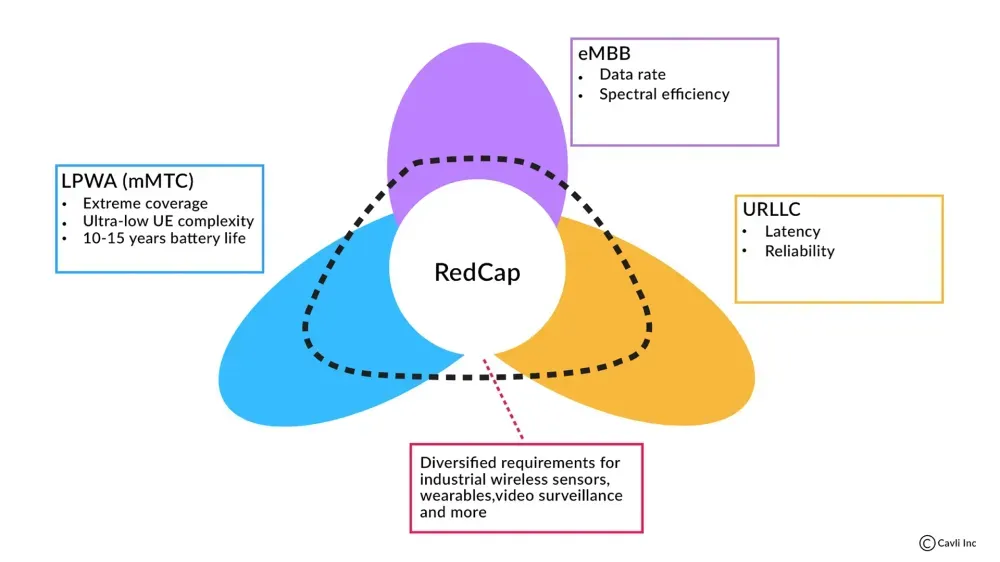
Unlike full 5G NR solutions designed for applications requiring the highest throughput and advanced capabilities, RedCap simplifies certain aspects of the 5G architecture to make it suitable for a broader range of IoT deployments.
In simple terms:
5G RedCap brings selected 5G capabilities to IoT devices that do not require the full complexity and performance of traditional 5G NR modules.
5G RedCap Within the 5G NR Ecosystem
5G New Radio (NR) is the radio access technology introduced as part of the 5G standardization process. It supports a broad range of applications, including enhanced Mobile Broadband (eMBB), Ultra-Reliable Low-Latency Communications (URLLC), and massive Machine-Type Communications (mMTC).
However, not every connected device requires:
- Multi-gigabit data rates
- Advanced antenna configurations
- Maximum 5G performance capabilities
Many IoT applications require a middle ground:
- More capability than traditional LTE IoT technologies
- Less complexity than full 5G NR
5G RedCap was developed to address this requirement.
Why Was 5G RedCap Introduced?
Before RedCap, cellular IoT deployments were generally divided into two broad categories.
Low-Complexity IoT
Technologies such as:
are optimized for applications requiring:
- Low power consumption
- Long battery life
- Small amounts of data transmission
Examples include:
- Sensors
- Tracking devices
- Utility monitoring systems
High-Performance Connectivity
Full 5G NR supports applications requiring:
- Very high throughput
- Advanced connectivity features
- Low latency
- High computing capability
Examples include:
- Industrial automation
- Edge computing
- High-definition video applications
- Advanced gateways
The Market Gap
Between these two categories existed a requirement for devices that needed:
- More bandwidth than low-power IoT technologies
- Lower complexity than full 5G NR solutions
- A pathway into 5G networks
5G RedCap addresses this middle segment.
It enables IoT manufacturers to design devices requiring:
- Moderate data rates
- Efficient hardware implementation
- 5G network compatibility
Where Does 5G RedCap Fit in Cellular IoT?
The cellular IoT ecosystem can be viewed as a spectrum based on performance, complexity, and application requirements.
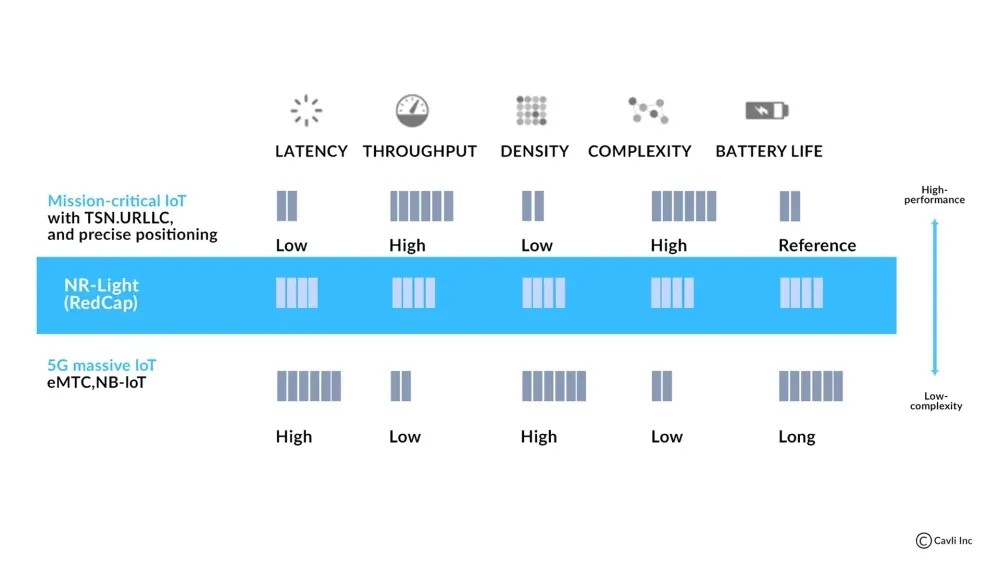
| Technology | Connectivity Focus | Typical Applications |
|---|---|---|
| NB-IoT | Ultra-low power, low data communication | Sensors, meters, monitoring devices |
| LTE-M | Low-power mobile IoT connectivity | Tracking, wearables, mobile IoT devices |
| LTE Cat 1bis | Balanced LTE connectivity for IoT | Industrial devices, connected equipment |
| 5G RedCap | Mid-tier 5G IoT connectivity | Enterprise and industrial IoT applications |
| Full 5G NR | High-performance connectivity | Advanced industrial systems, high-bandwidth applications |
5G RedCap Compared With Full 5G NR
Full 5G NR is designed to deliver the highest level of cellular performance.
It supports applications requiring:
- High throughput
- Advanced radio capabilities
- Complex industrial connectivity requirements
5G RedCap simplifies the technology for applications where those capabilities may not be necessary.
The difference can be summarized as:
| Requirement | 5G RedCap | Full 5G NR |
|---|---|---|
| Target applications | IoT-focused deployments | High-performance applications |
| Device complexity | Reduced | Higher |
| Performance requirement | Moderate | Maximum |
| Deployment objective | Efficient IoT connectivity | Advanced connectivity capabilities |
When Should Engineers Consider 5G RedCap?
5G RedCap is suitable when an application requires:
- More capability than LTE IoT solutions
- Compatibility with 5G networks
- Lower complexity compared to full 5G NR
- Efficient connectivity for industrial and enterprise devices
Examples include:
- Industrial monitoring systems
- Connected equipment
- Enterprise IoT devices
- Smart infrastructure applications
Choosing the right cellular technology depends on your application's bandwidth, power, deployment environment, and lifecycle requirements.
Explore Cavli's cellular IoT solutions to evaluate connectivity options for your next IoT design.
5G RedCap vs LTE Cat 1bis: Understanding the Difference
As IoT applications continue to evolve, engineers increasingly need to evaluate whether existing LTE technologies are sufficient or whether newer 5G-based solutions provide a better long-term path.
Two technologies often considered for mid-range IoT applications are:
Both address applications requiring more capability than ultra-low-power IoT technologies, but they differ in network generation, architecture, and deployment strategy.
5G RedCap vs LTE Cat 1bis Comparison
| Parameter | 5G RedCap | LTE Cat 1bis |
|---|---|---|
| Network generation | 5G NR-based | LTE-based |
| Technology positioning | Reduced-complexity 5G IoT | LTE IoT connectivity |
| Performance category | Mid-tier 5G connectivity | Mid-tier LTE connectivity |
| Hardware complexity | Reduced compared with full 5G NR | Mature LTE architecture |
| Network compatibility | Designed for 5G deployments | Designed for LTE deployments |
| Application focus | Enterprise and industrial IoT | Industrial and commercial IoT |
| Deployment consideration | Suitable for new 5G IoT designs | Suitable where LTE infrastructure is preferred |
When Should Engineers Choose 5G RedCap?
5G RedCap can be considered when a product requires:
1. 5G Network Compatibility
For organizations planning future 5G-based deployments, RedCap provides a pathway into the 5G ecosystem while avoiding the complexity of full 5G NR solutions.
2. More Capability Than Traditional LTE IoT
Applications requiring:
- Higher data capability
- More advanced connectivity
- Long-term network evolution
may benefit from moving beyond traditional LTE IoT solutions.
3. Reduced Complexity Compared With Full 5G NR
Many IoT applications do not require:
- Multi-gigabit throughput
- Advanced MIMO configurations
- Maximum 5G performance capabilities
RedCap provides a simplified alternative.
When Should Engineers Choose LTE Cat 1bis?
LTE Cat 1bis remains relevant for applications where:
- LTE deployment availability is important
- Mature LTE ecosystems are preferred
- Moderate connectivity requirements are sufficient
Common use cases include:
- Industrial devices
- Tracking applications
- Connected equipment
- Commercial IoT deployments
For products already designed around LTE networks, LTE Cat 1bis may continue to provide an efficient connectivity option.
5G RedCap vs Full 5G NR
5G RedCap and full 5G NR belong to the same 5G ecosystem but target different application requirements.
Full 5G NR is designed for applications requiring the highest level of cellular performance.
Examples include:
- Industrial automation
- Edge computing systems
- High-bandwidth gateways
- Advanced video applications
5G RedCap focuses on applications where moderate performance and reduced complexity are more important.
Comparison: 5G RedCap vs Full 5G NR
| Parameter | 5G RedCap | Full 5G NR |
|---|---|---|
| Primary objective | Efficient 5G connectivity for IoT | Maximum 5G performance |
| Application category | Mid-performance IoT | High-performance IoT |
| Hardware complexity | Reduced | Higher |
| Throughput requirement | Moderate | Multi-gigabit |
| Device design focus | Cost and efficiency balance | Maximum performance |
| Suitable applications | Industrial IoT, enterprise devices | Edge AI, video, advanced automation |
When Full 5G NR Makes Sense
Full 5G NR is appropriate when applications require:
Multi-Gigabit Connectivity
Applications involving:
- Large data transfers
- Video analytics
- High-bandwidth communication
benefit from the performance capabilities of full 5G NR.
Advanced Processing and Edge Applications
Some IoT systems require:
- Local processing
- Edge intelligence
- High-speed data exchange
These applications often require higher-performance connectivity platforms.
Industrial High-Performance Systems
Examples include:
- Industrial gateways
- Smart surveillance infrastructure
- Advanced automation systems
Cavli Full 5G NR Module Portfolio
Cavli's 5G NR module portfolio is designed for applications requiring high-performance cellular connectivity.
Cavli CQM212
The Cavli CQM212 is a 5G NR Advanced Sub-6 GHz module designed for high-performance IoT and M2M applications requiring reliable connectivity and edge processing capabilities.
The module supports:
- 3GPP Release 18 5G NR connectivity
- LTE Cat 20 fallback for network continuity
- Up to 5.36 Gbps downlink and 1.25 Gbps uplink
- Quad-core Arm Cortex-A55 processor
- Linux/OpenWrt operating system support
- Integrated GNSS capability
- LGA form factor
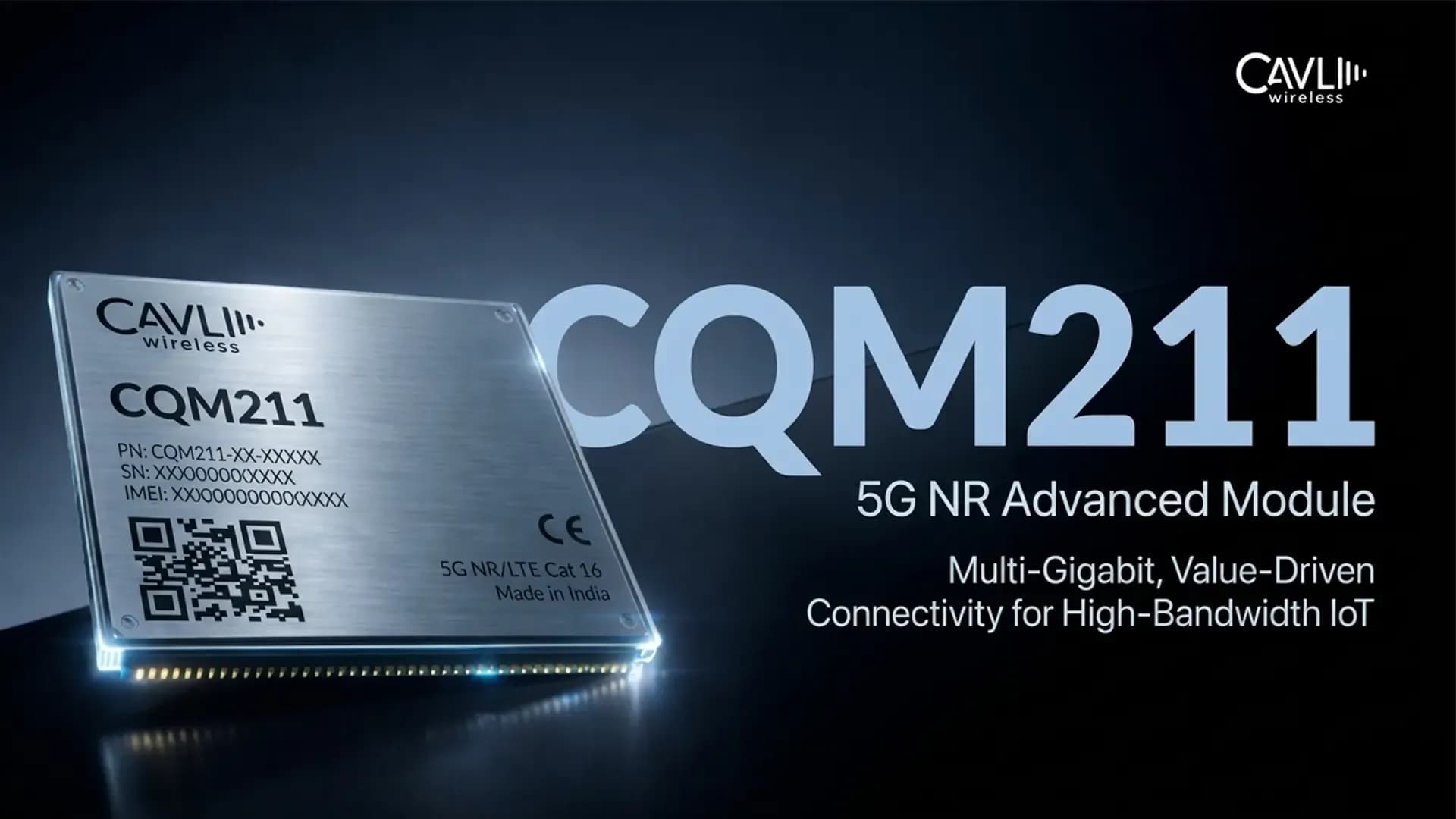
Cavli CQM211
The Cavli CQM211 is a 5G NR Sub-6 GHz module designed for industrial and enterprise IoT applications requiring high-speed connectivity and embedded processing capabilities.
It supports:
- 5G NR SA and NSA connectivity
- LTE Cat 16 fallback
- Up to 2.4 Gbps DL / 900 Mbps UL in 5G SA mode
- Up to 3.4 Gbps DL / 550 Mbps UL in 5G NSA mode
- Arm Cortex-A7 processor
- Linux/OpenWrt support
- GNSS capability
- LGA and M.2 form factors
Cavli CQM215
The Cavli CQM215 is a high-performance 5G NR module designed for applications requiring advanced connectivity capabilities and higher throughput.
It supports:
- 3GPP Release 18 5G NR
- LTE Cat 20 fallback
- Up to 7.01 Gbps downlink and 1.25 Gbps uplink
- Quad-core Arm Cortex-A55 processor
- Carrier aggregation support
- Integrated GNSS capability
- LGA form factor
Need high-performance 5G connectivity for your IoT application?
Explore Cavli's 5G NR modules designed for industrial, enterprise, and high-bandwidth connected applications.
How to Choose Between 5G RedCap, LTE Cat 1bis, and Full 5G NR
Selecting the right cellular technology depends on balancing:
- Performance requirements
- Network availability
- Device complexity
- Application lifecycle
Choose 5G RedCap If:
- You need a 5G-based IoT connectivity solution
- Your application requires moderate bandwidth
- Full 5G NR performance is unnecessary
- Reduced hardware complexity is important
- You are designing next-generation enterprise IoT devices
Choose Full 5G NR If:
- Multi-gigabit connectivity is required
- High-bandwidth applications are involved
- Advanced processing capabilities are needed
- Industrial performance requirements demand maximum throughput
Choose LTE Cat 1bis If:
- LTE deployment is preferred
- Existing LTE infrastructure supports your application
- Moderate data requirements are sufficient
- Mature LTE ecosystems are important
5G RedCap Module Selection Checklist
Selecting a 5G RedCap module requires evaluating multiple engineering factors.
1. Application Requirements
Data Requirements
Understand:
- Required throughput
- Upload/download requirements
- Data frequency
A monitoring device and a connected industrial gateway may have very different connectivity requirements.
Latency Requirements
Evaluate whether the application requires:
- Periodic data transmission
- Near real-time communication
- Continuous connectivity
Power Requirements
Consider:
- Battery operation
- Sleep requirements
- Device lifecycle
2. Hardware Requirements
Form Factor
Evaluate:
- PCB space availability
- Module integration requirements
- Mechanical constraints
Processing Capability
Applications requiring local processing should evaluate:
- Processor capability
- Memory availability
- Software support
Interfaces
Consider required interfaces such as:
3. Network Requirements
Before selecting a module, verify:
Regional Availability
Confirm:
- Supported regions
- Carrier compatibility
- Required certifications
Long-Term Deployment Strategy
Consider:
- Network evolution
- Product lifecycle
- Future connectivity requirements
Choosing the right cellular module requires balancing performance, power, cost, and deployment requirements.
Download Cavli's IoT Module Selection Guide to evaluate the right connectivity approach for your application.
For engineers exploring how 5G RedCap addresses real-world IoT design challenges, read our detailed guide on breaking interface limitations in cellular IoT with 5G RedCap connectivity .
5G RedCap Applications
5G RedCap is designed for IoT applications that require a balance between performance, power efficiency, and device complexity.
Unlike ultra-low-power IoT technologies designed for small data transmissions or full 5G NR solutions designed for maximum performance, RedCap targets connected devices that require moderate bandwidth and reliable cellular connectivity.
Key application areas include:
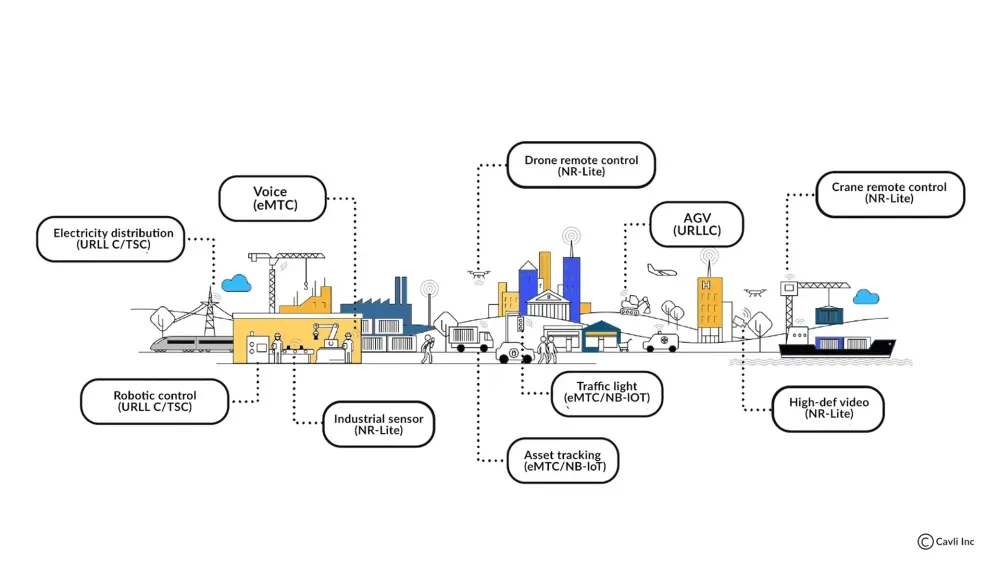
Industrial IoT
Industrial environments increasingly require connected devices capable of transmitting operational data while maintaining efficient power consumption and manageable hardware complexity.
5G RedCap can support applications such as:
- Industrial sensors
- Equipment monitoring systems
- Predictive maintenance devices
- Connected industrial controllers
- Factory monitoring solutions
These applications benefit from reliable cellular connectivity while avoiding the complexity of higher-performance 5G solutions.
Smart Surveillance
Modern surveillance systems increasingly require connected cameras and monitoring equipment capable of transferring larger amounts of data compared with traditional IoT sensors.
5G RedCap can enable:
- Connected surveillance equipment
- Remote monitoring systems
- Enterprise security devices
- Distributed monitoring infrastructure
For applications requiring higher video throughput, advanced analytics, or edge processing, full 5G NR solutions may be more suitable.
Enterprise Connectivity Solutions
Enterprises are adopting connected devices across offices, campuses, and commercial environments.
5G RedCap can support:
- Connected enterprise equipment
- Smart infrastructure devices
- Monitoring systems
- Industrial communication solutions
Its position between LTE IoT and full 5G NR makes it suitable for applications requiring improved performance without unnecessary complexity.
Connected Equipment and Devices
Many connected products require continuous cellular connectivity but do not require maximum 5G performance.
Examples include:
- Commercial equipment
- Smart devices
- Industrial monitoring products
- Connected gateways
5G RedCap provides a path for manufacturers designing the next generation of connected products.
Cavli 5G RedCap Solution
Cavli CQM220 5G RedCap Module
The Cavli CQM220 is designed for IoT applications requiring the balance between 5G connectivity, efficient hardware design, and scalable deployment.
The module is positioned for applications that require:
- 5G-based IoT connectivity
- Optimized device complexity
- Reliable cellular communication
- Future-ready network compatibility
Applications
The CQM220 can support applications such as:
- Industrial IoT devices
- Enterprise connected equipment
- Smart monitoring systems
- Next-generation IoT solutions
Building a connected IoT product with 5G RedCap?
Explore Cavli's 5G RedCap solution and evaluate how reduced-complexity 5G connectivity can support your application requirements.
Explore Cavli 5G RedCap Module
Conclusion
The evolution of cellular IoT has created multiple connectivity options designed for different application requirements.
While LTE technologies continue to support many IoT deployments and full 5G NR enables advanced high-performance applications, 5G RedCap provides an important middle path for IoT manufacturers.
By combining 5G network compatibility with reduced device complexity, RedCap enables a new generation of connected products across industrial, enterprise, and commercial applications.
Selecting the right cellular technology requires evaluating:
- Required performance
- Power requirements
- Hardware complexity
- Deployment environment
- Long-term connectivity strategy
Understanding where technologies such as LTE Cat 1bis, 5G RedCap, and full 5G NR fit within the cellular IoT ecosystem helps engineers design more efficient and scalable connected solutions.
Need help selecting the right cellular IoT connectivity solution?
Contact Cavli's IoT connectivity experts to discuss your application requirements and find the right LTE, 5G RedCap, or 5G NR solution for your next-generation connected application.
Go Beyond and Explore
What is 5G RedCap?
Is 5G RedCap the same as 5G NR?
No. 5G RedCap is part of the 5G NR ecosystem but is optimized for a different class of applications. Full 5G NR focuses on maximum performance, including multi-gigabit connectivity, advanced industrial applications, and high-bandwidth communication.
5G RedCap focuses on reduced complexity, moderate bandwidth requirements, and IoT-focused deployments.
How is 5G RedCap different from LTE Cat 1bis?
5G RedCap and LTE Cat 1bis address similar mid-tier IoT requirements but belong to different cellular generations. LTE Cat 1bis is based on LTE technology and is suitable for applications requiring mature LTE connectivity.
5G RedCap is based on 5G NR and is designed for IoT applications requiring a pathway into 5G networks. The right choice depends on network availability, application requirements, product lifecycle, and performance expectations.
What applications use 5G RedCap?
Is 5G RedCap suitable for industrial IoT?
How do I choose between 5G RedCap and full 5G NR?
The choice depends on application requirements. 5G RedCap is suitable when moderate bandwidth is sufficient, reduced complexity is important, and 5G connectivity is required.
Full 5G NR is suitable when multi-gigabit performance is required, advanced edge processing is needed, and high-bandwidth applications are involved.
Author

Drishya Manohar
Sr. Associate - Content Marketing